What a welder earns
Rates move with the year and the currency, so specific figures date quickly. What does not change is the shape of the market: which factors multiply the rate and which do not.
Short answer
Indicative salary bands are in the table below, for the Polish market in złoty: from 6,000–8,000 zł gross for certified MMA to 12,000–18,000 zł for pressure pipework. The amounts change every year; what does not move is the spread — bottom to top of the market is roughly double, and three things multiply the rate: process and position, certification, and willingness to travel.

What actually moves the rate
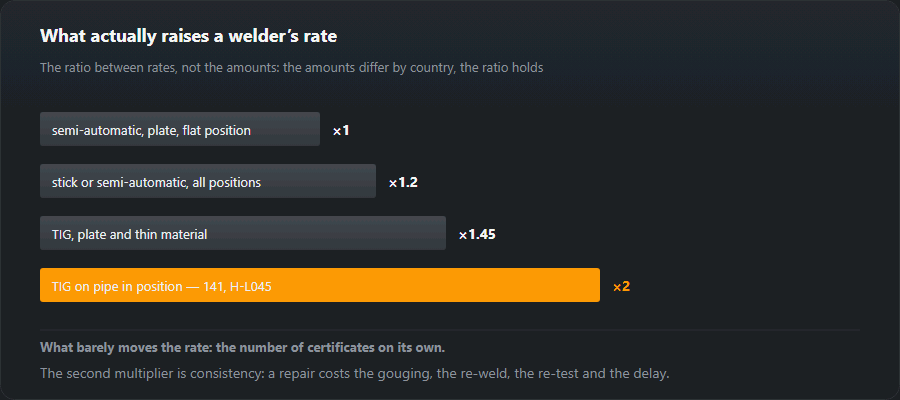
Process and position, above all. The spread between plate MAG in the flat position and coded TIG on pipe in position is roughly a factor of two, in every country. Positional pipe work is hard, hard to automate and hard to staff, and the rate reflects all three.
Certification. Not the piece of paper as such, but what it lets you be put on. A welder qualified for pressure work can be assigned to jobs a plate-qualified welder cannot, and it is the assignment that pays.
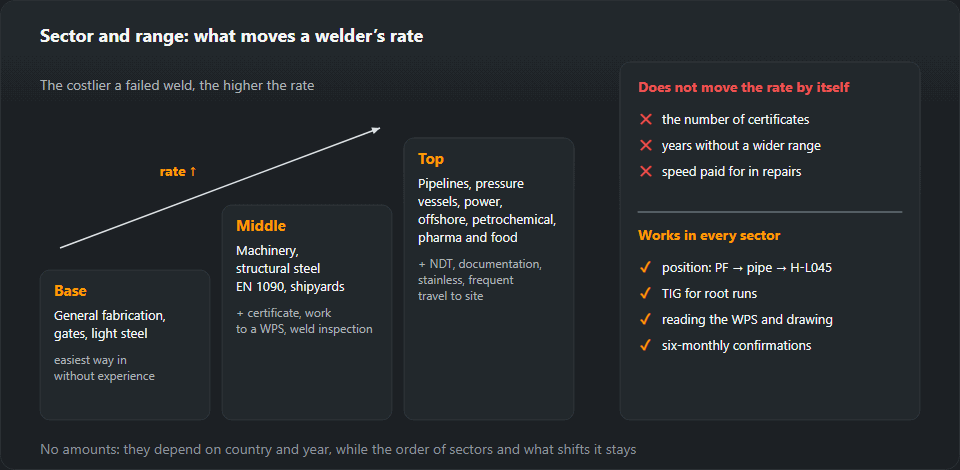
Sector. Offshore, power generation, pharmaceutical and petrochemical pay well above general fabrication for the same nominal skill, because the consequence of a failed weld is different. Shipbuilding and structural steel sit in the middle. General jobbing fabrication is the base.
Site versus shop. Site work pays more, and the premium is partly compensation: travel, accommodation, weather, and periods with no work between contracts.
Consistency. The quiet one. A welder whose work does not come back is worth more than one who is 20 % faster and produces occasional repairs — because a repair costs the gouging, the re-weld, the re-test and the delay. Employers know exactly who this is.
| Who | Gross per month | Notes |
|---|---|---|
| Helper or fitter without certificates | 5 000 – 6 500 zł | Formally not a welder |
| MMA (111), certified | 6 000 – 8 000 zł | Structures, fabrication, repairs |
| MIG/MAG (135), certified | 6 500 – 9 000 zł | Series production, the most vacancies |
| TIG (141), carbon steel | 8 000 – 11 000 zł | Thinner material, higher precision |
| TIG, stainless and aluminium | 10 000 – 14 000 zł | Food, chemical and pharmaceutical industry |
| Pressure pipework, orbital welding, EXC3–EXC4 | 12 000 – 18 000 zł | Non-destructive testing of the welds is required |
The Polish market, gross per month, in złoty. There is deliberately no euro conversion: the rate moves faster than this table is updated.
Actual amounts for Poland and Warsaw — each with its source and month (GUS, the Polish National Salary Survey, job ads from September 2026), plus take-home pay, hourly rates and what is left after rent — are on a separate page: welder salary in Poland and Warsaw.

Geography
Within the EU the ranking has been stable for years: Norway, Denmark and the Netherlands at the top, Germany and Austria next, then Poland, Czechia and the Baltics, with Romania and Bulgaria at the lower end. The spread between top and bottom is roughly three to one on gross rates and considerably less on purchasing power.
Posted work under EU rules is the interesting middle case: an employee posted from one member state to another is generally entitled to the host country's minimum terms, which is what makes short contracts abroad attractive. What that involves in practice is in welding work in the EU.
What to compare
Not the hourly rate. Compare the annual figure after: unpaid gaps between contracts, travel time, accommodation costs, your own social contributions if self-employed, and the tools and PPE you supply yourself. Agency and contract work often looks 40 % better hourly and lands within a few per cent of staff employment over a year.
The figures above come from a review of job adverts and pay reports and are indicative. Current levels in Poland are worth checking against public salary surveys — for example the Nationwide Salary Survey — or against live vacancies.
Raising your own rate
- Add a position, not a process. PF, then pipe, then H-L045. That progression is worth more than a fourth plate certificate.
- Add TIG. It is the qualification most employers are short of, and root runs are where it is needed.
- Learn to read the documentation. A welder who can read a WPS and knows what their own certificate covers is trusted with work that others are not.
- Keep the paperwork current. Six-monthly confirmations, renewals before expiry. A lapsed certificate takes you off the site regardless of skill.
Frequently asked questions
Which certificate raises pay the most?
TIG on pipe, in position — 141 with H-L045. It is the hardest to obtain and the hardest to replace, which is precisely why it is paid for. Adding a second plate process to a plate qualification changes the rate far less.
Why do agency rates look so much higher?
Because they are gross of everything. Out of an agency day rate come your own social contributions, holiday, sick pay, pension, tools and often travel and accommodation. Compare net against net over a year, including the weeks between contracts, before concluding the agency pays better.
Is it worth moving country for the rate?
Only after the arithmetic. A Norwegian rate against Norwegian rents and a Polish rate against Polish rents can leave similar money in hand. What genuinely differs is the ceiling: specialised work at the top end of the market pays disproportionately more, and that work is concentrated in a few places.
Updated: