Which EU countries and sectors are hiring welders
One qualification standard, twenty-seven labour markets, and free movement between them. What that means in practice for someone deciding where to work.
Where the shortage is
Energy infrastructure. Grid work, substations, offshore wind foundations and the associated fabrication. Long-term programmes with committed funding, which makes the demand steady rather than cyclical.
Shipbuilding and repair. Northern Europe and the Baltic. Heavy plate, positional work, and a persistent shortage of coded welders.
Process plant and pipework. Chemical, pharmaceutical and food industries. Stainless, hygienic welding, TIG root runs — the highest skill requirement and the highest rates.
Structural steel. The largest employer by headcount and the most cyclical, since it follows construction. EN 1090 certification of the fabricator is mandatory, which is why these employers care about welder certificates.
Rail and rolling stock. Growing with the modernisation programmes, with its own certification requirements on top of the general ones — EN 15085 for rail vehicle welding.
The paperwork you need
- EN ISO 9606-1 certificate from an accredited body, with current six-monthly confirmations. Translated if it is not in English or the local language.
- A1 certificate if you are posted, showing which country your social security contributions go to.
- Safety passport where the sector requires one — the offshore and construction schemes differ by country.
- Medical certificate for confined space or working at height, depending on the job.
- Eyesight test. Required for visual inspection duties and asked for more widely than welders expect.
The general rules for recognition of professional qualifications across the Union are set out on the Your Europe portal: it shows whether the trade is regulated in the destination country and which procedure applies.
| Document | Whose | Travels with you? |
|---|---|---|
| Welder qualification certificate EN ISO 9606-1 | Yours | Yes, across the EU |
| The welder's log book with its endorsements | Yours | Yes, but keep the signatures up to date |
| Procedure qualification WPQR | The employer's | No |
| Manufacturer certification EN 1090 | The employer's | No |
| Safety certificate (VCA, SCC) | Yours | Yes, though recognition varies by country |
Posting versus local employment
Posted means your home employer sends you abroad temporarily. Your contract stays at home, your social security stays at home under the A1, and the host country's rules on pay — not merely its minimum wage — and on working conditions apply. Good for short contracts; the accommodation and travel arrangements are worth pinning down in writing before departure.
Locally employed means a contract in the host country, with its social security, its pension and its notice rules. Better for anything longer than a season, and the only route to the local benefit system.
Agency work sits between the two and is where most of the confusion — and most of the disputes — occur. Establish which country's law governs the contract before signing it.
Choosing where to go
Compare net income against local cost of living rather than gross rates, and add the things that do not appear on a payslip: what the accommodation actually costs, how often you can get home, and how much work there is between contracts. The ranking of gross rates is in what a welder earns, and it looks very different once rent is subtracted.
For welders coming from outside the Union the entry route is different and starts with certificate recognition — see welding work for foreign workers.

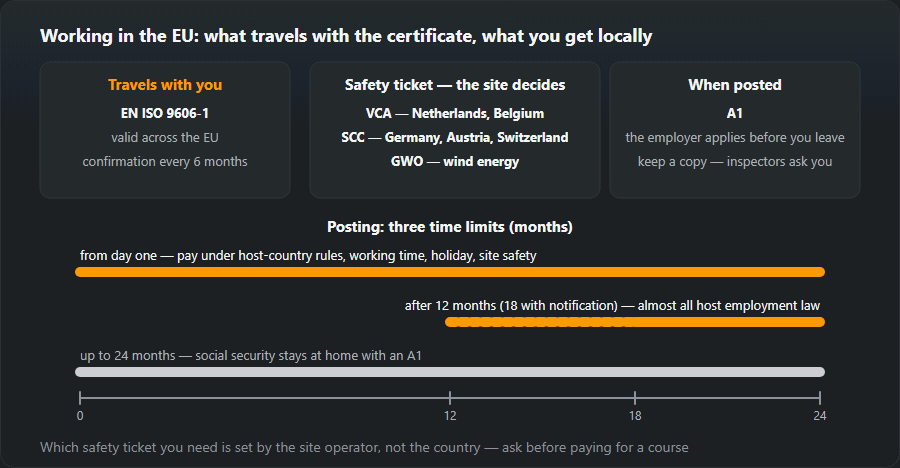
Safety tickets: VCA, SCC, GWO
A welder certificate gets you into the workshop, but a construction site, refinery or wind farm only lets you in with a safety course the site operator recognises. It is a separate document, taken separately, usually in one day:
- VCA — the Netherlands and Belgium. Operatives take the basic level (VCA Basis), foremen and supervisors VOL-VCA. A multiple-choice exam, offered in many languages and in many countries.
- SCC — Germany, Austria, Switzerland. The same idea as VCA: one common safety test, without which chemical and power plants will not take contractors.
- GWO — wind energy, onshore and offshore. The basic training is built from modules: first aid, working at heights, fire awareness, manual handling, plus sea survival for offshore.
Ask the client which ticket the site requires before paying for a course — the operator sets the requirement, not the country.
Posting in numbers
The posting section above explains the principle; three time limits decide what you are actually entitled to:
- From day one — pay under the host country's rules, not merely its minimum wage: that is what the revised Posting of Workers Directive (2018/957) requires. Plus working time, holiday and the site's safety rules.
- After 12 months (18 if the employer files a reasoned notification) — almost all of the host country's employment law, as for a local worker.
- Up to 24 months — social security stays in the home country if you hold an A1 certificate (Regulation 883/2004). Without the A1 the host authority can claim contributions itself.
The employer applies for the A1 before you leave. Ask for a copy — an inspection on a site in Germany or the Netherlands asks the worker for it, not the office.
How to check an offer from abroad
- The company exists. The German Handelsregister, the Dutch Chamber of Commerce register (KVK) and the Polish KRS are public — the name and number on the contract must match.
- The agency is allowed to place workers. In Poland that means an entry in the KRAZ register; in Germany, a temporary-agency work licence (Arbeitnehmerüberlassung).
- The contract says which law applies, how many hours a month, the gross rate and what is deducted for accommodation and travel.
- Your certificate range fits the job. The recruiter writes “TIG welder” and the project needs pipe in H-L045 — check before you travel, not at the test.
Polish rates with data and sources are in welder salary in Poland; the same arithmetic of rent and tax works for any destination.
Which certificates open which markets
- Pipe and plant (refineries, chemicals, power) — 141 root, a pipe test in H-L045; the widest range and the best-paid contracts.
- Hygienic stainless (food, pharma) — 141 on austenitic steel, often with root purging; the technology — welding stainless steel.
- Shipyards — flux-cored 136 in positional work; about the process — flux-cored arc welding.
- Rail and rolling stock — EN 15085 requirements for the company, and a welder with a current EN ISO 9606-1 certificate covering the project.
What your current certificate covers and what is missing for a given offer — qualification range calculator; how to read the entries on the document — welder qualification to EN ISO 9606-1.
Frequently asked questions
Is my certificate valid in another EU country?
Yes, if it is an EN ISO 9606-1 certificate from an accredited body: the standard is European and so is the recognition. You may be asked for a translation and for evidence that the six-monthly confirmations are current.
What is posting, and does it affect my pay?
Posting is being sent by your employer to work temporarily in another member state. Under the posted workers rules you are entitled to the host country's rules on pay (not merely its minimum wage), working time and holiday, while your social security usually stays in the home country under an A1 certificate.
Do I need to speak the local language?
Enough for safety instructions and to read a WPS. On international sites the working language is often English, and the documents certainly are — which is one practical reason the English terminology is worth learning even if you weld somewhere else.
What is VCA and where do I get it?
VCA is the safety certificate required on construction sites and industrial plants in the Netherlands and Belgium. Operatives take VCA Basis, foremen VOL-VCA. It is a one-day multiple-choice exam offered by exam centres in many countries.
Does a posted welder need an A1 certificate?
Yes. The A1 is issued by the home social security institution at the employer’s request and confirms that contributions are paid at home — for up to 24 months of posting. Keep a copy with you: site inspections abroad ask the worker for it.
Is a posted welder paid the host country rate?
From day one the host country’s pay rules apply, not only its minimum wage — that is the revised Posting of Workers Directive 2018/957. After 12 months (18 by exception) almost all local employment law applies.
Updated: