How to weld austenitic stainless without sensitisation
Stainless is not difficult so much as different. It conducts heat badly, expands more than carbon steel, and its corrosion resistance depends on a surface layer that welding attacks.
Three physical facts that drive everything
Low thermal conductivity — about a third that of carbon steel. Heat stays where you put it, so the same settings that suit mild steel will overheat stainless. Expect to weld at roughly 10–20 % lower current.
High thermal expansion — around 1.5 times carbon steel. Combined with the poor conductivity, that means distortion, and it means the sequence and the clamping matter more than on mild steel.
The chromium oxide layer. What makes the steel stainless is a self-healing chromium oxide film. Heat, contamination with carbon steel, and oxidation during welding all damage it, and where it is damaged the steel rusts like anything else.
Filler and gas
Filler is chosen to leave a small amount of delta ferrite in the deposit, which prevents solidification cracking: 308L for 304, 316L for 316, 309L for stainless-to-carbon joints. The L means low carbon, which matters for the next section.
Gas: argon with 2 % CO₂ or 2 % oxygen for MAG, kept deliberately lean because carbon picked up from CO₂ reduces corrosion resistance. Pure argon for TIG, or argon with a few per cent hydrogen on austenitic grades to raise the heat and brighten the surface. The gas calculator gives the designation to order by.
Sensitisation — the invisible damage
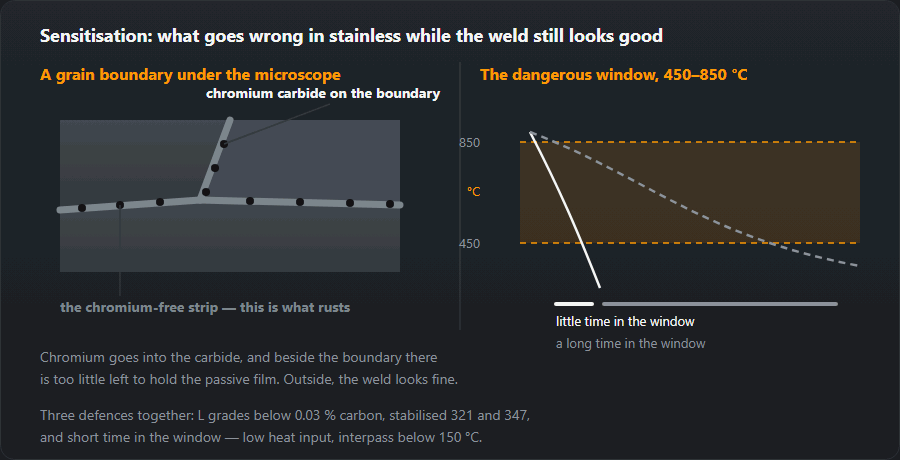
Held between roughly 450 and 850 °C, chromium in austenitic stainless combines with carbon and precipitates as chromium carbide at the grain boundaries. The metal immediately around those boundaries is left short of chromium, and it corrodes preferentially — intergranular corrosion, which shows up months later as cracking alongside the weld.
Three defences, and they are used together. Use L grades with carbon below 0.03 %, so there is little carbon to react. Use stabilised grades — 321 with titanium, 347 with niobium — which tie the carbon up. And keep the time in that temperature range short: low heat input, interpass temperature below about 150 °C, no unnecessary weaving.

Cleanliness and cross-contamination
Stainless must not share tools with carbon steel. A wire brush that has touched mild steel, a grinding disc used on structural work, or a bench where carbon steel was cut all embed iron particles in the surface, and those particles rust and stain the stainless around them.
Dedicated stainless brushes and discs, a separate bench or a clean cover, and gloves. It sounds fussy until the first job comes back with rust spots on material that "cannot rust".
Managing distortion
Tack more often than on carbon steel — every 50 mm rather than every 100. Weld in short runs, alternating ends. Use clamps and backing bars, which also draw heat away. And accept that on thin stainless sheet some straightening afterwards is normal rather than a sign of poor technique — the same measures that work on thin sheet generally apply, with less heat still.
The same care applies to stainless table frames and worktops — the whole piece is shown under furniture and interior.
Gases for stainless
| Process | Mixture | Designation | Flow |
|---|---|---|---|
| TIG (141) | Ar 100 % or Ar + 2 % H₂ | I1 / R1 | 6–12 l/min |
| MIG/MAG (135) | Ar + 2 % CO₂ or Ar + 2 % O₂ | M12 / M13 | 12–15 l/min |
| Root purging | Ar 100 % | I1 | until the air is displaced |
Stainless electrodes and wires: reading the codes
The filler follows the steel grade, and the box carries a code to EN ISO 3581 (electrodes) or EN ISO 14343 (wire and rod), usually next to the American AWS one. The pairs you meet most in a workshop:
| Steel (EN / no. / AISI) | Filler | Electrode EN ISO 3581 / AWS | Wire EN ISO 14343 / AWS |
|---|---|---|---|
| X5CrNi18-10 / 1.4301 / 304 | 308L | E 19 9 L / E308L | G 19 9 L Si / ER308LSi |
| X2CrNi19-11 / 1.4306 / 304L | 308L | E 19 9 L / E308L | G 19 9 L Si / ER308LSi |
| X2CrNiMo17-12-2 / 1.4404 / 316L | 316L | E 19 12 3 L / E316L | G 19 12 3 L Si / ER316LSi |
| X6CrNiTi18-10 / 1.4541 / 321 | 347 | E 19 9 Nb / E347 | G 19 9 Nb Si / ER347Si |
| stainless + carbon steel | 309L | E 23 12 L / E309L | G 23 12 L Si / ER309LSi |
How to read E 19 9 L R 12: E is a covered electrode (G a MIG/MAG wire, W a TIG rod), 19 and 9 are roughly 19 % chromium and 9 % nickel in the weld metal, L means low carbon, R a rutile covering (B basic), then digits for current type and positions. In AWS the suffix describes the covering: -16 rutile for AC and DC, -17 rutile with a smoother bead, -15 basic, DC only. The rule behind the table: the filler must not be leaner than the steel — 316L on 304 is fine, 308L on 316L is not, because the weld loses its molybdenum. The full catalogue of codes — electrode and wire designations.
Worked example: heat input with TIG and MAG
The same formula and efficiency factors as the heat input calculator: Q = k·U·I·60 / (v·1000), with k 0.6 for TIG and 0.8 for MAG. The parameters are example inputs, not a recommendation:
- TIG, 110 A, 12 V, 100 mm/min — Q = 0.48 kJ/mm.
- The same TIG at 200 mm/min — Q = 0.24 kJ/mm. Twice as fast means half the heat per millimetre at the same current.
- Pulsed MAG, 160 A, 22 V, 350 mm/min — Q = 0.48 kJ/mm, the same as the slow TIG pass despite half as much current again.
The lesson for stainless: overheating is decided by current and travel speed together, not by current alone. A slow TIG cap that is “polished” into place can put more heat into a joint than a brisk MIG pass. Check your own figures in the heat input calculator.
Pickling and passivation, step by step
- Remove slag and spatter with a stainless wire brush or a non-woven pad — never with a brush that has touched carbon steel.
- Apply pickling paste to the heat tint and leave it for the time the manufacturer states; overdoing it dulls the surface.
- Rinse thoroughly with water, ideally low in chlorides — paste residue and chlorides cause corrosion on their own.
- Passivate if the specification calls for it: the protective layer also rebuilds itself in air, only more slowly.
- Check: an even matt colour with no rainbow and no rust specks.
Pickling pastes contain strong acids, usually including hydrofluoric acid: acid-resistant gloves, goggles or a face shield, and ventilation — welding PPE.
Ferritic stainless and duplex — what changes
Ferritic (430, 1.4016) does not harden like carbon steel, but the grains grow in the heat-affected zone and the joint turns brittle. So the same rule as for austenitic applies, only stricter: as little heat as possible, short runs, filler per the WPS.
Duplex (2205, 1.4462) needs a balance of ferrite and austenite. The filler is over-alloyed with nickel (type 2209), and heat input has a limit on both sides: too cold gives too much ferrite, too hot gives brittle intermetallic phases. Here the parameters come from the WPS only, never by eye. Duplex to carbon steel — dissimilar steels.
Frequently asked questions
Why 308L filler on 304 rather than a matching one?
Because 308L deposits a few per cent of delta ferrite, and that ferrite is what stops hot cracking down the centreline of the weld. A perfectly matching fully austenitic deposit would be more prone to solidification cracking, not less. The same logic gives 316L for 316 and 309L for joining stainless to carbon steel.
What are the rainbow colours next to the weld?
Oxide, and it means the chromium oxide layer that makes the steel stainless has been damaged. Light straw is usually acceptable; blue and grey are not, because corrosion resistance is reduced there. Remove them by pickling or mechanical cleaning, then passivate.
Does stainless need a back purge?
On pipe and on anything where the root side matters, yes. An unpurged root oxidises into a grey, sugary surface that has lost its corrosion resistance and often its integrity. On open fillets in general fabrication, no.
What electrode for 304 stainless?
A 308L electrode: E 19 9 L to EN ISO 3581, E308L-16 or -17 in AWS terms. For 316L use E 19 12 3 L (E316L), for stabilised 321 E 19 9 Nb (E347), and for a joint to carbon steel E 23 12 L (E309L).
Can you MIG weld stainless?
Yes: 308LSi or 316LSi wire, argon with 2 % CO₂ or 2 % O₂, ideally in pulsed transfer. Pure CO₂ and carbon steel mixes are not used — carbon from the gas goes into the weld and lowers corrosion resistance.
How do you remove heat tint after welding stainless?
With pickling paste: apply it to the discoloured band, leave it for the time in the manufacturer’s instructions, rinse with water and passivate if required. Grinding removes the colour but leaves scratches where dirt and chlorides cling more easily.
Updated: