Chromium and nickel equivalents on the Schaeffler diagram
A weld does not have the composition of the filler: it is a mixture of filler with the melted parent metals. The calculator works out that mixture, derives the Cr and Ni equivalents and puts the point on the Schaeffler diagram — you see at once which region your weld lands in.
Short answer
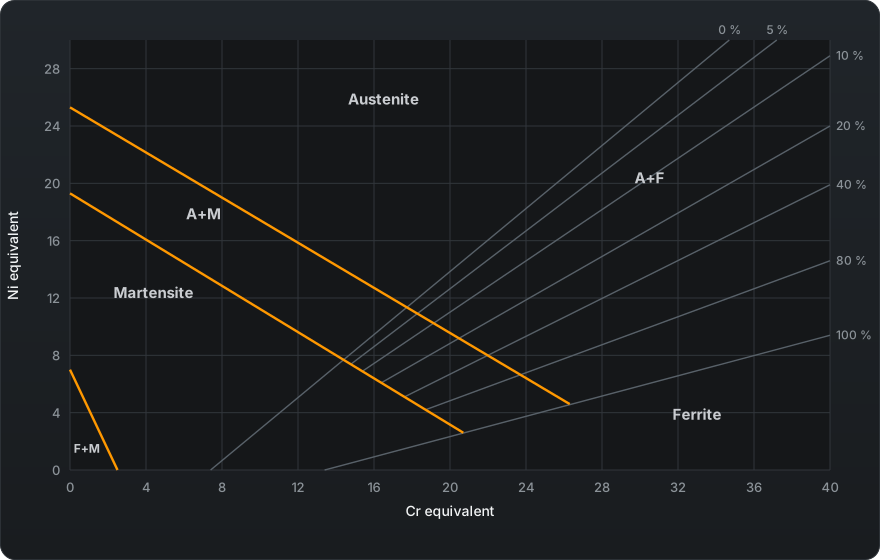
Two numbers place a weld on the Schaeffler diagram: the chromium equivalent and the nickel equivalent. Carbon counts thirty times more heavily than nickel in them — a tenth of a per cent of C shifts the point as far as three per cent of Ni does. The formulas and the diagram are below.
The formulas
Schaeffler:
Cr-eq = Cr + Mo + 1.5·Si + 0.5·Nb + 2·Ti
Ni-eq = Ni + 30·C + 0.5·Mn
WRC-1992:
Cr-eq = Cr + Mo + 0.7·Nb
Ni-eq = Ni + 35·C + 20·N + 0.25·Cu
The ×30 on carbon (×35 in WRC-1992) is the term that matters in practice: when welding unalloyed steel with a stainless filler, the number to watch is not the chromium but how much carbon the parent metal brings in.
Dilution
The weld composition is a weighted average. On a similar joint there are two terms: parent metal and filler. On a dissimilar one there are three, and that is exactly where mental arithmetic starts to slip.
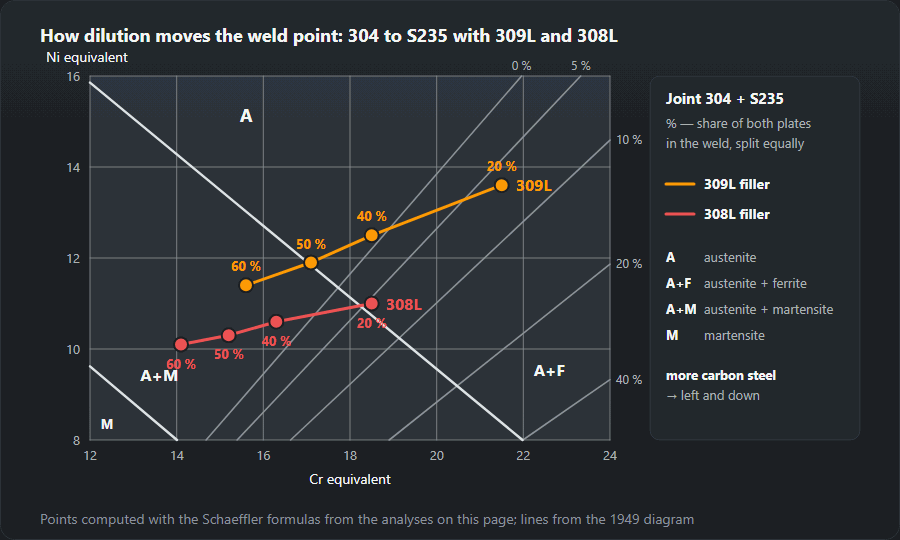
The defaults in the calculator are that very case: 304 on one side, S235 on the other, 309L filler, 25 % dilution from each side. The raised chromium and nickel of 309L are no accident: the surplus is there so that after dilution with carbon steel the weld does not drop into the martensitic region. Put an ordinary 308L in place of the 309L and watch both equivalents fall.
Where it is needed
- Dissimilar joints. Choosing a filler for the stainless-to -carbon pair rests on exactly this arithmetic; the detail is in the article on welding dissimilar metals.
- Ferrite in an austenitic weld. A few per cent of ferrite guards against hot cracking; none at all and far too much are two different problems.
- Hardfacing and buttering. A buffer layer exists to cut the dilution — and the point of it only shows up in numbers.
How to read the Schaeffler diagram, step by step
- Work out the weld, not the filler. Enter both parent metals, the filler and their shares; the calculator mixes the three analyses and normalises the shares to 100 %.
- Chromium equivalent on the horizontal axis, 0 to 40:
Cr + Mo + 1.5·Si + 0.5·Nb + 2·Ti, the ferrite formers. - Nickel equivalent on the vertical axis, 0 to 30:
Ni + 30·C + 0.5·Mn, the austenite formers. - Find the region. Three boundaries cut off martensite, ferrite with martensite and austenite with martensite; above them lie austenite, austenite with ferrite and ferrite.
- Read the ferrite as a band. Iso-ferrite lines are drawn for 0, 5, 10, 20, 40, 80 and 100 %. The two lines around the point are the answer: 5–10 %, not 7 %.
- Check the boundary. Closer than one unit of nickel equivalent to a region boundary, the calculator warns: that is the width of a line on the 1949 chart.
Worked reading: Cr-eq 39, Ni-eq 29
At Cr-eq 39 the 10 % iso-ferrite line passes at Ni-eq 28.0, and the 5 % line would pass at 31.8 — above the top of the chart. The point lies between them, so the calculator reports austenite with ferrite, 5–10 %. It is one unit above the 10 % line: a little more chromium and the reading becomes 10–20 %. The martensite boundaries are far away, so no warning. Ordinary welds sit much further left: every example below lands between Cr-eq 14 and 22.
What the regions mean and what each one threatens
| Region | Calculator says | Risk for the weld |
|---|---|---|
| A | austenite, 0 % ferrite | Tough, but with no ferrite the most prone to hot cracking along the centreline |
| A+F | austenite with ferrite | The target: a few per cent of delta ferrite stops hot cracks |
| A+M | austenite with martensite | Hard islands, less ductility, cold cracks; typical of too much carbon steel in the mix |
| M | martensite | Hard and brittle as welded; cold cracks with hydrogen and restraint |
| F+M | ferrite with martensite | Hardened zones and coarse ferrite at once |
| F | ferrite | Grain growth in the heat and low toughness |
These are Schaeffler’s classic four hazards: hot cracking in fully austenitic welds, hardening cracks in the martensitic corner, grain growth in the ferritic area and sigma phase where ferrite is excessive. Sigma is a hard, brittle iron-chromium phase that grows out of chromium-rich ferrite when the weld is held long at elevated temperature, in service or in heat treatment. So the aim is a band of a few per cent, not as much ferrite as possible. How the cracks look is in the article on weld cracks.
Worked examples with the calculator
Figures are exactly what the calculator prints. Parent metals: 304 (C 0.08, Cr 18, Ni 9, Mn 1.5, Si 0.5, N 0.05) and S235 (C 0.18, Cr 0.2, Ni 0.1, Mn 1.2, Si 0.3).
304 to S235 with 309L, the default case
309L (C 0.03, Cr 23.5, Ni 13, Mo 0.3, Mn 1.7, Si 0.4, N 0.05), shares 25/25/50: Cr-eq 17.1, Ni-eq 11.9, austenite, 0 % ferrite, ratio 1.43, WRC-1992 16.5 / 12.3 — and the boundary warning is on. 309L keeps the weld out of martensite, but at 50 % total dilution its reserve is spent: no ferrite against hot cracking, and any more dilution pushes the point across the line.
The same joint with 308L
For 308L we use the typical analysis voestalpine Böhler Welding publishes for its ER308L rod EAS 2-IG: C 0.02, Cr 20.0, Ni 10.0, Mn 1.8, Si 0.45; ESAB gives nearly the same for OK Autrod 308L (Cr 19.8, Ni 9.8, Mn 1.9, Si 0.4). At 25/25/50: Cr-eq 15.2, Ni-eq 10.3, austenite with martensite; the ESAB analysis lands in the same region. This is the arithmetic behind the rule on the dissimilar steels page: 308L on stainless to carbon steel falls into martensite.
How dilution moves the point
The parent-metal share is split evenly between the sides, as in the dilution sketch: 20 % means low current and shallow penetration, 40 % deep penetration.
| Dilution (A/B/filler) | 309L | 308L |
|---|---|---|
| 20 % (10/10/80) | 21.5 / 13.6, austenite with ferrite 5–10 % | 18.5 / 11.0, austenite with ferrite 5–10 %, boundary warning |
| 40 % (20/20/60) | 18.5 / 12.5, austenite 0 % | 16.3 / 10.6, austenite with martensite |
| 50 % (25/25/50) | 17.1 / 11.9, austenite 0 %, boundary warning | 15.2 / 10.3, austenite with martensite |
| 60 % (30/30/40) | 15.6 / 11.4, austenite with martensite | 14.1 / 10.1, austenite with martensite |
More carbon steel moves the point down and left, towards martensite. 309L keeps ferrite at low dilution and stays austenitic up to about half; 308L survives only the shallowest penetration, and on the edge — with the ESAB analysis the 20 % point already drops into austenite with martensite. Low current, stringer beads and, on thick sections, buttering matter as much as the filler.

Like for like: 304 to 304 with 308L
304 in both parent columns, the same 308L, shares 15/15/70: Cr-eq 20.1, Ni-eq 11.7, austenite with ferrite 5–10 % (WRC-1992 19.4 / 11.3). Dilution does no harm here: 308L alone reads 20.7 / 11.5 with 10–20 % ferrite. Why matching stainless fillers leave some ferrite is covered in welding stainless steel.
Schaeffler, DeLong and WRC-1992
Schaeffler covers the whole field including martensite, so it is the tool for dissimilar joints and buffer layers. DeLong refined the austenitic corner, added nitrogen and introduced the Ferrite Number; WRC-1992 continues that line with nitrogen and copper, reports FN rather than per cent and is more accurate for austenitic and duplex welds, but has no martensite region. Hence both pairs in the calculator: Schaeffler for the region, WRC-1992 for the ferrite. In the default case the WRC nickel equivalent is higher (12.3 against 11.9) because of the 20·N term.
Typical mistakes
- Plotting the filler. 309L alone reads 24.4 / 14.8 with 10–20 % ferrite; the default weld reads 17.1 / 11.9 with none.
- Forgetting the parent’s carbon. Carbon counts ×30: the 0.18 % C of S235 is worth 5.4 units, and at a 25 % share it adds 1.35 to the weld.
- Leaving out Ti and Nb. On stabilised steels each 0.1 % Ti adds 0.2 to the Schaeffler Cr-eq, each 0.1 % Nb adds 0.05 (0.07 in WRC-1992).
- Reading one number. The chart gives a band, and near a boundary no firm answer. With the warning on, change the filler or the dilution, not the reading.
- One dilution for every process. Covered electrode usually 20–30 %, MAG 25–50 %, under flux over 60 % — and 60 % pushes even 309L into austenite with martensite. For the carbon steel side work out the preheat with the carbon equivalent calculator.
Frequently asked questions
How accurate is the diagram?
It gives a region, not a number. Schaeffler built it in 1949 on arc welds in stainless steels, and between the iso-ferrite lines the reading comes out as a band — which is why the calculator says 5–10 % rather than 7 %. For the exact ferrite content of an austenitic weld use WRC-1992 or a ferritescope. Schaeffler’s strength lies elsewhere: it also covers the martensitic region, and that is what decides matters on dissimilar joints.
Where do the shares of each metal come from?
From the dilution, that is, the share of parent metal in the weld. It depends on process and settings; as a rough guide: with a covered electrode usually 20–30 %, with MAG 25–50 %, under flux it can pass 60 %. On a dissimilar joint that share is split between the two sides, normally evenly, and the rest is filler.
Schaeffler or WRC-1992?
WRC-1992 is newer and more accurate for austenitic and duplex steels because it accounts for nitrogen and copper, and it reports ferrite as a Ferrite Number rather than a percentage. Schaeffler stays useful on dissimilar joints — it covers the martensitic region, which the WRC chart does not. Hence both are calculated.
How do I read the ferrite percentage on the Schaeffler diagram?
Between the two iso-ferrite lines around the point (0, 5, 10, 20, 40, 80, 100 %), so the answer is a band. Example: Cr-eq 39, Ni-eq 29 lies between the 10 % line (Ni-eq 28.0 there) and the 5 % line — austenite with 5–10 % ferrite.
Why 309L and not 308L for stainless to carbon steel?
Because carbon steel dilutes the filler. With the defaults (304, S235, 25/25/50) 309L gives Cr-eq 17.1, Ni-eq 11.9 — austenite, on the martensite boundary. A typical 308L gives 15.2 and 10.3 — austenite with martensite.
What is sigma phase and what has ferrite to do with it?
A hard, brittle iron-chromium phase that grows out of chromium-rich delta ferrite when the weld is held long at elevated temperature. It lowers toughness and corrosion resistance — hence a few per cent of ferrite, not as much as possible.
Updated: