Products and structures
What a fabrication shop makes: carports, gates, fences, stairs, garages and halls — how they are built and what varies.
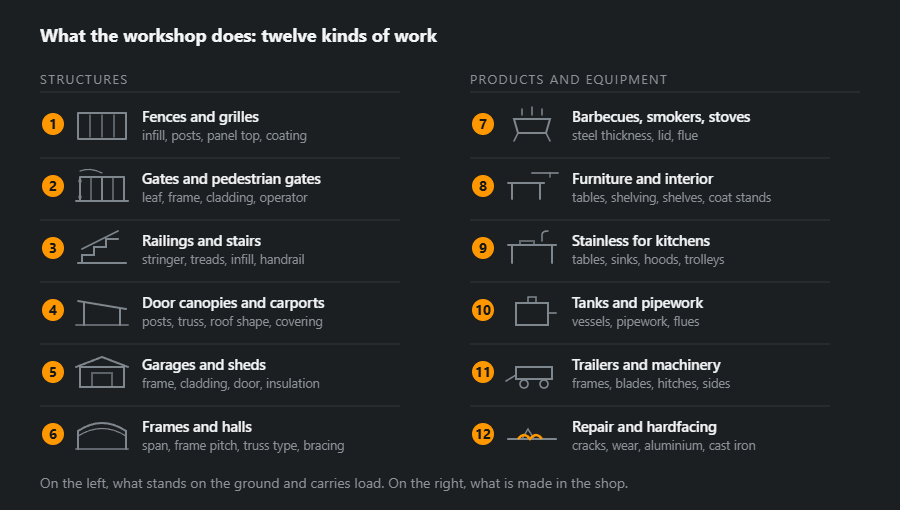
This section is about what leaves the shop on a trailer: carports, gates, fences, stairs, door canopies, garages and structural frames, and alongside them barbecues, stainless steel for kitchens, furniture on a steel frame, tanks and machinery repair. Welding is not the subject here. It is the way a thing gets assembled that then stands outdoors for fifteen years.
Every article is laid out the same way. First the product as a whole: what carries what, which dimensions are worth arguing about, and where the load actually arrives. Then joint by joint, and at each joint six options with one line saying when that one is chosen. That is how the conversation goes on the shop floor, and it transfers to the page cleanly: a carport post comes in six kinds, and choosing between them is a question of span and snow load, not taste.
Where to start — by where the thing will stand. On a plot: carports, gates, fences, door canopies, garages, yard and garden. In a house and on a wall: stairs and railings, furniture on a steel frame, brackets and fixings, grilles and hatches. In a shop and a warehouse: halls, platforms and walkways, frames and jigs, storage and handling. In a kitchen and food production: stainless equipment, tanks and pipework, barbecues and stoves. Something you already own has failed — repairs and rebuilding. What is common to all of them — price, lead time, coating and fixings — is in how ordering works.
The numbers here are Warsaw numbers: 0.9 kPa of snow load, a frost line at 0.9–1.2 m, coating lives from local practice. A loaded structure is sized by an engineer, not by a handbook; what is here is what is worth understanding before that conversation starts.

- Carports What a carport is made of: the posts, how they meet the ground, the truss, the roof shape and the reinforcements — six options for each joint.
- Gates and wickets A sliding gate in section, six types of gate, posts and foundations, what closes the leaf, and sizing the operator by the weight it has to move.
- Fences A whole fence bay with its foundation in section, six kinds of infill, and six ways of setting a post in ground that freezes and heaves.
- Stairs and railings A flight in section with the step dimensions, six types of staircase, six fixing details, and six ways of closing the gap in a railing.
- Door canopies A 1.2×1.5 m canopy is about 34 kg of steel but carries 160 kg of snow. Which tubes, which anchors for each wall, the bracket weld and mistakes to avoid.
- Garages and sheds The frame of a garage taken apart, six types from profiled sheet to sandwich panel, and why steel sweats inside without vents under the eaves.
- Halls and frames A hangar frame in section with its purlins and bracing, six ways of covering a span, and what happens when bracing is struck off the quotation.
- Platforms and walkways How an access platform is built, six kinds of platform, what closes the gap between beams, guardrails to the standard and industrial stairs.
- Frames and jigs How a pump bedplate is built, six jobs on frames and jigs and six versions of a machine guard — what decides alignment and access.
- Storage and handling How a pallet racking bay is built, six ways of storing and six things on the move — trolleys, stillages, pallets and ramps; what the forklift dictates.
- Grilles, doors and hatches A window grille and a hinged one, a boiler room door, a floor hatch, a light-well grating and an air conditioner cage — how each one is built.
- Yard and garden How a gazebo is built and how it differs from a carport, six greenhouse frames, garden furniture and yard oddments — from a swing to a bin shelter.
- Barbecues and stoves How a firebox is built and why the wall thickness decides it, six kinds of barbecue and six layouts of a set, the flue and the draught.
- Furniture and interior How a table on a steel frame is built, six frame joints, six kinds of top, and what else gets welded for an interior: shelving, racks, coat stands.
- Brackets and fixings How a bracket for an outdoor unit is built, six common brackets and six household oddments — why overturning is what gets calculated, not weight.
- Stainless equipment How a work table is built, six stainless items and six details the job is accepted on: the corner radius, the weld, the gap under the foot.
- Tanks and pipework How a rectangular tank is built, six jobs on vessels, six kinds of pipework joint and six ventilation parts — what gets welded and what gets bought.
- Repairs and rebuilding Six repair techniques and the work that comes with machinery: a stop-drilled crack, an insert, hardfacing a worn surface, cast iron and aluminium.
- How ordering works What the price is made of, how the order runs week by week, how to choose a coating and the fixings, and what insulation actually buys you.
Frequently asked questions
Why is there no price list?
Because no two carports are the same. The price is built from steel (about a third), cutting and bending, welding, coating, installation and delivery, and it moves with the span, the height and the ground. What it is made of is broken down in how ordering works, with cost bars for a fence, a carport, a staircase and a gate.
Do I need an engineer?
A single-car carport, a fence, a door canopy and a house staircase are covered by a standard solution and a site survey. A hall, a frame carrying a crane and any carport spanning more than 6 m need calculation: snow, wind and the joints all get sized. This handbook does not replace that calculation — it tells you what to discuss with the person doing it.
How long does it take?
Three to four weeks as a rule: a day for the survey, two or three for the sketch and quotation, up to a week for approval — which depends on you — seven to ten days of fabrication, three to five for coating and a day or two on site. The long parts are not the welding; they are approval and drying paint.
Paint or galvanise?
Primer and enamel last 3–5 years, powder coating 7–10, hot dip galvanising 25+, zinc with a polymer coat 30+. Beside a salted road, zinc wins outright; in a sheltered yard the difference between powder and zinc does not always pay for itself. The life is counted to the first rust stain, not to failure.