Repairs and rebuilding
Repair is the one job in this section that is brought in rather than ordered. It usually arrives after somebody else has already tried, so half the work is removing the previous weld.
Six techniques

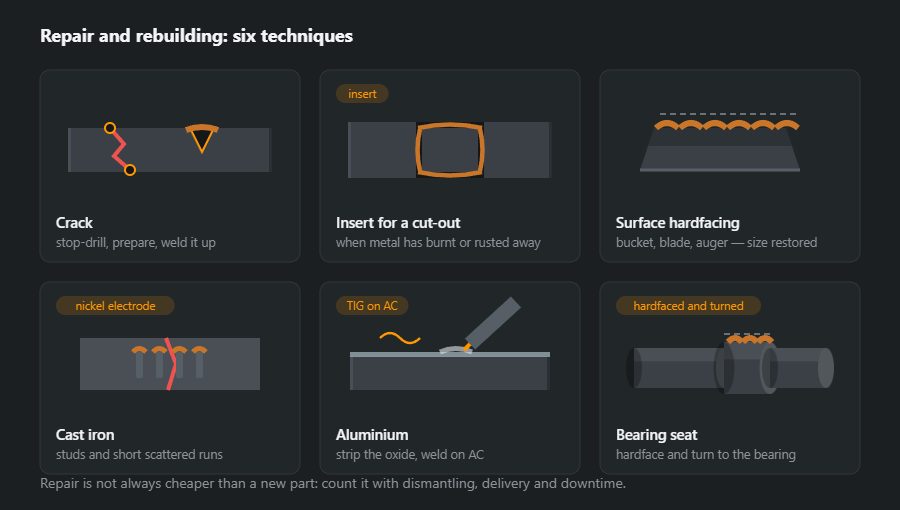
- Crack — stop-drill the ends, prepare the edges, weld it up. Without stop-drilling the crack runs on past the weld.
- Insert instead of a cut-out — when the metal has burnt away or rusted through and there is nothing left to weld to.
- Surface hardfacing — bucket, blade, auger: the size is brought back with weld metal and the excess machined off.
- Cast iron — nickel electrode, studs, short scattered runs, slow cooling.
- Aluminium — strip the oxide, weld TIG on AC.
- Bearing seat on a shaft — hardface and turn back to the bearing size.
Trailers and machinery
A separate and very frequent group of jobs: frames, drawbars, blades and everything that breaks on attachments. Here repair almost always beats replacement, because the assembly is large and the damage local.

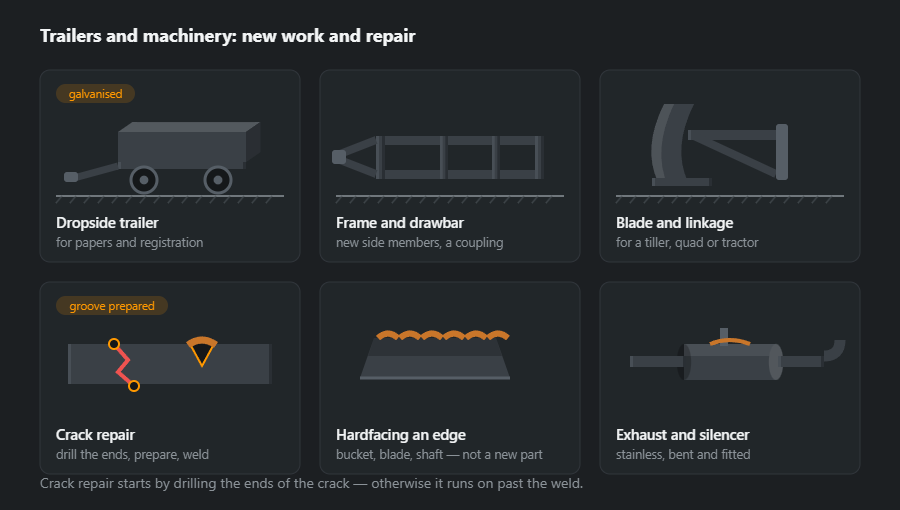
A dropside trailer is built for papers and registration — meaning the dimensions, the coupling and the lighting have to satisfy the requirements rather than convenience. A blade or a linkage for a tiller or a quad carries no such constraint and is made to suit.
When repair makes no sense
Three cases where it is more honest to decline:
- The part works under pressure or in lifting gear and nobody knows its loading history.
- The crack runs through a zone that has already been welded twice: the metal there is overheated and brittle.
- Dismantling and downtime cost more than a new part — a sum to do before, not after.
Repairing steel structures: from inspection to sign-off
Repairing a carport, a stair, a balustrade or a building frame differs from repairing a machine part because the member is still carrying something. So the job starts not with the welder but with the question of how to take the load off it and how much metal is left. A loaded structure is the engineer's territory: they decide whether an insert is enough or strengthening or replacement of the whole member is needed. The shop is responsible for carrying out the repair as designed.
- Inspection — rust holes, layered scaling, cracks at welds, buckling and sagging, loose bolts and anchors.
- Measuring section loss — the actual wall thickness with a thickness gauge or a test hole; rust judged by eye always looks smaller than it is.
- Decision — an insert in place of the cut-out length, a strengthening plate or a new member; for load-bearing members the calculation decides, not the appearance.
What repairs are made with: the same sections and plates
An insert is made from the same section as the member: a different stiffness in the middle of a post or beam changes how the whole structure works. The mass per metre is in the tables: a 100×100×4 post is 11.7 kg/m, 80×80×4 — 9.22 kg/m, an L 50×50×5 brace — 3.77 kg/m, an IPE 160 beam — 15.8 kg/m. Strengthening plates and new base plates are cut from plate: 8 mm weighs 62.8 kg/m², 10 mm — 78.5 kg/m². When the exact section is no longer sold, a substitute is chosen by cross-section area and moment of inertia, not by outside dimensions — the hollow section calculator helps here.
Welds in repair work: size is counted from the sound wall
The most common repair mistake is a weld laid on a wall that is no longer there. The rule “a no more than 0.7 of the thickness” applies to the real, measured thickness: a 4 mm wall eaten down to 2.5 mm gives 0.7·2.5 = 1.75 mm, while the smallest load-bearing fillet is a3 (leg z ≈ 4.2 mm). Such a weld cannot be laid without burning through, so you cut further — to full-thickness metal. The fillet weld calculator shows the range and the conversion.
- Cracks — drill the ends with a 3–4 mm hole, gouge out and only then weld; otherwise the crack runs on from the same tip.
- Unknown steel — old structures may be in steel with more carbon; the carbon equivalent shows the risk and the preheat calculator the temperature.
- Weld zone to bare steel — paint, zinc and rust give porosity, and zinc also gives fumes that can cause metal fume fever.
- Plates welded all round — the gap under a plate welded in stitches is where rust starts again, and from the inside.
Order of the repair
- Unloading — temporary props under the beam or roof before anything is cut.
- Cleaning — wire brush, grinder or blasting of the repair zone to bare steel.
- Measuring and marking — the cut line where the wall is full thickness.
- Cutting out and preparation — edge bevels for a butt weld, the insert fitted with a root gap for full penetration.
- Welding — alternately from opposite sides so the member does not pull; cracks from the drilled ends towards the middle.
- Inspection — visual inspection of the welds, and for load-bearing members assessment against the ISO 5817 acceptance limits.
- Protection and removal of props — coating over the whole repair zone; props come out last.
Protection after repair
An erected structure cannot be dipped in a zinc bath, so after a repair only coatings applied on site remain. Cold zinc brushed onto the weld gives 5–7 years, primer and enamel 3–5; hot-dip galvanising (25+) only makes sense if the member is being removed and replaced as a whole anyway. The repaired zone is painted wider than the weld itself: rust likes the boundary between old and new coating.
Typical mistakes
- Cutting without props — a load-bearing member cut under load settles or pinches the saw.
- Welding over rust and paint — porosity, lack of fusion and a weld that comes off with the scale.
- Patch on patch — yet another plate on a rusted wall instead of cutting out and inserting.
- A third weld in the same place — metal overheated twice is brittle; replacing the member is the honest answer.
- No protection after repair — a bare weld rusts in its first season.
How to work out materials: a carport repair
A carport with four 100×100×4 posts whose bottom 0.6 m has rusted through at the concrete, and four rusted braces. The repair: new inserts for the bottom of the posts, new 200×200×10 mm base plates, new braces.
| Member | Section | Length, m | Qty | kg/m | kg |
|---|---|---|---|---|---|
| Post insert | 100×100×4 | 0.60 | 4 | 11.7 | 28.1 |
| Brace | L 50×50×5 | 2.10 | 4 | 3.77 | 31.7 |
| Total | 59.7 | ||||
| With 5 % allowance | 63 | ||||
The sections come to 60 kg net and 63 kg with allowance; the four base plates add another 13 kg. The a3 fillet round the four posts at the plates is 1.6 m and about 0.12 kg of weld metal. Steel is a small part of a repair — the bigger part is propping, cutting, preparation and coating. Your own list with plates and bolts can be reworked in the bill of materials calculator.
Where to go next
The metallurgy is covered separately: welding cast iron for nickel electrodes and parameters, welding aluminium for the oxide and alternating current, and cracks in welds for why they appear in the first place. Items made new rather than repaired are in shop products.
Frequently asked questions
Why is a crack drilled first?
Because a crack has a sharp tip and stress concentrates in it. Welded up without stop-drilling, it carries on growing past the weld — out of the same tip, still in the metal. A 3–4 mm hole at each end removes the concentrator.
Is repair always cheaper than a new part?
No. The sum has to include dismantling, transport and downtime. Repair wins where the part is large, rare or out of production; on a cheap series part the dismantling alone often costs more than replacement.
What do you weld cast iron with?
Nickel electrodes, short scattered runs, peened and never overheated. Studs are often added: they hold the weld mechanically rather than by adhesion alone. Cast iron dislikes rapid heating and dislikes rapid cooling even more.
Why is aluminium welded on AC?
Because of the oxide film. Aluminium oxide melts at around 2050 °C, the metal itself at 660 °C. Alternating current in TIG breaks the film up on the positive half-cycle, and only because of that does a weld form at all.
How do you repair a rusted steel post?
First prop whatever the post carries, then cut out the corroded length back to sound metal, fit a new piece of the same section (100×100×4 weighs 11.7 kg/m) and weld it all round, and finally protect the welds with cold zinc or paint. Welding over rust and paint gives porosity, and a weld on a wall thinner than designed will not carry the load. For a load-bearing member, the scope of the repair is agreed with a structural engineer.
Can you weld onto a rusted wall?
Not if the member has to carry anything. The smallest load-bearing fillet is a3, and the sensible upper limit is 0.7 of the wall thickness: a wall eaten from 4 to 2.5 mm gives 1.75 mm, so no load-bearing fillet fits there. The remaining thickness is measured with a thickness gauge or a test hole, and the member is cut back to full-thickness metal.
What needs doing before welding an old structure?
Find out what it is made of: the grade of old steel is often unknown, and the composition decides whether preheat is needed. The carbon equivalent from the certificate or an analysis shows the cracking risk, and the preheat calculator the temperature. Paint, zinc and rust are removed from the weld zone down to bare steel.
Updated: