Carbon equivalent calculator
One number that says how the steel will behave when it cools: whether the heat-affected zone hardens, and whether preheat is needed before the first run.
Chemical composition, % by mass
Welding conditions — used for the preheat figure
What is carbon equivalent?
It is the chemical analysis squeezed into one number that behaves like a carbon content. Carbon decides how hard martensite gets when steel cools fast; manganese, chromium, molybdenum, vanadium, nickel and copper slow the transformation down, so martensite forms even at slower cooling. Each formula gives these elements a weight — manganese counts as one sixth of carbon in CE (IIW), one tenth in CET — and adds them up.
Next to the pool the heat-affected zone is heated above the transformation range and then quenched by the cold plate within seconds. The higher the carbon equivalent, the harder and more brittle it comes out. A hard zone, diffusible hydrogen and residual stress together cause hydrogen (cold) cracks, which can appear hours later and below the surface — see weld cracks. Carbon equivalent measures the first factor; preheat and low-hydrogen consumables deal with the other two. And it is worked out from the heat’s actual analysis: the grade standard only gives upper limits.
Two formulae, two uses
CE (IIW) = C + Mn/6 + (Cr+Mo+V)/5 + (Ni+Cu)/15. This is the classic index quoted on certificates and in steel standards; it works well for carbon-manganese steels above about 0.18 % C.
CET = C + (Mn+Mo)/10 + (Cr+Cu)/20 + Ni/40. This is the one EN 1011-2 method B uses for the preheat calculation, and it fits modern low-carbon fine-grained steels better.
| CE (IIW) | Weldability | What to do |
|---|---|---|
| up to 0.40 | Good | No preheat needed, ordinary electrodes |
| 0.40–0.60 | Limited | Preheat 100–200 °C, low-hydrogen electrodes, baked |
| above 0.60 | Poor | Preheat 200–350 °C, keep it warm while welding, stress relief afterwards |
Reading the result
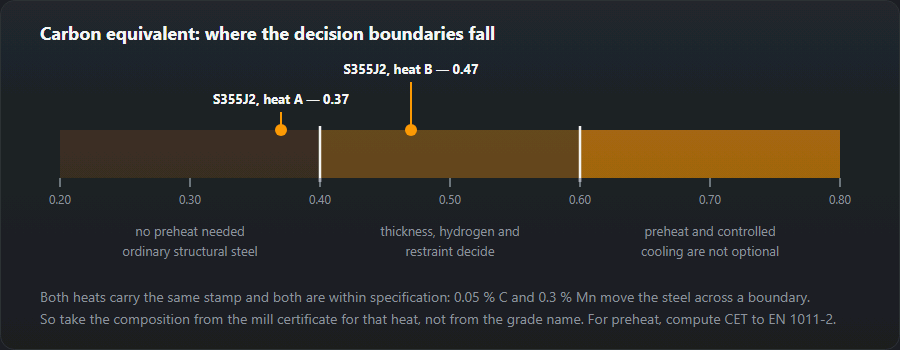
Below 0.40 % CE, ordinary structural steel welds without preheat. From 0.40 to 0.60 the risk of a hard heat-affected zone is real and preheat depends on thickness, hydrogen and restraint — feed the CET into the preheat calculator. Above 0.60 preheat and controlled cooling are not optional, and post-weld heat treatment usually enters the procedure.
The composition has to come from the mill certificate for that heat, not from the grade designation. Two plates both stamped S355J2 can differ by 0.05 % C and 0.3 % Mn and still be within specification — which is enough to move CE across a decision boundary.

Common grades
| Grade | C, % | Mn, % | CE ≈ |
|---|---|---|---|
| S235JR | 0.17 | 1.40 | 0.40 |
| S355J2 | 0.20 | 1.60 | 0.47 |
| C22 | 0.20 | 0.50 | 0.28 |
| C45 | 0.45 | 0.65 | 0.56 |
| 30ChGSA | 0.30 | 1.00 | 0.67 |
The CE column is worked out with the IIW formula from the same composition rather than copied, so the table and the calculator cannot drift apart.
Worked examples with the calculator’s numbers
Each figure is what this calculator prints for the stated input. Welding conditions are its defaults unless said otherwise: 12 mm, hydrogen option “5–10 ml/100 g”, 1.0 kJ/mm. Preheat is rounded up to the next 5 °C.
1. The default analysis
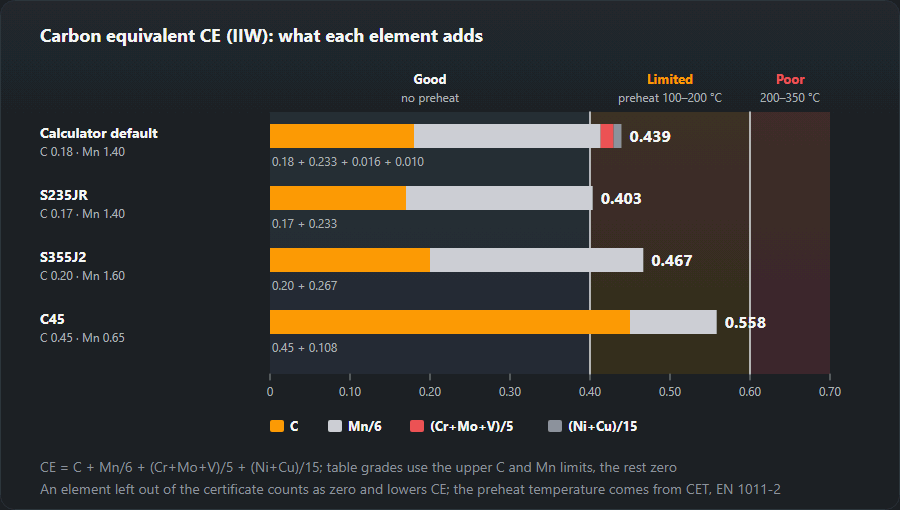
C 0.18, Mn 1.40, Si 0.30, Cr 0.05, Mo 0.02, V 0.01, Ni 0.05, Cu 0.10 — a typical C-Mn structural plate. CE = 0.18 + 1.40/6 (0.233) + (0.05 + 0.02 + 0.01)/5 (0.016) + (0.05 + 0.10)/15 (0.010) = 0.439. CET = 0.18 + 1.42/10 (0.142) + 0.15/20 (0.0075) + 0.05/40 (0.00125) = 0.331. Silicon is in the form, but neither formula uses it. 0.439 is in the 0.40–0.60 band — limited, preheat required — and the calculator gives 70 °C. With the “up to 5” hydrogen option it drops to 45 °C; at 30 mm it rises to 130 °C. Same steel, three answers: the band alone never gives a temperature.
2. S235JR and S355J2 from the table
The grade table uses the upper limits of C and Mn and sets the other elements to zero — a worst case, not a real heat. S235JR (C 0.17, Mn 1.40): CE 0.403, CET 0.310, preheat 55 °C. With every maximum at once it just touches the 0.40 line; real heats usually sit below it, which is why S235 in ordinary thicknesses is welded without preheat. S355J2 (C 0.20, Mn 1.60): CE 0.467, CET 0.360, preheat 95 °C at 12 mm and 150 °C at 30 mm. The table tells you which band to expect; for S355 in thick sections take the certificate CET into the preheat calculator.

3. Reading a 3.1 certificate
On an EN 10204 3.1 certificate the chemistry is in the ladle (heat) analysis block, in mass per cent; some mills print the CEV there too. Copy C, Mn, Cr, Mo, V, Ni and Cu. An element left out counts as zero, and the result comes out low. Example heat: C 0.15, Mn 1.40, Cr 0.06, Mo 0.02, V 0.04, Ni 0.12, Cu 0.30. CE = 0.15 + 0.233 + 0.12/5 (0.024) + 0.42/15 (0.028) = 0.435, CET 0.313, preheat 60 °C. Enter only C and Mn and you get CE 0.383, CET 0.290, badge “good, no preheat needed”: the residuals were worth 0.052, enough to cross the 0.40 line. Yet the preheat cell still shows 40 °C — the badge is the coarse IIW band, the cell is the EN 1011-2 formula with your thickness and hydrogen. When they disagree, follow the formula and the welding procedure.
4. Hardenable grades: C45 and 30ChGSA
C45 (C 0.45, Mn 0.65): CE 0.558, CET 0.515, preheat 210 °C, 180 °C with basic dry electrodes. Still “limited” by CE, yet above the 100–200 °C the table gives for that band: CET weighs carbon more, and C45 is mostly carbon. 30ChGSA (C 0.30, Mn 1.00, Cr 1.00): CE 0.667, “poor”, CET 0.450, preheat 160 °C. Use baked basic electrodes, check the preheat before every run, cool slowly and add post-weld heat treatment where the procedure calls for it. Check the cooling time t8/5: too short, and the zone hardens despite the preheat. Method B was developed for structural steels, so here its figure is a starting point for the procedure.
CEV, CET or Pcm — which one when
- CEV = CE (IIW). Two names for one formula; “CEV” is the label in EN 10025 and on certificates. For a first view of weldability, comparing heats and checking a maximum set in an order. The 0.40 and 0.60 bands belong to it.
- CET (EN 1011-2) weighs carbon relatively more and is the input for preheat by method B. It is lower than CE for the same heat — 0.331 against 0.439 for the default analysis — so never read it against the CE bands.
- Pcm, published by Ito and Bessyo in 1968: C + Si/30 + (Mn+Cu+Cr)/20 + Ni/60 + Mo/15 + V/10 + 5B. Made for low-carbon high-strength and pipeline steels; the only one of the three counting silicon and boron. This calculator does not work it out.
Preheat by carbon equivalent
Method B of EN 1011-2 combines four inputs: CET, thickness, the consumable’s diffusible hydrogen (HD) and heat input. Thicker plate draws heat away faster, more hydrogen needs longer at temperature to escape, higher heat input slows cooling. In the preheat calculator its defaults — S355J2, CET 0.34, 20 mm, HD 12, 1.5 kJ/mm — give 120 °C; HD 4 gives 75 °C, 40 mm gives 170 °C, S235JR (CET 0.25) gives 50 °C. On this page, default analysis at 30 mm: 130 °C at 1.0 kJ/mm, 115 °C at 2.0 kJ/mm (work out heat input with the heat input calculator). Both calculators round up to the next 5 °C — the safe side — so the same input gives the same figure on both. Interpass: from the preheat up to the usual 250 °C for structural steels.
Typical mistakes
- Standard maxima instead of the actual heat. Right at design and purchase, when the heat is unknown; once the certificate is in hand, use it.
- Forgetting Cu, Ni and V. An empty field is zero — in the certificate example that hid 0.052 of CE.
- Mixing up CE and CET limits. 0.40 and 0.60 are CE limits; a CET of 0.33 is not “good weldability”.
- CE for stainless steel or cast iron. Not applicable: for stainless and dissimilar joints use the Schaeffler diagram, for cast iron see welding cast iron.
Frequently asked questions
CE or CET — which do I use?
CET when the question is preheat to EN 1011-2: that is the figure method B works with. CE to IIW is the older, more widely quoted number for a first view of weldability. The calculator gives both, because both turn up in documents.
Where do I get the analysis?
From the 3.1 inspection certificate to EN 10204 that comes with the material. Without one there is no CE — the grade name will not do, because the standard allows a range and heats spread across it.
What does a CE above 0.40 mean?
That the hardenability is enough to form a hard structure on fast cooling, and with it cold cracks. From 0.40 the preheat is calculated rather than guessed; from 0.60 post-weld heat treatment usually enters the procedure as well.
What is carbon equivalent?
The steel analysis turned into one carbon-like number: carbon plus Mn, Cr, Mo, V, Ni and Cu, each with its own weight. The higher it is, the harder the heat-affected zone and the greater the risk of hydrogen cracking.
CEV vs CE — is there a difference?
No. CEV is what EN 10025 and mill certificates call the IIW formula C + Mn/6 + (Cr+Mo+V)/5 + (Ni+Cu)/15, which the calculator prints as CE (IIW). CET and Pcm are different formulae with their own scales.
When should I preheat based on CE?
From CE 0.40 the calculator marks preheat as required. The temperature depends on thickness, hydrogen and heat input: the default analysis (CE 0.439) needs 70 °C at 12 mm and 130 °C at 30 mm.
Updated: