Heat input calculator
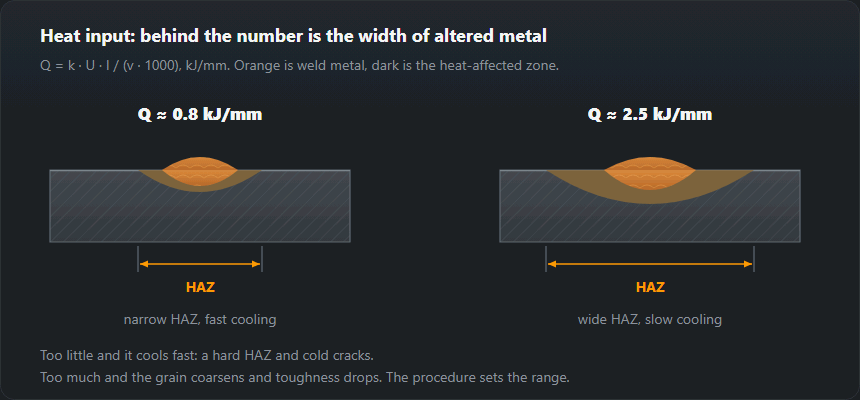
Heat input is what ties your settings to the metallurgy: cooling rate, weld structure and the need for preheat all follow from it. Procedure specifications limit it at both ends.

The formula
Q = k · (U · I · 60) / (v · 1000), where U is the arc voltage in
volts, I the current in amperes, v the travel speed in mm/min and k the thermal
efficiency of the process.
The efficiency figures are those of ISO/TR 18491 and EN 1011-1. Without the coefficient the result is called arc energy, not heat input — in documentation the two are not interchangeable, and quoting one where the other is required is a common way to fail a review.
How to calculate heat input: worked examples
Every example below uses the numbers you would type into the calculator above, and the results are exactly what it shows: arc energy and heat input in kJ/mm, rounded to two decimals. The calculator does not print kJ/cm — multiply the kJ/mm figure by 10.
| Example | k | I, A | U, V | v, mm/min | E, kJ/mm | Q, kJ/mm | Q, kJ/cm |
|---|---|---|---|---|---|---|---|
| Calculator default, MMA 111 | 0.8 | 150 | 24 | 150 | 1.44 | 1.15 | 11.5 |
| MAG 135 | 0.8 | 220 | 24 | 300 | 1.06 | 0.84 | 8.4 |
| MMA 111, 3.2 mm electrode | 0.8 | 125 | 25 | 150 | 1.25 | 1.00 | 10.0 |
| TIG 141, 2 mm sheet | 0.6 | 90 | 11 | 60 | 0.99 | 0.59 | 5.9 |
| SAW 121 | 1.0 | 500 | 30 | 500 | 1.80 | 1.80 | 18.0 |

Example 1: the calculator default (MMA 111)
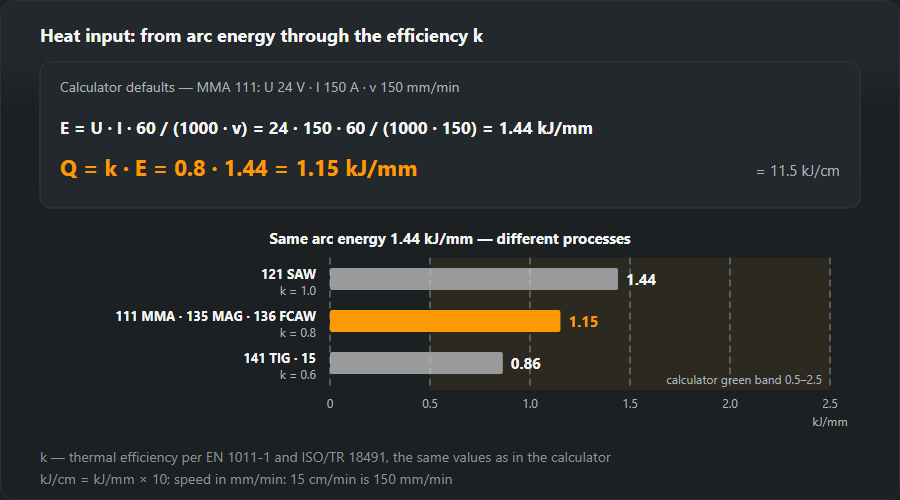
150 A, 24 V, 150 mm/min, process MMA with k = 0.8.
Step one, arc energy: E = 24 · 150 · 60 / (150 · 1000) = 1.44 kJ/mm.
Step two, heat input: Q = 0.8 · 1.44 = 1.15 kJ/mm, which is
11.5 kJ/cm. The result sits in the green band of 0.5–2.5 kJ/mm. Enter
a weld length of 1 m and the calculator adds the arc time: 1000 mm at
150 mm/min is 6.7 min.
Example 2: MAG 135 at 220 A, 24 V, 30 cm/min
The speed is given in cm/min, the calculator wants mm/min: 30 cm/min =
300 mm/min. Arc energy E = 24 · 220 · 60 / (300 · 1000) = 1.06 kJ/mm
(unrounded 1.056). MAG has k = 0.8 in the table on this page, so
Q = 0.8 · 1.056 = 0.84 kJ/mm = 8.4 kJ/cm. Note the small trap:
the calculator multiplies the unrounded arc energy. If you multiply the
displayed 1.06 by hand you get 0.848 and round it to 0.85 — a harmless
difference, but a reviewer comparing your sheet with the calculator will ask
about it.
Example 3: MMA 111 with a 3.2 mm electrode, 15 cm/min
The electrode current
table gives 90–140 A for 3.2 mm; take 125 A. Many MMA
machines show no voltage, so for a quick estimate use the rule from the FAQ
below: U ≈ 20 + 0.04 · 125 = 25 V. Travel speed 15 cm/min =
150 mm/min. Arc energy E = 25 · 125 · 60 / (150 · 1000) = 1.25 kJ/mm,
heat input Q = 0.8 · 1.25 = 1.00 kJ/mm = 10.0 kJ/cm. For a
document the 25 V has to be replaced by a measured value — see the section
on measuring below.
Example 4: TIG 141 on 2 mm sheet
The settings table
gives 50–90 A for 1.5–2.0 mm; take 90 A. A TIG arc voltage is not
set on the machine, it follows from the arc length, so it has to be measured —
assume the voltmeter shows 11 V. At 60 mm/min (1 mm/s) the arc
energy is E = 11 · 90 · 60 / (60 · 1000) = 0.99 kJ/mm. With
k = 0.6: Q = 0.6 · 0.99 = 0.59 kJ/mm = 5.9 kJ/cm, the
“thin material” band. Leave the selector on MIG/MAG by mistake and the same
settings give 0.79 kJ/mm — a third more on paper for exactly the same weld.
Example 5: SAW 121
Assume a single-wire run at 500 A, 30 V and 500 mm/min. Arc
energy E = 30 · 500 · 60 / (500 · 1000) = 1.80 kJ/mm. Submerged arc
has k = 1.0, so heat input equals arc energy: 1.80 kJ/mm =
18.0 kJ/cm. This is the one process where confusing the two figures does
no harm — and the only one.
Units: mm/s, cm/min, mm/min, kJ/mm and kJ/cm
- Speed: mm/min = cm/min × 10 = mm/s × 60. So 30 cm/min = 300 mm/min = 5 mm/s.
- Energy per length: kJ/cm = kJ/mm × 10, J/mm = kJ/mm × 1000. The default example gives 1.15 kJ/mm = 11.5 kJ/cm = 1150 J/mm (the unrounded value is 1152 J/mm).
- The formula in other units:
Q = k · U · I · 60 / vwith v in mm/min gives J/mm (MAG example: 844.8 J/mm). With v in mm/s,Q = k · U · I / (v · 1000)gives kJ/mm. And the calculator's formula with v in cm/min returns kJ/cm directly: 0.8 · 24 · 220 · 60 / (30 · 1000) = 8.4.
Measuring travel speed: weld length divided by arc time
v = L / t, where L is the length of weld actually made and t is
the time the arc was burning on it. The simplest method: mark 200 mm and
time it with a stopwatch. 200 mm in 40 s is 5 mm/s, that is
300 mm/min — the MAG example. For a whole bead, measure its finished length
and divide by the arc-on time only: pauses for changing an electrode or chipping
slag do not count. If the machine or a weld monitor records arc time, use it:
that is more reliable than a stopwatch started by a helper.
Where the number is used
Three places, mainly. In the preheat calculation to EN 1011-2, where higher heat input lowers the required preheat. In a WPS, where the qualified range of heat input is one of the essential variables. And in any argument about toughness: for fine-grained structural steels the upper limit exists because the heat-affected zone loses impact energy long before the weld metal does.
Thermal efficiency k
| Process | ISO 4063 | k |
|---|---|---|
| Submerged arc welding with solid wire electrode SAW | 121 | 1.0 |
| Manual metal arc welding with covered electrode MMA · SMAW | 111 | 0.8 |
| MAG welding with solid wire in active gas MAG · GMAW | 135 | 0.8 |
| MAG welding with flux-cored wire FCAW | 136 | 0.8 |
| TIG welding with solid filler TIG · GTAW | 141 | 0.6 |
| Plasma arc welding | 15 | 0.6 |
What the number means
| Q, kJ/mm | What it means |
|---|---|
| < 0.5 | Fast cooling; risk of hard structures and cold cracks in the HAZ |
| 0.5–1.0 | Thin material, root runs, stainless |
| 1.0–2.5 | The working range for most manual processes on steel |
| > 2.5 | Coarse grain in the HAZ, loss of toughness, distortion |
Measuring the real current and voltage
Current is measured with a DC clamp meter (Hall-effect type) around the welding lead; an ordinary AC clamp does not read direct current. Read it during steady welding, not at the strike. The figure on the machine panel may be the preset rather than what actually flows.
Voltage is measured as close to the arc as possible: between the electrode holder or the torch connection and the workpiece next to the joint. The machine display measures at its own terminals, so it includes the drop in both cables. The voltage drop calculator gives 4.40 V for 220 A through 20 m of 35 mm² copper. With 24 V at the arc the terminals then sit at about 28.4 V, and entering that value turns the MAG example into 1.00 kJ/mm instead of 0.84 — almost a fifth too high.
Pulsed and waveform-controlled modes
In pulsed MIG/MAG and similar modes current and voltage change many times
a second. A meter shows averages — or RMS values, depending on the instrument —
and the product of two averages is not the average power: the peaks of current
and voltage come together, so average U × average I usually understates the
real power, while RMS readings can overstate it. ISO/TR 18491 therefore
calculates arc energy from instantaneous power or instantaneous energy,
measured by a fast-sampling instrument or by the energy counter that some
machines have. Then E = energy / weld length: 211.2 kJ over a
200 mm bead gives 1.056 kJ/mm, and Q = k · E as
before.
Weave beads and stringer beads
Weaving does not change the current or voltage, it slows the progress along the joint — and speed is in the denominator. Take the MAG example and weave so that the joint advances at 150 mm/min instead of 300: arc energy 2.11 kJ/mm, heat input 1.69 kJ/mm (16.9 kJ/cm), twice the stringer bead. The speed that goes into the formula is always the advance along the weld axis, never the zigzag path of the torch. Where heat input is limited, the joint is filled with more narrow stringer beads instead of a few wide weaves; each run then has its own heat input, and each must be within range.
Heat input in the WPS, t8/5, toughness and hardness
WPS. The WPS states a heat input range, fixed when the procedure was qualified and recorded in the WPQR. The limits belong to that procedure: they are not copied from a table, and on site you stay inside them run by run.
Cooling time t8/5. EN 1011-2 converts heat input, plate thickness and preheat into the cooling time from 800 to 500 °C, and that decides the structure of the heat-affected zone. Put the two MAG figures into the t8/5 calculator (butt weld, 20 °C): on 10 mm plate 0.84 kJ/mm gives 7.2 s and the weave with 1.69 kJ/mm gives 29.2 s — outside the 5–25 s window the calculator marks for non-alloy and low-alloy steels. On 20 mm plate the same values give 4.0 and 8.0 s: here it is the stringer bead that cools too fast, and the answer is preheat, not more current.
Toughness and hardness. Too short a t8/5 means a hard HAZ and a risk of cold cracking; too long means coarse grain and lower impact energy in the HAZ. Procedure tests measure HAZ hardness in HV; to compare it with a specification given in HB or HRC use the hardness converter.
If a WPS or catalogue gives heat input in kJ/in and travel speed in inches per minute, run them through the welding unit converter first and only then compare with a result in kJ/mm.
Typical mistakes
- Forgetting k — or applying it twice. Arc energy reported as heat input makes the MAG example 1.06 instead of 0.84 kJ/mm, a quarter too high. Multiplying a value that already contains k by 0.8 again gives 0.68 instead of 0.84. Always write down which of the two figures you are giving.
- kJ/cm and kJ/mm. The factor is 10: 8.4 kJ/cm is 0.84 kJ/mm. A limit copied without its unit is a limit that will be misread.
- Torch path instead of joint progress. Timing the zigzag of a weave overstates the speed and understates heat input.
- Voltage from the machine with a long lead. The display includes the cable drop — in the example above almost a fifth of heat input that never reached the joint.
- Speed by eye. A guessed speed moves the result more than any other input; measure length and arc time.
Frequently asked questions
Why does heat input matter?
It sets how fast the weld cools. Too little energy means rapid cooling, a hard structure and a risk of cracking; too much means coarse grain and poor impact toughness. That is why procedure specifications limit it from both sides, not just from above.
How do I measure travel speed?
With a stopwatch. Time a known length of weld — 200 mm is convenient — and divide. Speed judged by eye is usually out by tens of per cent, which moves the result more than any of the other inputs.
What voltage do I enter if the machine does not display it?
For manual metal arc you can estimate it as U ≈ 20 + 0.04 · I. That is an approximation: if the number is going into a document, voltage is measured, not estimated.
What is the difference between arc energy and heat input?
Arc energy is the electrical figure: E = U · I · 60 / (v · 1000) in kJ/mm. Heat input is the part that goes into the work: Q = k · E, with k = 0.8 for MMA, MIG/MAG and flux-cored, 0.6 for TIG and plasma, 1.0 for submerged arc. For the MAG example on this page (220 A, 24 V, 300 mm/min) that is 1.06 against 0.84 kJ/mm. Only for SAW are the two numbers the same.
How do I convert kJ/cm to kJ/mm?
Divide by 10: 11.5 kJ/cm = 1.15 kJ/mm. The other way round, multiply by 10. J/mm is kJ/mm × 1000, so 1.15 kJ/mm = 1150 J/mm. The calculator shows kJ/mm only.
What heat input is allowed for S355 or fine-grained steels?
There is no single number. The range is set by the WPS, fixed during procedure qualification, and EN 1011-2 derives it from the cooling time t8/5 for the given thickness, joint and preheat. Check your value with the t8/5 calculator: for non-alloy and low-alloy steels it marks 5–25 s; for quenched and tempered high-strength steels the steel maker gives a narrower window.
How do I calculate heat input for weave beads?
With the same formula, but the speed is the progress along the joint, not the torch path. Weaving halves that progress easily: MAG at 220 A and 24 V gives 0.84 kJ/mm as a stringer at 300 mm/min and 1.69 kJ/mm as a weave advancing at 150 mm/min.
Updated: