Preheat temperature calculator
Whether to preheat, and to what temperature — by method B of EN 1011-2, the method that actually accounts for hydrogen and heat input rather than reading a single number off a table.

What goes into it
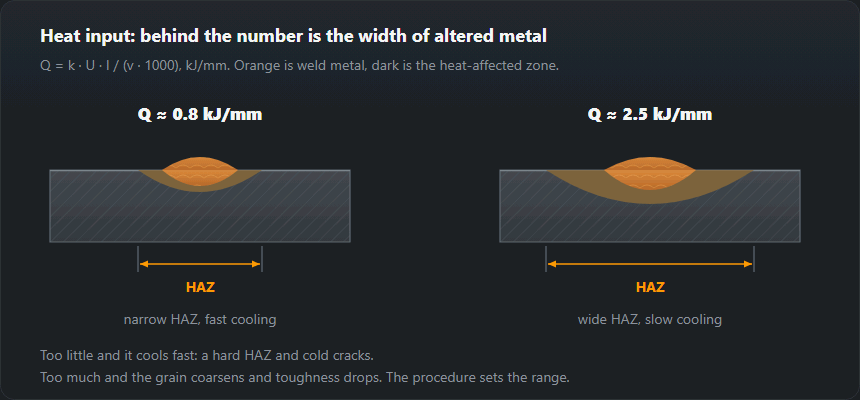
Four inputs, and all four matter. CET — the carbon equivalent from the mill certificate, worked out by the carbon equivalent calculator. Plate thickness — the thickness of the plate being welded, not the sum: in method B the formula itself accounts for heat flow, and adding up the thicknesses meeting at the joint belongs to method A with the CE carbon equivalent. With plates of different thickness, calculate for the thicker one — the answer comes out higher, on the safe side. Hydrogen — from the consumable data sheet: a re-baked basic electrode gives about 5 ml/100 g, an ordinary rutile one about 15. Heat input — higher energy means slower cooling and less preheat.
Why it works
Cold cracking needs three things at once: a susceptible hard structure, dissolved hydrogen, and tensile stress. Preheat attacks the first two. It slows the cooling through the 800–500 °C range, so the heat-affected zone comes out softer, and it keeps the joint warm long enough for hydrogen to diffuse out instead of collecting at the fusion line.
Note the range the formula is valid in: CET 0.20–0.50 %, thickness 10–90 mm, hydrogen 1–20 ml/100 g, heat input 0.5–4.0 kJ/mm. Outside it the calculator warns you, and the answer needs a metallurgist rather than a formula.
The HD hydrogen scale
| Designation | HD, ml/100 g | Typical consumable |
|---|---|---|
| E — very low | < 3 | Basic electrodes after baking, vacuum pack |
| D — low | 3–5 | Basic electrodes, solid wire in a gas mixture |
| C — medium | 5–10 | Flux-cored wire, basic electrodes after storage |
| B — high | 10–15 | Rutile electrodes |
| A — very high | > 15 | Damp electrodes, cellulosic |
The scale comes from EN 1011-2. The HD value is on the consumable certificate; without one, reckon a step worse.
Preheat temperature for S235, S355 and S460 by thickness — table
Results of the same formula for typical grades from the calculator's list, at two hydrogen levels: HD 12 (rutile electrodes) and HD 4 (re-baked basic electrodes, solid wire).
| d, mm | S235JR CET 0.25 · HD 12, °C | S355J2 CET 0.34 · HD 4, °C | S355J2 CET 0.34 · HD 12, °C | S460N CET 0.42 · HD 4, °C | S460N CET 0.42 · HD 12, °C |
|---|---|---|---|---|---|
| 10 | — | 35 | 85 | 100 | 145 |
| 15 | 35 | 55 | 105 | 120 | 165 |
| 20 | 50 | 75 | 120 | 135 | 185 |
| 30 | 80 | 100 | 150 | 165 | 210 |
| 40 | 100 | 120 | 170 | 185 | 230 |
| 60 | 120 | 140 | 190 | 205 | 250 |
| 80 | 125 | 150 | 195 | 210 | 255 |
Heat input 1.5 kJ/mm (the calculator default), result rounded up to 5 °C as in the calculator. "—" means the formula calls for no preheat. Grade CET values are the calculator's starting points; for a document use the CET from the heat certificate.
How to read the table
Find the row for your thickness and the column for your grade with the right hydrogen. S235 at HD 12 needs preheat only from a dozen or so millimetres, and at HD 4 the formula asks for it only from about 27 mm. S355 with a rutile electrode at 20 mm is already 120 °C, with a low-hydrogen consumable 75 °C. Between the HD 4 and HD 12 columns of the same steel there are always about 47 °C — that is what a damp electrode costs.
Worked examples, step by step
Example 1: S355J2, 20 mm, rutile electrode (HD 12), 1.5 kJ/mm
These are the calculator defaults. The terms of the formula:
697 · 0.34 = 237.0; 160 · tanh(20/35) = 82.6;
62 · 120.35 = 147.9;
(53 · 0.34 − 32) · 1.5 = −21.0; minus 328. Sum: 118.6 °C, which
the calculator rounds up to 120 °C. Interpass temperature: 120 to
250 °C.
Example 2: the same plate with a low-hydrogen consumable (HD 4)
Only the hydrogen term changes: 62 · 40.35 = 100.7
instead of 147.9. Result: 71.4 °C, so 75 °C. A re-baked basic
electrode or solid wire saves 45 °C of preheat along the whole weld here —
and torch time over the whole shift.
Example 3: S460N, 40 mm, HD 4, 1.2 kJ/mm
CET 0.42: 292.7 + 130.5 + 100.7 − 11.7 − 328 ≈ 184.2, so
185 °C. With a rutile electrode (HD 12) it would come to 235 °C —
close to the upper interpass limit, so the window between minimum and maximum
gets narrow. In cases like this a low-hydrogen consumable is practically the
only sensible choice.
What weighs most in the formula
- CET. Every 0.01 of CET is about +7.8 °C at 1.5 kJ/mm. A 0.03 gap between the certificate and the "typical" value of the grade is already more than 20 °C.
- Thickness d. The term
160 · tanh(d/35)rises quickly up to about 40 mm and then levels off: 10 mm gives 44.5, 20 mm 82.6, 30 mm 111.2, 60 mm 149.9, 90 mm 158.1. A 60 mm plate does not need twice as much as 30 mm. - Hydrogen HD. From HD 2 (79.0) to HD 18 (170.5) the term grows by over 90 °C — the largest single lever the shop itself controls.
- Heat input Q. The factor
53·CET − 32is negative for the grades on the list: at CET 0.34 each extra kJ/mm lowers the preheat by about 14 °C. Slower cooling helps, but less than a dry consumable. Heat input is worked out by the heat input calculator.
CET from the mill certificate: a worked example
The 3.1 inspection certificate gives the chemical composition. For example:
C 0.16, Mn 1.40, Mo 0.02, Cr 0.05, Cu 0.10, Ni 0.05.
Then CET = 0.16 + (1.40 + 0.02)/10 + (0.05 + 0.10)/20 + 0.05/40 ≈ 0.311.
That CET in the calculator ("Enter CET manually") gives about 100 °C at
20 mm, HD 12 and 1.5 kJ/mm, instead of 120 °C from the typical
0.34. All carbon equivalents at once come from the
carbon equivalent calculator.
Preheating in practice: the order of work
- Work out the temperature for the thickest part of the joint and the consumable you will actually use.
- Heat wide and evenly, on both sides of the joint, until the heat has soaked through — not just the surface under the torch.
- Measure the metal with a temperature crayon or contact thermometer just before striking the arc.
- Keep the interpass window: not below the calculated minimum, not above the maximum in the WPS (the calculator gives 250 °C for ordinary structural steels).
- Do not leave a thick weld half done. If you must, bring it back to preheat temperature before carrying on.
Typical mistakes in preheat calculations
- CE (IIW) entered as CET. CE is usually higher, so the result comes out too high; the EN 1011-2 formula needs CET.
- Heat input in kJ/cm instead of kJ/mm. Typing 15 instead of 1.5 gives "not needed" — the calculator then warns that the heat input is outside the formula's range.
- Hydrogen from the box, not from practice. A basic electrode left out in the shop for a day no longer has HD 4.
- Heating only the surface. The thermometer reads 120 °C on top while the root zone stays cold.
- The result instead of the WPS. The calculation explains the number in the procedure; it does not replace a qualified procedure. How fast the weld cools after preheating is shown by the t8/5 cooling time calculator.
Frequently asked questions
Can I skip preheat if the plate is thin?
Often yes, and the calculation says so — plate thickness is one of its four inputs. But thin plate with a high carbon equivalent and damp electrodes still cracks. Preheat is decided by the combination, never by thickness alone.
How do I hold the interpass temperature?
Measure it with a contact thermometer or a temperature crayon 25 mm from the joint, immediately before striking the next run. If it has dropped below the preheat figure, warm it up again: the requirement applies to every run, not only to the first one.
Does 20 mm S355 need preheat?
By the EN 1011-2 formula at CET 0.34 and 1.5 kJ/mm, yes: 120 °C with a rutile electrode (HD 12) and 75 °C with a low-hydrogen consumable (HD 4). With the CET worked out from the certificate the result can come out noticeably lower or higher.
From what thickness does S235 need preheat?
At CET 0.25 and 1.5 kJ/mm the formula asks for preheat from about 13 mm at HD 12 (15 mm — 35 °C, 20 mm — 50 °C), and only from about 27 mm at HD 4. Metal below +5 °C is warmed and damp joint faces are dried regardless.
Can higher heat input mean less preheat?
A little. At CET 0.34 each extra kJ/mm lowers the result by about 14 °C: at 20 mm and HD 12 the formula gives about 126 °C at 1.0 kJ/mm and about 112 °C at 2.0 kJ/mm. Switching from HD 12 to HD 4 does more than three times as much.
Updated: