Cost per metre of weld
What a metre of weld really costs once the filler, the gas, the electricity and the hours are all counted — the number you need before quoting, not after.

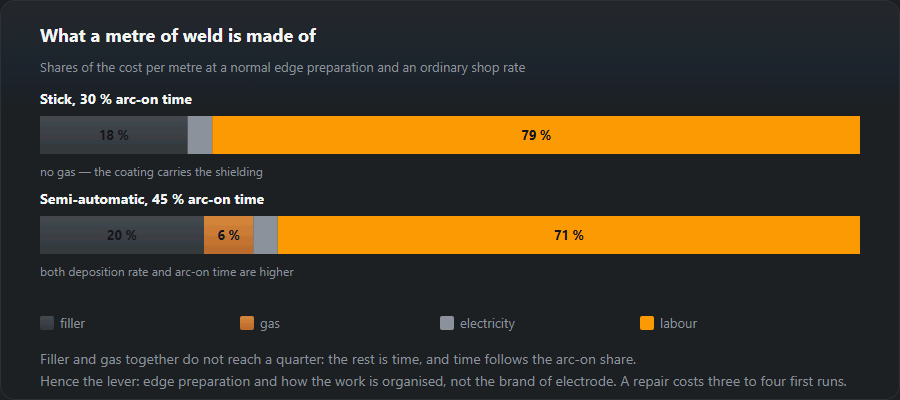
Where the money goes
The calculation starts from the groove cross-section, converts it to deposited metal, then adds losses to get the filler actually consumed. Gas follows from the arc time. Electricity follows from current, voltage and the efficiency of the source. Labour follows from arc time divided by the share of the shift spent under the arc.
That last input is the one that decides the answer. Stick welding runs at 25–35 % arc-on time, semi-automatic at 40–55 %. Everything else is fitting, tacking, changing electrodes, chipping slag and moving. Quotes that assume a welder welds all day are the usual reason a job loses money.
| Process | Deposition efficiency | Output, kg/h | Gas, l/min |
|---|---|---|---|
| MMA, rutile (111) | 0.65 | 1.3 | — |
| MAG, solid wire (135) | 0.93 | 3.2 | 13 |
| FCAW, flux-cored wire (136) | 0.85 | 4.2 | 15 |
| TIG (141) | 0.95 | 0.6 | 8 |
Output is per hour of burning arc. Fitting, cleaning and measuring come in through the share of time under the arc, which the calculator applies separately.
What actually makes it cheaper
Not the price of the filler — it is rarely more than a fifth of the total. Labour dominates, so anything that reduces arc time or rework wins: a smaller groove angle, correct fit-up, a process with a higher deposition rate, and welds that pass first time. Over-welding is the quiet killer: a fillet made 8 mm where the drawing asks for 6 costs 78 % more filler and just as much extra time, and it is not stronger.
Worked example: 10 m of V weld in 10 mm plate, MAG — where 41 per metre comes from
With its default values the calculator works out exactly this case: 60° V joint, 2 mm gap and root face, 10 m of weld, MAG, wire at 14 PLN/kg, gas at 18 PLN/m³, power at 0.9 PLN/kWh, labour at 90 PLN/h, 45 % arc-on time. The fields are labelled in złoty, but the arithmetic works in any currency as long as every price is entered in it. Step by step:
- Cross-section with reinforcement: 62.6 mm².
- Weld metal:
62.6 · 10 · 0.00785 ≈ 4.92 kg. - Wire:
4.92 / 0.93 ≈ 5.29 kg→ 74.03 PLN. - Arc time:
4.92 / 3.2 ≈ 1.54 h; over that time 13 l/min uses 1.20 m³ of gas (21.58 PLN) and about 9.4 kWh of power (8.46 PLN). - Paid time:
1.54 / 0.45 ≈ 3.42 h→ 307.35 PLN of labour. - Total 411.42 PLN, or 41.14 PLN per metre.
Labour is 75 % of the cost here, wire and gas together 23 %, power 2 %. The chart above shows the same split: anyone looking for savings in the price of wire is looking in the smallest drawer.
What changes the cost per metre the most
The same weld, with one calculator field changed in each row:
| Variant | Cost per metre, PLN/m | Change | Labour |
|---|---|---|---|
| Base: V 10 mm, MAG, default values | 41.14 | — | 75 % |
| Arc-on share 30 % instead of 45 % | 56.51 | +37 % | 82 % |
| Arc-on share 60 % instead of 45 % | 33.46 | −19 % | 69 % |
| Rate 120 instead of 90 PLN/h | 51.39 | +25 % | 80 % |
| Wire 20 instead of 14 PLN/kg | 44.31 | +8 % | 69 % |
| Bevel angle 50° instead of 60° | 36.01 | −12 % | 75 % |
| Gap 3 mm instead of 2 mm | 48.37 | +18 % | 75 % |
| Flux-cored wire (136) instead of MAG | 34.18 | −17 % | 69 % |
| Stick electrode (111), arc-on 30 % | 125.33 | +205 % | 91 % |
| TIG (141) | 179.71 | +337 % | 91 % |
Each row changes one calculator field from the defaults: wire 14 PLN/kg, gas 18 PLN/m³, power 0.9 PLN/kWh, rate 90 PLN/h, arc-on share 45 %. These are sample prices, not a market price list.
How to read it
The biggest lever is the arc-on share: a drop from 45 to 30 % raises the cost per metre by 37 %, a rise to 60 % cuts it by 19 %. It depends on organisation — fixtures, access to the joint, whether the welder grinds and carries parts on top of welding. The labour rate acts in proportion to the labour share, the wire price only weakly: +43 % on wire gives +8 % on the metre. Geometry matters more than it looks: one millimetre more gap is +18 %, because the cross-section grows and every other item grows with it. Flux-cored wire comes out cheaper than MAG thanks to its higher deposition rate (4.2 against 3.2 kg/h), although the calculator prices it per kilogram the same — if your flux-cored wire costs more, enter its price.
Cost per metre of fillet weld by throat size
For fillet welds the calculator takes the leg z. At the same prices a metre of a4 (z = 5.7 mm) costs about 11.56 PLN, and a metre of a6 (z = 8.5 mm) about 26.04 PLN. The throat grows by half, the cost more than doubles, because the cross-section goes with the square. Reading "a6" where the drawing meant z6 therefore adds about 13 PLN to every metre (z6 costs 13.00 PLN). The a-to-z conversion is in the fillet weld calculator.
Pricing a structure from the cost per metre — step by step
- Weld lengths from the drawing, split by joint type — easiest in the weld map.
- Cost per metre for each type with the calculator, using your prices and your arc-on share. If you do not know it, measure one day: arc hours from the machine counter divided by shift hours.
- Multiply and add up. Double-sided welds count as two.
- Work outside welding as separate items: cutting, bevelling, fitting, straightening, cleaning, testing. None of it is in the cost per metre.
- Check the material quantity — weld metal mass and number of spools come from the deposited metal calculator.
Typical mistakes in welding cost estimates
- Pricing by arc time. At a 30 % arc-on share the paid time is more than three times the arc time.
- Material without losses. Weld metal mass is not the mass of wire or electrodes bought — divide by the deposition efficiency.
- One arc-on share for shop and site. On site it is usually lower; price site work separately.
- The other side forgotten. A double-sided weld and an X joint are the full cross-section, not half.
- Nominal geometry. The real gap and angle on the shop floor move the cost by well over ten per cent (table above).
Frequently asked questions
Why is labour the largest item?
Because filler and gas together rarely pass a quarter of the cost. The rest is time, and time depends on arc-on time: 25 to 35 % with stick, 40 to 55 % semi-automatic. Anyone trying to get cheaper does not start with the brand of electrode.
What exactly is arc-on time?
The share of the paid hour in which the arc is actually burning. Changing electrodes, chipping slag, repositioning and measuring do not count towards it but are all paid for. That is why the figure sits so prominently in the calculator.
Is it worth moving from stick to MAG?
Run both. On short welds with a lot of repositioning, stick wins on setup time; from a few metres of continuous weld onwards MAG wins clearly, because deposition rate and arc-on time both rise.
How much does a metre of MAG weld in 10 mm plate cost?
With the calculator defaults (60° V joint, wire 14 PLN/kg, gas 18 PLN/m³, labour 90 PLN/h, 45 % arc-on time) about 41 PLN per metre, 75 % of it labour. Enter your own prices and rate in any currency — the result moves mainly with the arc-on share and the labour rate.
What cuts welding cost more: cheaper wire or better organisation?
Organisation. Raising the arc-on share from 45 to 60 % cuts the cost per metre by 19 %, while wire dearer by 6 PLN/kg raises it by only 8 %. The wire price moves the smallest item in the quote.
Is MAG cheaper than stick welding?
Per metre of weld, clearly. For the same 10 mm V joint the calculator gives about 41 PLN/m for MAG at 45 % arc-on and about 125 PLN/m for stick at 30 %. The gap comes from deposition rate (3.2 against 1.3 kg/h) and arc-on share, not from the price of the consumable.
Updated: