Fillet weld: throat a and leg z
The drawing says a5, the gauge in your hand measures z. This converts between the two, and shows what the difference costs in filler metal.
Short answer
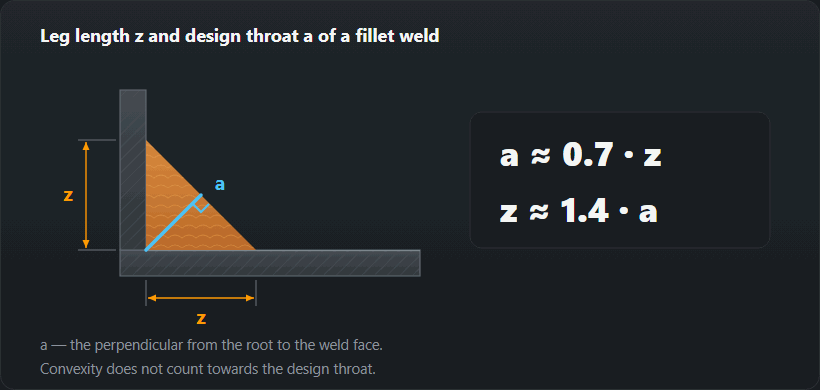
a = 0.7·z and z = 1.41·a: the design throat of a fillet weld is the leg divided by the square root of two. An a4 weld has a 5.7 mm leg; a z5 weld has a 3.5 mm throat.
The conversion
For a fillet with equal legs, a = z / √2 ≈ 0.7·z and
z = a · √2 ≈ 1.41·a. So a5 and z7 are the same weld, and the two
notations get confused constantly — usually in the expensive direction, because
somebody reads a5 as a leg of 5 mm and welds a throat about 30 % too thin.
The cost runs with the square. Going from a4 to a5 is a 56 % increase in cross-section, filler and arc time. That is why over-welding is worth catching: it is not free, and it is not stronger than the drawing asked for.

Sensible limits
Below about 3 mm a fillet does not fuse reliably and cracks as it cools. Above about 0.7 of the thinner part it is pointless — the parent metal will fail first. Between those bounds the size comes from the design, and the calculator's load figure is a sanity check on the order of magnitude, not a substitute for the structural calculation.
Design strength of the weld
| Steel | fu, N/mm² | βw | fvw,d, N/mm² |
|---|---|---|---|
| S235 | 360 | 0.80 | 208 |
| S275 | 430 | 0.85 | 234 |
| S355 | 490 | 0.90 | 251 |
| S420 | 520 | 1.00 | 240 |
| S460 | 540 | 1.00 | 249 |
The values are worked out with the EN 1993-1-8 formula at γM2 = 1.25 rather than copied, so the table and the calculator cannot drift apart.
Fillet weld size chart: leg, deposit and capacity from a3 to a12
The values you need most often, in one place. The columns use the same formulas as the calculator above and the deposited metal calculator, so the chart cannot disagree with what you get when you type in your own numbers.
| a, mm | z, mm | Weld metal area, mm² | Deposit, kg/m | MAG passes | Capacity S235, kN per 100 mm | Capacity S355, kN per 100 mm |
|---|---|---|---|---|---|---|
| a3 | 4.2 | 9.9 | 0.078 | 1 | 62.4 | 75.4 |
| a4 | 5.7 | 17.6 | 0.138 | 1 | 83.1 | 100.6 |
| a5 | 7.1 | 27.5 | 0.216 | 1 | 103.9 | 125.7 |
| a6 | 8.5 | 39.6 | 0.311 | 2 | 124.7 | 150.9 |
| a7 | 9.9 | 53.9 | 0.423 | 2 | 145.5 | 176.0 |
| a8 | 11.3 | 70.4 | 0.553 | 3 | 166.3 | 201.2 |
| a10 | 14.1 | 110.0 | 0.864 | 4 | 207.8 | 251.5 |
| a12 | 17.0 | 158.4 | 1.243 | 5 | 249.4 | 301.8 |
Area includes +10 % reinforcement, steel density 7.85 g/cm³, one MAG pass about 35 mm² — the same assumptions as the deposited-metal calculator. Capacity: EN 1993-1-8 simplified method, γM2 = 1.25, load along the weld.
How to read the chart
Left to right: throat from the drawing (a) → leg to set on the gauge (z) → how much metal goes into each metre → whether it fits in one pass → what the weld carries per 100 mm of length. Capacity grows linearly with a, deposit mass with its square. Hence a simple costing rule: an a8 fillet is only twice as strong as an a4, but it eats four times the wire (0.553 against 0.138 kg/m). The capacity columns are for one fillet; a double fillet is two welds, so the value doubles.
Worked examples of a = 0.7·z
Example 1: drawing says "a5", S355, 150 mm weld
Leg: z = 5 · 1.414 = 7.07 — in the shop you set the gauge to
7 mm and make sure it does not come out smaller. The design strength of
S355 is 251 N/mm², so the weld carries 251 · 5 ≈ 1257 N
per millimetre of length, about 189 kN over the full 150 mm. The
calculator gives exactly this for a = 5, S355 and 150 mm.
Example 2: a6 required, 6 mm leg welded
The most common mistake in practice. A 6 mm leg gives
a = 6 · 0.707 = 4.24 mm instead of 6. Capacity drops to 71 %
of what was asked for, and the deposit cross-section to half (0.155 against
0.311 kg/m). Grinding will not fix it: it needs a second pass up to an
8.5 mm leg. At inspection it shows at once — the a6 gauge does not reach
the weld face.
Example 3: 8 mm S235 plate — what range of a makes sense
Upper limit 0.7 · 8 = 5.6 mm, lower limit 3 mm. The
calculator prints this as "Sensible range for a: 3…5.6 mm". You pick, say,
a4 (5.7 mm leg): with S235 that is 208 · 4 ≈ 831 N/mm. If
the designer needs more, the weld is not blown up past 5.6 mm — it is made
longer or welded on both sides.
Example 4: how much wire for 10 m of a4 fillet
Area with reinforcement: 5.66² / 2 · 1.10 ≈ 17.6 mm², mass
17.6 · 0.00785 ≈ 0.138 kg/m, so 1.38 kg of weld metal over
10 m. For MAG the site uses a deposition efficiency of 0.93, so about
1.49 kg of wire comes off the spool. The same weld on both sides — twice
that. What such a metre costs with gas, power and labour is worked out by the
weld cost calculator.
How to choose the throat for a given plate thickness
- Take the thinner of the parts being joined. That is what limits the weld: a 10 mm flange on a 20 mm plate — work with 10.
- Upper limit: a ≤ 0.7·t. Above it the parent metal fails first; the calculator warns about this on a line of its own.
- Lower limit: a ≥ 3 mm. EN 1993-1-8 (clause 4.5.2) does not allow a load-bearing fillet with a throat under 3 mm.
- Length: a fillet shorter than 30 mm or 6·a, whichever is larger, is not treated as load-bearing under EN 1993-1-8. For a5 that is 30 mm, for a8 48 mm.
- Angle between the parts of 60° to 120° — within this range the standard treats the joint as a fillet weld; outside it the joint is designed differently.
- Check the capacity with the calculator and compare it with
the force from the designer. The simplified figure assumes load along the
weld; for combined stresses the designer uses the directional method:
√(σ⊥² + 3·(τ⊥² + τ∥²)) ≤ fu / (βw·γM2)andσ⊥ ≤ 0.9·fu / γM2.
Very long welds in lap joints are reduced further by the factor βLw — this applies to welds longer than about 150·a, which for a5 means over 750 mm. That is a job for the designer's calculation.
Concave, convex and unequal leg fillets

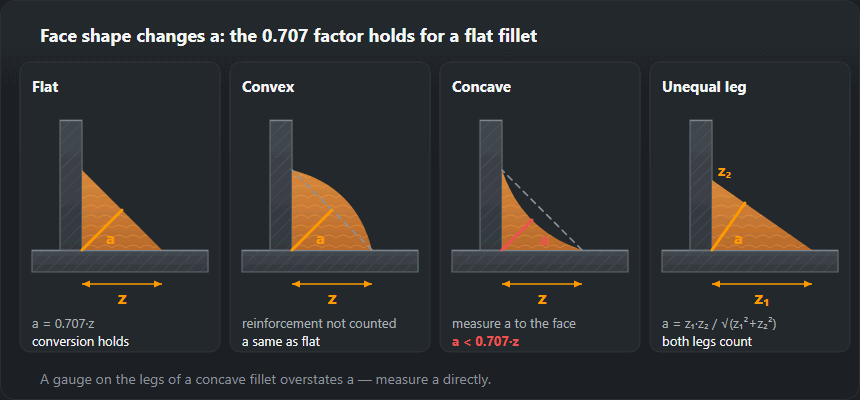
Convex. Anything beyond the straight line between the leg toes does not count towards a. A z6 fillet with a visible crown still has a = 4.24 — it is just heavier and has a sharper transition into the parent metal, which is worse for fatigue.
Concave. Here a is measured from the root to the deepest point of the face, not from the legs. With 8 mm legs a flat fillet would have a = 5.66; if the face dips by 1 mm, about 4.7 mm is left. A gauge set on the legs will read "a5.7" — and mislead you.
Unequal leg. For legs z₁ and z₂ the throat is the height of
the right triangle: a = z₁·z₂ / √(z₁² + z₂²). Legs of 6 and
8 mm give 48 / 10 = 4.8 mm — more than a 6×6 fillet
(4.24), but less than 8×8 (5.66). Both legs count, not the longer one.
Deep penetration: when you may count more than the face throat
Spray-transfer MAG and submerged arc penetrate the root beyond the apex of the triangle. EN 1993-1-8 lets you add this penetration to the design throat only when procedure tests have shown it is achieved consistently. Without that evidence (in practice a WPQR with a macro section) a is taken from the face geometry, and the penetration is a reserve. On the drawing a deep penetration fillet is marked separately, so the welder does not shrink the leg by eye.
Multi-pass fillet: from what size and how many passes
The "MAG passes" column assumes a typical single MAG pass of about 35 mm². It shows that up to and including a5 the fillet fits in one pass, a6 needs two, a8 three and a10 four. With stick electrodes (about 25 mm² per pass) two passes are needed already at a5, and five at a10. Build from the bottom: the first pass into the root, the next ones overlapping the previous, the last one evening out the face so that the legs come out equal. Your own cross-section and process go into the deposited metal and passes calculator.
Common mistakes on the drawing and in the shop
- A number with no letter. "5" next to the triangle symbol can be a5 or z5 — a capacity difference of over 40 %. Ask before you weld. On AWS drawings a bare number is the leg.
- a read as z. The weld comes out 29 % too thin, with half the cross-section (example 2).
- z read as a. The other way round: twice the deposit, more distortion, and only as much extra strength as the parent metal allows.
- Double fillet missed. Triangles on both sides of the reference line are two welds — mass and time double. How this looks on a drawing is shown on the page about reading weld symbols.
- a larger than 0.7·t. Usually "to be safe" — it does not strengthen the joint, it only distorts it.
- Segments too short. An intermittent fillet with segments under 30 mm or 6·a does not count as load-bearing.
Measuring with a fillet gauge: what you are really measuring
A fillet weld gauge usually has two scales: leg (set against the plate) and throat (set against the face at 45°). On flat and convex fillets measuring the legs is enough — the smaller leg times 0.707 gives a. On a concave fillet the throat has to be measured directly, because the legs overstate it. Measure in several places, including the ends, where the weld is often thinnest. Allowed throat shortfall and excess convexity for quality levels B, C and D are in the ISO 5817 calculator, and the reading goes into the VT report generator. How to run the bead so the legs come out equal is covered in the PB fillet weld guide.
Frequently asked questions
Does the drawing give a or z?
In Europe almost always a, the design throat. American drawings give the leg, which is z. A bare number with no letter is a gap in the documentation: a5 and z5 differ by more than 40 %.
Why is a weld thicker than the plate pointless?
Because past that point it is no longer the weld that fails but the parent metal beside it. Above roughly 0.7 of the plate thickness every further millimetre buys filler, time and distortion — and no capacity.
Does the convexity count towards the throat?
No. The design throat is the perpendicular from the root to the theoretical face, and anything standing proud of it is ignored. A heavily convex weld is therefore not stronger, only heavier.
What does a5 weld size mean, and how much does a metre weigh?
a5 is a fillet with a 5 mm design throat, which means a 7.07 mm leg. It holds about 0.216 kg of weld metal per metre (27.5 mm² with reinforcement, steel at 7.85); with MAG at 0.93 efficiency about 0.232 kg/m of wire. A double fillet takes twice that. An a4 has a 5.66 mm leg and 0.138 kg/m.
Is an a2 fillet allowed?
Not as a load-bearing weld: EN 1993-1-8 requires a throat of at least 3 mm, and the calculator warns at a < 3. An a2 (2.8 mm leg) turns up on thin sheet in parts that are not designed for load, such as covers, where the weld only has to close the joint.
How do I measure the throat of a concave fillet?
Directly, with the throat scale of the gauge on the deepest point of the face. Measuring the legs overstates a: with 8 mm legs and a face dipping 1 mm the real throat is about 4.7 mm, not 5.66.
What is the minimum length of a load-bearing fillet?
Under EN 1993-1-8, 30 mm or six times the throat, whichever is larger. For a4 and a5 that is 30 mm, for a6 36 mm, for a8 48 mm. Shorter segments are not counted as carrying load.
Updated: