Shielding gas selection
Which mixture suits the material, the process and the thickness — with the EN ISO 14175 designation, so you can order it by name rather than by nickname.

Carbon steel
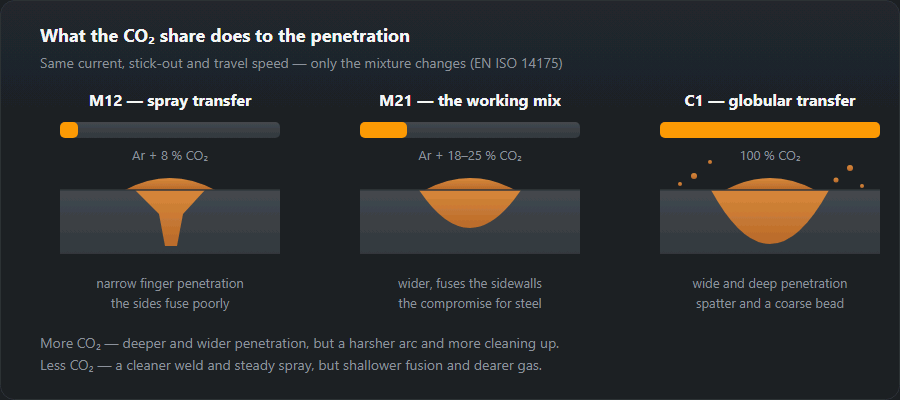
Argon with 8–25 % CO₂ covers nearly everything. More CO₂ means a hotter, deeper-penetrating arc and more spatter; less means a cleaner bead face and a steadier arc, and it is what spray transfer needs — above about 20 % CO₂ spray transfer stops working at all. Pure CO₂ is cheap and penetrates well, but it only gives globular transfer and it spatters.
Stainless and aluminium
Austenitic stainless takes argon with a small active addition — 2 % CO₂ or 2 % oxygen — kept small on purpose: carbon picked up from CO₂ reduces corrosion resistance. Aluminium takes pure argon, or argon with helium once the section is thick enough that argon alone will not carry the heat.
TIG
Inert gas without exception. Any active component destroys the tungsten within minutes. Argon-hydrogen mixtures are used on austenitic stainless to raise the heat and clean the surface, and on nothing else — hydrogen in ferritic or duplex steel causes exactly the cracking that preheat is meant to prevent.
Reading the gas designation
| Group | What it is | Examples |
|---|---|---|
| I | Inert | I1 — Ar, I2 — He, I3 — Ar + He |
| M1, M2, M3 | Mixtures with an oxidising addition, in rising order | M12, M13, M21 |
| C | Strongly oxidising | C1 — CO₂ |
| R | Reducing, with hydrogen | R1 — Ar + H₂ |
| N, O, Z | Nitrogen, oxygen, other compositions | — |

M21, M20, M12, I1 — what is in the cylinder
The label reads something like “ISO 14175 – M21 – ArC – 18”: the group, the components and the addition in per cent. The groups you meet most often in a shop:
- M21 — argon with more than 15 and up to 25 % CO₂. The classic 82/18 mix (Ar + 18 % CO₂) for carbon steel.
- M20 — argon with more than 5 and up to 15 % CO₂, e.g. Ar + 8 %: a softer arc, less spatter, good for thin sheet and spray transfer.
- M12 — argon with 0.5–5 % CO₂, in practice Ar + 2 % CO₂ for stainless; M13 — argon with 0.5–3 % oxygen.
- C1 — pure CO₂. I1 — pure argon, I3 — argon with helium. R1 — argon with hydrogen.
The group limits are set by EN ISO 14175, and gas suppliers describe their mixes the same way (Ar + 8 % CO₂ as M20, Ar + 18 % as M21, for example). Two cylinders of “mix” from different suppliers can therefore sit in different groups — read the code, not the trade name.
Which gas for what — the calculator’s settings at a glance
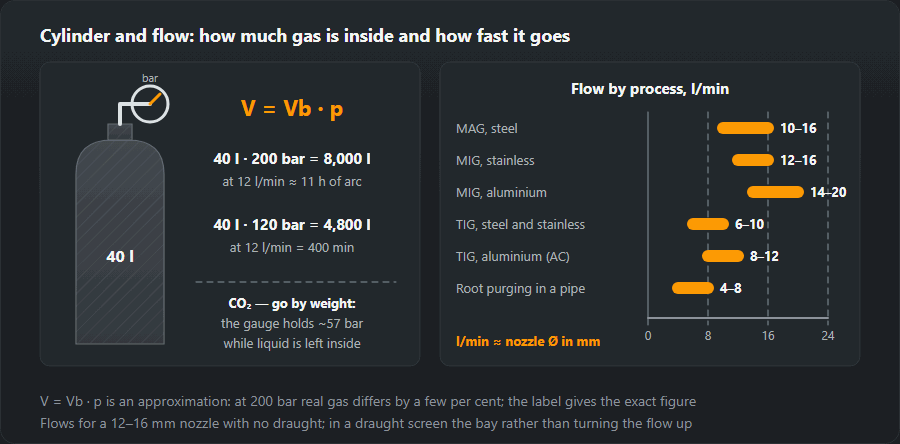
- Carbon steel, MAG, up to 3 mm: a lower-CO₂ mix (Ar + 8…18 %, M20 / M21), about 11 l/min.
- Carbon steel, MAG, over 3 mm: M21 (Ar + 18…25 % CO₂) or C1, about 14 l/min.
- Stainless, MIG/MAG: M12 or M13, 12 l/min up to 3 mm, 15 l/min above.
- Aluminium, MIG: pure argon I1 up to 6 mm (14 l/min), thicker — Ar + 30 % He, group I3 (18 l/min).
- TIG, any metal: argon I1 — 6 l/min up to 2 mm, 8 l/min up to 6 mm, 12 l/min above; R1 is acceptable on austenitic stainless.
Three examples from the shop
- A gate from 40×40×2 box section. 2 mm steel, lots of short visible welds. A lower-CO₂ mix (M20, e.g. Ar + 8 %) means less spatter and less grinding before painting; flow about 11 l/min.
- A frame from 10 mm plate. M21 with 18 % CO₂ as the standard; pure CO₂ gives deeper penetration and cheaper gas, but about 90 % of the melted wire ends up in the weld instead of 95 %. On 20 kg of wire that is 2 kg lost to spatter instead of 1 kg — plus the time to chip it off. Flow about 14 l/min.
- A 3 mm stainless handrail. With MIG — M12 (Ar + 2 % CO₂), 12 l/min; with TIG — pure argon I1, 8 l/min, and a root purge inside the tube.
CO₂ or a mix — cost against quality
Pure CO₂ is the cheapest gas but not the cheapest weld. In CO₂ the arc needs roughly 2–3 V more at the same current, it is harsher and spatters more, and the bead stands higher. It pays where the weld is heavy and hidden and penetration is what matters. On visible work, thin sheet and spray transfer the mix pays for itself in grinding time. Wire feed and voltage for both gases are worked out by the wire feed speed calculator.
Typical mistakes when choosing a gas
- M21 on stainless. Carbon from the CO₂ carburises the weld and strips its corrosion resistance — use M12 or M13 on stainless.
- A CO₂ mix on aluminium. The pool oxidises and the weld comes out black and porous. I1 or I3 only.
- A MAG mix in a TIG torch. Any active component burns the tungsten away in seconds.
- Hydrogen on carbon steel. R1 is for austenitic stainless only; on carbon steel it risks cold cracking.
- Purging with “whatever is to hand”. Root purging uses argon or an N₂ + H₂ mix (4–8 l/min), not a CO₂ welding mix.
More on the metals themselves: welding stainless steel and welding aluminium; argon for TIG is covered on the TIG welding page.
Frequently asked questions
What does the CO₂ content change?
Penetration and arc stability, in opposite directions. More CO₂ gives deeper, wider penetration and more spatter; less gives a cleaner bead face and a steadier spray arc. M21 with 18 % is the usual compromise for carbon steel.
Can I weld stainless with M21?
Better not. Carbon from the CO₂ enters the weld and lowers the corrosion resistance — the very property the material was bought for. For stainless the cylinder should hold no more than 2 to 3 % active component.
Why pure argon for TIG and for MIG on aluminium?
Because any active component burns the tungsten away in TIG, and on aluminium it thickens the oxide film instead of removing it. Aluminium also gets helium in the mix to carry heat into thick material — which is why it is argon-helium and never anything with CO₂.
What does M21 on a gas cylinder mean?
It is the gas group in EN ISO 14175: argon with more than 15 and up to 25 % CO₂. The most common version is 82 % argon and 18 % CO₂, written M21 – ArC – 18. It is used for MAG welding of carbon steel.
What is the difference between M20 and M21?
The CO₂ content: M20 has more than 5 and up to 15 % (e.g. Ar + 8 %), M21 more than 15 and up to 25 %. M20 gives a softer arc and less spatter, M21 deeper penetration.
Which gas and flow for MIG on aluminium?
Pure argon (I1), about 14 l/min up to 6 mm thick. On thicker aluminium switch to Ar + 30 % He (I3) at about 18 l/min, because the helium brings more heat.
Updated: