Tungsten electrode selection
Which tungsten, at what diameter, ground to what angle — and which gas cup and flow rate go with it.
Choosing the type
Lanthanated (blue or gold) and ceriated (grey) electrodes will do almost everything: they strike easily, run on both AC and DC and keep their point. Pure tungsten (green) is the traditional choice for AC aluminium, where it forms the balled end the process wants.
Thoriated electrodes — the red ones — are left out of the calculation on purpose. The thorium is mildly radioactive and the grinding dust is the problem, not the electrode itself. Lanthanated types replace them with no loss of arc performance, and there is no reason left to buy them.
| Designation | Tip colour | Oxide | Current | Where it is used |
|---|---|---|---|---|
| WP | green | W ≥ 99.95 % | AC | Aluminium, magnesium and their alloys |
| WT-20 | red | 2 % ThO₂ | DC | Steel, stainless, titanium, copper |
| WT-10 | yellow | 1 % ThO₂ | DC | Steel, low and medium current |
| WT-30 | purple | 3 % ThO₂ | DC | Steel, high current |
| WC-20 | grey | 2 % CeO₂ | AC / DC | General purpose, excellent at low current |
| WL-15 | gold | 1.5 % La₂O₃ | AC / DC | General purpose |
| WL-20 | blue | 2 % La₂O₃ | AC / DC | General purpose, the most common choice |
| WZ-8 | white | 0.8 % ZrO₂ | AC | Aluminium where weld contamination is unacceptable |
| WY-20 | dark blue | 2 % Y₂O₃ | DC | Critical joints, titanium, deep penetration |
The colour is a standard, not a brand: the code comes from ISO 6848 (EN 26848), so a red tip means 2 % thoria whoever made it.
Grinding
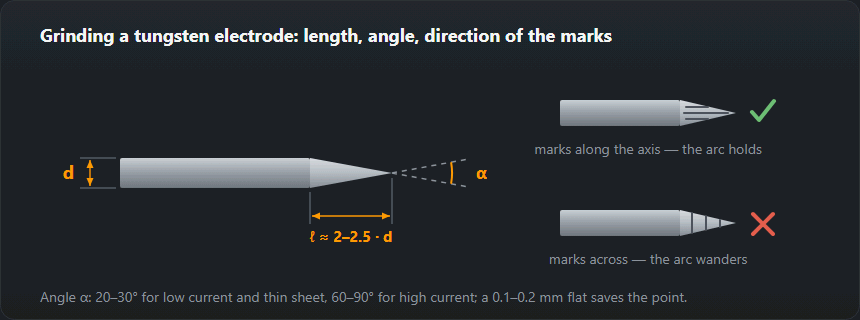
Grind lengthwise, never across: the grinding marks guide the arc, so circumferential marks make it wander. A sharp point, about 20–30°, concentrates the arc for thin material and low current; a blunter 45–60° point carries more current and lasts longer on thicker work. On AC the tip balls over by itself, so the angle matters less.

Diameter follows the current, with a margin on AC because the electrode runs hotter there. Too large a tungsten at low current gives an arc that wanders across the tip; too small at high current melts it into the pool, and then the weld gets ground out.
How the calculator picks the diameter
The calculator takes the thinnest electrode whose range covers the current you enter, using the same table as the tungsten colour codes page. On DC− that is 1.0 mm up to 80 A, 1.6 mm up to 150 A, 2.4 mm up to 250 A, 3.2 mm up to 400 A, 4.0 mm up to 500 A and 4.8 mm above. On AC (balanced wave) the electrode runs hotter, so the limits are lower: 1.0 mm up to 60 A, 1.6 mm up to 120 A, 2.4 mm up to 180 A, 3.2 mm up to 250 A, 4.0 mm up to 320 A. These are the usual ranges for oxide-doped electrodes (WL, WC, WT) in argon, as given in the tables of U.S. Alloy (Washington Alloy) and CK Worldwide. Near the top of a range the point burns back faster, and some makers quote narrower working ranges (ESAB: 2.4 mm up to 150 A), so for long runs close to the limit take the next size up.
The grind angle follows the current: below 80 A 20–30°, 80 to 200 A 30–60°, above that 60–90°; a ball on AC. Type: WL-15 or WC-20 on DC, WZ-8 on AC for aluminium, WL-15 on AC for other metals. Thoriated electrodes are never suggested.
Three worked examples
- 1 mm stainless, DC, 40 A. 1.0 mm electrode, 20–30° point, No. 4 cup, argon 5 l/min. A thicker electrode at that current would strike reluctantly and the arc would wander about the end.
- 3 mm steel, DC, 110 A. 1.6 mm, 30–60° taper, No. 5 cup, 6 l/min, WL-15 or WC-20. 110 A sits mid-range in 70–150 A; for long welds at 140–150 A a 2.4 mm runs more comfortably.
- 3 mm aluminium, AC, 130 A. On AC a 2.4 mm carries 100–180 A, so the calculator gives 2.4 mm, a ball instead of a point, a No. 6 cup and 8 l/min, type WZ-8. The same current on DC would fit a 1.6 mm — hence the rule that aluminium takes a thicker tungsten than steel.
What the cup number means
A ceramic TIG cup number is its bore in sixteenths of an inch: No. 4 ≈ 6.4 mm, No. 5 ≈ 8 mm, No. 6 ≈ 9.5 mm, No. 8 ≈ 12.7 mm, No. 10 ≈ 16 mm. The flow in l/min is numerically close to the cup number — hence the “No. 6 cup, 8 l/min” pairing in the result. Too small a cup at high current gives a narrow shield and overheats; too large a cup will not reach into a tight corner. In fillets and with a longer tungsten stick-out a gas lens helps: it evens out the stream and shields further from the cup.
How to tell the electrode is right
- DC: after the weld the tip is bright and the taper has the same shape as after grinding. A melted droplet on the end means too thin an electrode or too much current.
- AC: the ball is no bigger than the electrode diameter and does not grow with every weld.
- Colour: blue or black tungsten is a gas problem, not a diameter problem — flow, post-flow, draught.
- Arc: it stands on the axis and does not drift sideways. A wandering arc at low current is often an electrode that is too thick, or cross-wise grinding marks.
Current by plate thickness is in the table on the TIG welding page, and how much argon a job uses is worked out by the gas consumption calculator.
Frequently asked questions
Why are thoriated electrodes left out?
Because their grinding dust is slightly radioactive and it is breathed in at the bench. Lanthanated (blue, gold) and ceriated (grey) reach the same currents and last as long. There is no longer a technical reason to buy red ones.
Point or ball?
A point on DC, a ball on AC for aluminium — where it forms by itself if you strike briefly on a piece of copper. Pure tungsten (green) makes the cleanest ball; lanthanated will take AC with a slightly rounded point.
How far should the tungsten stick out?
Roughly the nozzle diameter divided by three, and more in a fillet. The further it protrudes, the worse the gas covers it — a grey, dull start to the bead is the first sign of that.
Which tungsten for aluminium at 130 A?
On AC every diameter carries less current than on DC−: 2.4 mm takes 100–180 A. So at 130 A the calculator gives 2.4 mm with a balled end, type WZ-8 (white) or WP (green), a No. 6 cup and about 8 l/min of argon.
What does a TIG cup number mean?
The bore in sixteenths of an inch: No. 6 is 6/16″ ≈ 9.5 mm, No. 8 is 12.7 mm. The argon flow in l/min is roughly equal to the cup number.
Updated: