Duty cycle and fuse size
How long the machine can weld before the thermal cut-out stops it, and what the supply behind it has to be able to deliver.

Reading the plate
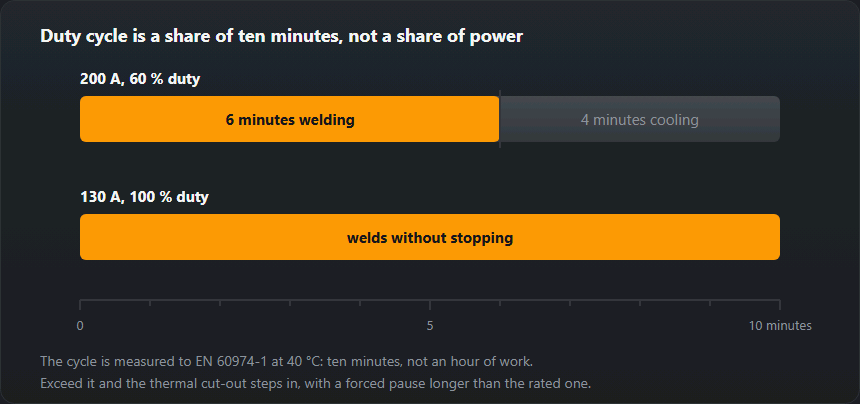
Duty cycle is quoted over a ten-minute cycle, as EN 60974-1 defines it. "160 A at 60 %" means six minutes of welding and four of cooling — with the fan running, which is why switching the machine off at the end of a run is exactly the wrong thing to do.
Duty cycle rises steeply as current falls: it goes with the square of the current ratio. The same machine that manages 60 % at 160 A will run continuously at about 125 A.
The supply side
The input current is not the welding current. It follows from the arc power divided by the mains voltage and the efficiency, which is why a 200 A inverter on a single phase can draw 30 A from the wall. Two practical consequences: use a type C breaker, because the inrush of an inverter trips a type B, and size a generator with a margin of about 30 %.
If the breaker trips anyway, the reasons are laid out in why your welder trips the breaker.
The breaker curve
| Curve | Trips at | Suits welding |
|---|---|---|
| B | 3–5 × rated current | No — it trips on the inrush surge |
| C | 5–10 × rated current | Yes — the usual choice for a workshop |
| D | 10–20 × rated current | For heavy machines — specified by the electrical design |
Worked examples from the calculator
A 200 A inverter, 35 % duty at 200 A, 230 V supply
- At the full 200 A: 35 % duty, so 3.5 min of welding and 6.5 min of rest. Mains current I1max about 30.2 A, effective I1eff about 17.8 A, a C20 breaker, a generator from about 9.0 kVA.
- At 140 A (a 3.2 mm rod at the top of its range): 0.35·(200/140)² ≈ 71 %, so about 7.1 min of work and 2.9 min of rest. I1max about 19.3 A, I1eff about 16.3 A, still a C20, and a generator from about 5.8 kVA.
The lesson: dropping 60 A turns the same machine from short bursts into near-continuous work, and the generator it needs shrinks by a third.
A 250 A three-phase MIG set, 40 % duty at 250 A
- At 250 A: 4 min on, 6 min off; per phase I1max about 13.4 A and I1eff about 8.5 A — the calculator suggests a C10; a generator from about 12.1 kVA.
- At 180 A: about 77 % duty, I1max about 8.8 A per phase.
These figures show why the bigger power sources are three-phase: at a higher welding current each phase carries less than a small welder draws from one. The calculator uses the MMA arc voltage, so for MIG/MAG the result has some headroom — more on that below.
How to read the rating plate
An EN 60974-1 rating plate usually has several columns. The key entries:
- X — duty cycle in percent (for example 35 %, 60 %, 100 %);
- I2 — welding current for each X column;
- U2 — conventional load voltage at that current;
- U0 — open-circuit voltage;
- U1, I1max, I1eff — the supply side;
- IP — enclosure protection, for example IP23S.
The most honest number is the current in the 100 % column: that is what the source gives without stopping. If the maker quotes only one column, the others follow from the same formula the calculator uses. Example: 200 A at 30 % is about 141 A at 60 % and about 110 A at 100 %. A figure printed on the plate always beats the calculation — each column is measured separately.
Comparing two welders by duty cycle
Adverts quote maximum current; what a machine does in continuous work is set by the duty cycle. Two machines:
- a “200 A” with 20 % at 200 A — at 100 % that is about 89 A;
- a “160 A” with 60 % at 160 A — at 100 % that is about 124 A.
For continuous work with 3.2 mm rods (90–140 A in our welding current table) the weaker-looking 160 wins. When comparing, check the test temperature too: EN 60974-1 requires 40 °C. A duty cycle quoted at 20 or 25 °C looks better but cannot be set against an honest plate.
MIG/MAG and TIG in this calculator
The calculator takes the MMA arc voltage, U2 = 20 + 0.04·I2. The same standard gives conventional voltages for the other processes: MIG/MAG U2 = 14 + 0.05·I2, TIG U2 = 10 + 0.04·I2. At 160 A that is 26.4 V, 22 V and 16.4 V. Mains current falls in proportion: where the calculator shows about 22.7 A for MMA, MAG will draw about 19 A and TIG about 14 A. For MIG and TIG the result is therefore a safe overestimate. The duty cycle itself is unchanged — it depends on current, not on process.
What happens when you exceed the duty cycle
The thermal lamp comes on and the machine stops delivering current, but the fan keeps running. Do not switch it off: without the fan it cools much more slowly. Wait until the lamp goes out and carry on at the same or a lower current. If the protection trips clearly earlier than the calculator predicts, look for a dust-clogged heatsink, blocked grilles or a hot workshop.
Common mistakes
- Confusing duty cycle with the length of one weld. It applies to every 10-minute period, not “six minutes and done for the day”.
- Judging duty cycle at maximum current when you work well below it — the machine then looks worse than it is.
- Sizing the breaker on I1max. The breaker goes by I1eff; the generator and cable section by I1max.
- Sizing a generator from welding current. The proper method is in the generator size calculator.
When buying, compare machines by the 100 % column and the input current — tips in the guide to choosing a welding machine.
Frequently asked questions
Why will a 16 A breaker not hold?
Because the mains current is not the welding current. 160 A of stick welding at 230 V draws about 23 A on the supply side by this calculator, and 200 A about 30 A. On top of that comes the inrush at switch-on, which a type B breaker reads as a fault.
What does 60 % duty cycle mean?
Six minutes of welding and four of cooling in every ten-minute cycle to EN 60974-1, at the stated current. At a lower current the welding time grows — which is exactly what this calculator works out.
Which generator is big enough?
Take the apparent power of the machine and add about 30 % for the inrush. A generator that fits on paper sags when the arc strikes, and repeated undervoltage damages an inverter more than overload does.
How do I work out the duty cycle at a different current?
With X₂ = X₁·(I₁/I₂)². A machine rated 35 % at 200 A gives 0.35·(200/140)² ≈ 71 % at 140 A, about 7 minutes of welding in every 10. A result above 100 % means it can run without stopping.
200 A at 20 % or 160 A at 60 % — which welder is stronger?
For continuous work, the second. Converted to 100 % duty the “200” gives about 89 A and the “160” about 124 A. The higher maximum only helps on short welds.
Why does my welder cut out after a few minutes?
The thermal protection has tripped — the duty cycle was exceeded or the machine is poorly cooled. Leave it switched on so the fan can cool it. If it happens sooner than the calculator suggests, clean the heatsink and grilles.
Updated: