Welding cable size calculator
Which cross-section a given current and cable length need — and how much arc voltage a long, thin run is quietly costing you.

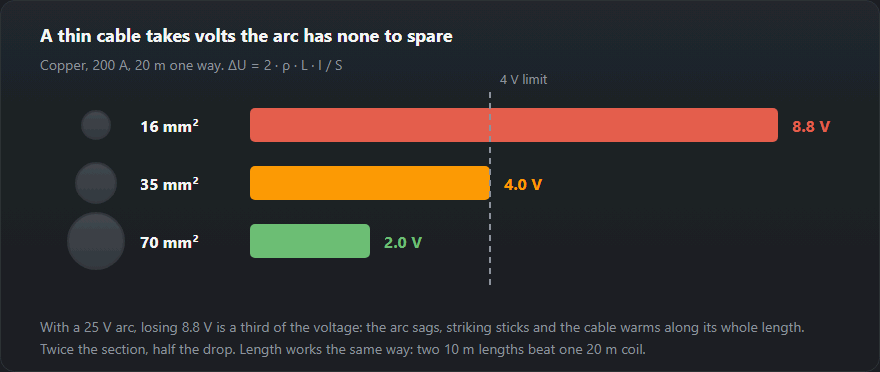
How it is worked out
The calculation uses the full circuit: both the welding lead and the return
lead, because the current goes down one and back along the other. Voltage drop
is ΔU = 2 · ρ · L · I / S, with ρ = 0.0175 Ω·mm²/m for copper.
The permitted drop is normally taken as 4 V.
Ready table: section by current and length
| Current, A | 10 m | 20 m | 30 m | 40 m | 50 m |
|---|---|---|---|---|---|
| 100 | 16 | 25 | 35 | 35 | 50 |
| 150 | 16 | 35 | 50 | 70 | 70 |
| 200 | 25 | 35 | 70 | 70 | 95 |
| 250 | 25 | 50 | 70 | 95 | 120 |
| 300 | 35 | 70 | 95 | 120 | 150 |
| 400 | 50 | 70 | 120 | 150 | 185 |
Copper, length of one conductor. Sizes chosen so the voltage drop stays within 4 V; on short runs a lower limit from continuous current rating applies.
The symptom to recognise
A machine that welded fine on the bench and feels soft at the far end of a long extension is almost never faulty. It is the cable: the drop happens in the copper instead of at the arc, and the arc gets what is left. The usual combination is a 200 A machine, 30 metres of 25 mm² cable and a puzzled welder.
Two things that cost as much as an undersized cable: a return clamp on painted or rusty steel, and joints made with tape rather than proper couplers. Both add resistance exactly where you cannot see it. If the cable warms up noticeably along its length, it is undersized — a correctly sized welding cable stays close to ambient.
Three worked examples
All use the same formula as the calculator: copper, a permitted drop of 4 V, and the one-way length (the electrode lead and the return lead are the same length).
Garage: 150 A, 10 m
S = 2·0.0175·10·150 / 4 = 13.1 mm², and the next standard size is 16 mm². The drop on it is about 3.3 V and the loss about 490 W — that is the heat both leads give off under a continuous arc. The table gives 16 mm² for this pair as well.
Site: 200 A, 30 m
S = 2·0.0175·30·200 / 4 = 52.5 mm², so 70 mm² with a drop of about 3.0 V. The classic site mistake is a 35 mm² lead “because it was there”: the drop climbs to about 6.0 V and about 1.2 kW disappears in the copper. With an MMA arc of about 28 V (the EN 60974-1 conventional voltage at 200 A) that is more than a fifth of the arc voltage.
Fabrication shop: 300 A, 40 m
S = 2·0.0175·40·300 / 4 = 105 mm², so 120 mm² with a drop of about 3.5 V. A lead like that is heavy and awkward to drag around, so in practice it is cheaper to move the power source closer to the job, or run mains power to it rather than welding cable. In aluminium the same case would need 185 mm² (ρ = 0.0282).
How to read the table, and why it sometimes disagrees with the calculator
Each row is a welding current, each column the length of one conductor. The cell shows the smallest section that keeps the drop within 4 V. On short runs a second limit takes over: a minimum section for heating. At 100 A and 10 m the formula gives 8.75 mm², the calculator rounds that to 10 mm², but the table shows 16 mm² because that is the floor for this current. The floors used in the table are 16 mm² for 100–150 A, 25 mm² for 200–250 A, 35 mm² for 300 A and 50 mm² for 400 A.
The practical rule: when the calculator and the table disagree, take the larger figure. The calculator looks after voltage; the table looks after temperature as well.
Voltage drop and heating are two different problems
Drop grows with length and affects the arc. Heating depends on current and duty cycle and affects the insulation. A long lead can stay cool and still eat the arc; a short thin one will not cost many volts but will overheat during long runs at high current. So a lead is sized for both conditions at once.
On MIG/MAG the number matters even more. Our wire feed speed calculator takes the MAG voltage in mixed gas as roughly 14 + 0.05·I, which is about 24 V at 200 A. The same 4 V of drop is here about a sixth of the arc voltage: the arc shortens, spatter goes up and the transfer changes. What helps is a return lead of the same section as the power lead, and a short interconnection to the wire feeder.
Couplers, lugs and the earth clamp — the hidden milliohms
The resistance of the cable itself is small: 10 m of 35 mm² copper is about 5 mΩ. A single corroded coupler or a badly crimped lug can add the same. Every 1 mΩ at 200 A is 0.2 V of drop and 40 W of heat in one spot — which is why a bad joint can be felt by hand after a few minutes of welding.
- Lugs crimped, not screwed onto bare strands. The lug size must match the cable section.
- Twist-lock connectors turned fully home. A loose one arcs and burns out the socket on the machine.
- Earth clamp on clean metal, close to the weld. Current that travels through half the structure takes a longer, higher-resistance path.
Common mistakes
- Counting only the electrode lead. The return carries the same current and loses just as much.
- A thinner earth lead, “it’s only the earth”. The return should never be smaller than the power lead.
- Joining lengths with twisted strands and tape. That is resistance and a fire risk; use proper couplers.
- Confusing the welding lead with the supply lead. Tripping breakers is a mains-side issue — see why your welder trips the breaker.
If you already own the cable and want to know what it costs you, run the problem backwards: the voltage drop calculator gives volts and watts for a known section. The signs of too much drop — a sticking rod and a soft arc — are covered in why the electrode sticks.
Frequently asked questions
Why does the cable count twice?
Because the current has to go and come back: out along the welding lead and back along the return. The voltage drop depends on the sum of both lengths, and that is what this calculator uses.
How do I notice that the cable is too thin?
The arc goes soft and the electrode sticks even though the set current is right — worst at the end of a long run. And the cable warms up: a lead that is noticeably warm after an hour was undersized.
Can I run two thin cables in parallel?
The cross-sections do add up, but it is a poor idea in practice: the joints are the weak point, and one loose clamp overloads the other branch. A cable of the right size costs less than the damage.
Does the ground (return) lead need the same size as the electrode lead?
Yes. Exactly the same current flows through it, so it loses the same volts per metre. A thinner return raises the drop of the whole circuit and warms up faster than the power lead. The calculator assumes both leads have the same length and section.
How long can a welding cable be?
There is no fixed limit — there is a permitted drop. At 200 A and a 4 V limit, 35 mm² is enough for about 20 m one way and 70 mm² for about 40 m. Further than that, go heavier or move the machine closer.
What size welding cable for 200 amps?
In copper, from the table on this page: 25 mm² for 10 m, 35 mm² for 20 m, 70 mm² for 30–40 m and 95 mm² for 50 m, each keeping the drop within 4 V. The length is one way; both leads are counted.
Updated: