Stainless steel sheet weight calculator
Stainless steel sheet in 1.4301 (304) weighs 7.90 kg/m² for every millimetre of thickness: 1 mm — 7.90 kg/m², 2 mm — 15.80, 3 mm — 23.70. A 1250×2500×2 sheet is 49.4 kg, 1500×3000×3 106.6 kg. Below: a table of 13 thicknesses in three sheet sizes and a calculator for any size.
Short answer
The weight of stainless sheet is thickness in mm × 7.90 kg/m² (1.4301/304) or × 8.00 (1.4404/316L). A 1000×2000×1 sheet weighs 15.8 kg, 1250×2500×1.5 37.0 kg, 1500×3000×2 71.1 kg. In 316L each figure is 1.3 % higher. The full table of thicknesses and sheet sizes is below.

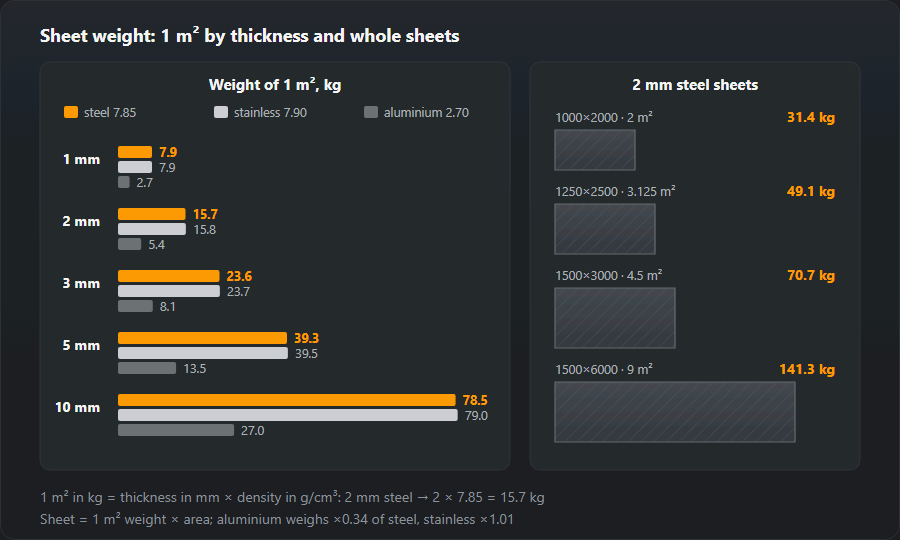
Stainless sheet weight by thickness: 1000×2000, 1250×2500, 1500×3000
Stainless sheet is stocked in three standard sizes. The table gives the mass per square metre in the two most common grades and the mass of a whole sheet.
| Thickness, mm | kg/m² — 1.4301 (304) | kg/m² — 1.4404 (316L) | Sheet 1000×2000, kg | Sheet 1250×2500, kg | Sheet 1500×3000, kg |
|---|---|---|---|---|---|
| 0.5 | 3.95 | 4.00 | 7.9 | 12.3 | 17.8 |
| 0.8 | 6.32 | 6.40 | 12.6 | 19.8 | 28.4 |
| 1 | 7.90 | 8.00 | 15.8 | 24.7 | 35.6 |
| 1.2 | 9.48 | 9.60 | 19.0 | 29.6 | 42.7 |
| 1.5 | 11.85 | 12.00 | 23.7 | 37.0 | 53.3 |
| 2 | 15.80 | 16.00 | 31.6 | 49.4 | 71.1 |
| 2.5 | 19.75 | 20.00 | 39.5 | 61.7 | 88.9 |
| 3 | 23.70 | 24.00 | 47.4 | 74.1 | 106.6 |
| 4 | 31.60 | 32.00 | 63.2 | 98.8 | 142.2 |
| 5 | 39.50 | 40.00 | 79.0 | 123.4 | 177.8 |
| 6 | 47.40 | 48.00 | 94.8 | 148.1 | 213.3 |
| 8 | 63.20 | 64.00 | 126.4 | 197.5 | 284.4 |
| 10 | 79.00 | 80.00 | 158.0 | 246.9 | 355.5 |
How to read it: a 1000×2000×1 sheet (15.8 kg) is a one-person lift, 1250×2500×3 (74.1 kg) needs two, and 1500×3000×5 (177.8 kg) comes off the rack with a crane or vacuum lifter. Thin sheet is cold rolled (2B finish), heavy plate hot rolled (1D); neither changes the mass.
Where the number comes from
One square metre of 1 mm sheet is 1 dm³ of metal. At 7.90 kg/dm³ that is 7.90 kg — hence the rule “thickness × 7.90”. Sheet mass = length (m) × width (m) × thickness (mm) × 7.90: for 1250×2500×2 that is 3.125 × 15.80 = 49.38 kg. Grade densities to EN 10088-1:
| EN grade | Designation | AISI / UNS | Structure | Density, g/cm³ | Difference from 1.4301 |
|---|---|---|---|---|---|
| 1.4301 | X5CrNi18-10 | 304 | austenitic | 7.90 | 0 |
| 1.4307 | X2CrNi18-9 | 304L | austenitic | 7.90 | 0 |
| 1.4541 | X6CrNiTi18-10 | 321 | austenitic | 7.90 | 0 |
| 1.4401 | X5CrNiMo17-12-2 | 316 | austenitic | 8.00 | +1.3 % |
| 1.4404 | X2CrNiMo17-12-2 | 316L | austenitic | 8.00 | +1.3 % |
| 1.4571 | X6CrNiMoTi17-12-2 | 316Ti | austenitic | 8.00 | +1.3 % |
| 1.4016 | X6Cr17 | 430 | ferritic | 7.70 | −2.5 % |
| 1.4462 | X2CrNiMoN22-5-3 | 2205 | duplex | 7.80 | −1.3 % |
Acid-resistant 1.4404 (316L) is 1.3 % heavier than 1.4301; ferritic 1.4016 (430), used for appliance panels and cheap cladding, is 2.5 % lighter. The calculator has one entry, “stainless steel — 7.90”; for 316L multiply the result by 1.013.
Finish, protective film and tread plate
Surface finish (2B, BA, brushed No. 4/240 grit, mirror) makes no measurable difference — grinding and polishing take off only a thin surface layer and leave the sheet thickness unchanged. Protective film does a little: around 0.1 kg/m², roughly 1 % on a 1 mm sheet — worth remembering when weighing sheets with the film on.
Actual thickness differs from nominal within the tolerances of EN ISO 9445 (cold-rolled sheet), which is why the stockist’s weight can be a few per cent off the calculator, especially on 0.5–1 mm sheet.
Stainless tread plate: the mass lies between the base thickness and the thickness over the pattern. The exact figure is on the mill’s data sheet, since the pattern differs between mills; for an estimate enter the base thickness and you get the lower bound.
How many sheets and how many kilograms to order
Example: an enclosure in 1.5 mm sheet, 5.2 m² of flat blanks in total.
- A 1000×2000 sheet is 2 m²: 5.2 / 2 = 2.6, so 3 sheets.
- You buy 3 × 23.7 = 71.1 kg — that is what you pay for at a price per kilogram.
- The finished product weighs 5.2 × 11.85 = 61.6 kg.
- The difference is offcut; larger pieces go into small parts, the rest is sold as stainless scrap, which yards pay more for than mild steel.
The same sheet in another material
A 1250×2500×2 sheet weighs 49.1 kg in mild steel (sheet metal weight calculator), 49.4 kg in stainless and 16.9 kg in aluminium (aluminium sheet). Stainless tube, bar and section are in the stainless steel weight calculator; cutting and welding thin 304 sheet is covered in welding stainless steel.
Frequently asked questions
How much does 1 m² of 1 mm stainless sheet weigh?
7.90 kg in 1.4301 (304) and 8.00 kg in 1.4404 (316L). A 1000×2000×1 sheet weighs 15.8 kg, 1250×2500×1 24.7 kg, 1500×3000×1 35.6 kg.
How much does a 1500×3000×3 stainless sheet weigh?
4.5 m² × 23.70 kg/m² = 106.6 kg in 304, 108.0 kg in 316L. In 2 mm the same size is 71.1 kg, in 4 mm 142.2 kg.
Is 316L sheet heavier than 304?
Yes, by 1.3 %: a density of 8.00 against 7.90 g/cm³ (EN 10088-1), because of the molybdenum and the extra nickel. On a 1250×2500×2 sheet that is 50.0 instead of 49.4 kg.
Does a brushed finish or protective film change the weight?
The finish does not: brushing or mirror polishing takes off only a thin surface layer and does not change the sheet thickness. The film does a little — around 0.1 kg/m², roughly 1 % on a 1 mm sheet. The gap against the stockist’s weight comes mainly from the thickness tolerance.
Updated: