Electrode consumption: pieces and kilos per metre of weld
How many kilograms of electrodes a job needs — and therefore how many packets to order. The calculation goes through the deposited metal, which is the only honest way to do it.
Short answer
A kilogram holds roughly 44 × 2.5 mm, 27 × 3.2 mm, 13 × 4.0 mm. The calculator below turns that into metres of weld: kilograms, pieces and whole packets.
| Diameter, mm | pcs/kg at 300 mm | pcs/kg at 350 mm | pcs/kg at 450 mm |
|---|---|---|---|
| 2.0 | 80 | 68 | 53 |
| 2.5 | 51 | 44 | 34 |
| 3.0 | 35 | 30 | 24 |
| 3.2 | 31 | 27 | 21 |
| 4.0 | 20 | 17 | 13 |
| 5.0 | 13 | 11 | 8 |
The table answers “how many electrodes in a kilo” for every common size. Find your diameter in the rows and the rod length in the columns — the length is printed on the packet next to the diameter, as in “3.2×350”. The numbers come from the same formula the calculator below uses.
How it is worked out
First the cross-sectional area of the weld: for a fillet it is
z² / 2 plus about 10 % for convexity; for a V butt it comes
from the included angle, the thickness, the root gap and the root face.
Multiplying by the length and by the density of steel, 7.85 g/cm³, gives the
mass of deposited metal.

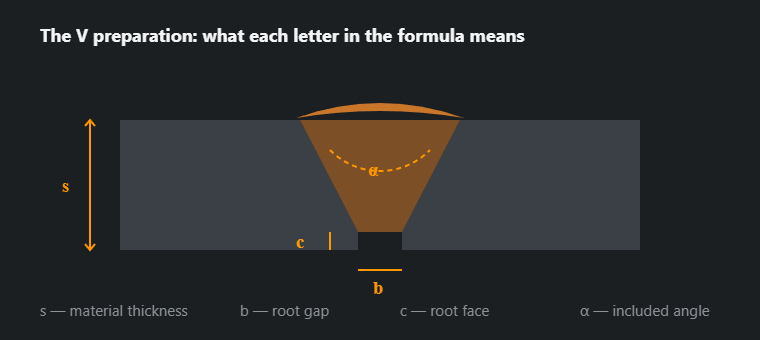
The mass of electrodes is larger than that, because the stub, the coating and the spatter never reach the joint. The loss factor covers this: 1.5 for careful shop work, 1.6 typically, 1.7 on site and overhead, 1.8 where conditions are bad enough that you would rather not know.
Ordering by the result
Round up to whole packets and add one. Electrodes that stay dry keep; a job stopped at four in the afternoon because a packet ran out costs more than the packet. If the material is a basic type, remember that an opened packet needs re-baking after a shift in humid air — see electrode coating types.
The loss factor
| Factor | When to take it |
|---|---|
| 1.5 | Shop floor, flat position, careful work, short stubs |
| 1.6 | Ordinary conditions — the default |
| 1.7 | Site work, overhead and vertical welds |
| 1.8 | Work at height, cramped space, many tacks |
Mass of one electrode
| Diameter × length | Mass, g | Pieces in 5 kg |
|---|---|---|
| 2.0 × 300 | 13 | 398 |
| 2.5 × 350 | 23 | 218 |
| 3.0 × 350 | 33 | 151 |
| 3.2 × 350 | 38 | 133 |
| 4.0 × 450 | 75 | 66 |
| 5.0 × 450 | 118 | 42 |
Core plus coating: core volume times the density of steel times 1.7. The same arithmetic the calculator above runs, so the two cannot drift apart.
Working out how many electrodes are in a kilogram

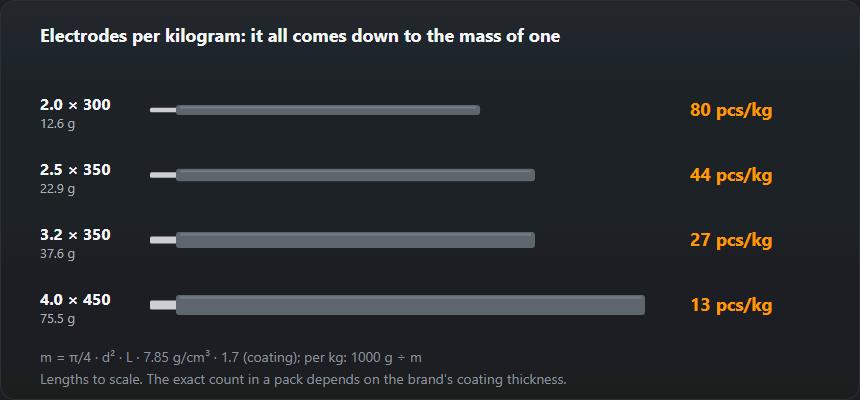
The route is the mass of a single electrode. Take a 2.5×350 rod, the one people ask about most.
- Core wire cross-section:
π/4 · 2.5² = 4.91 mm². - Core volume:
4.91 · 350 = 1718 mm³. - Core mass:
1718 · 0.00785 = 13.5 g(steel density 7.85 g/cm³). - With the coating:
13.5 · 1.7 = 22.9 g. - Pieces per kilogram:
1000 / 22.9 ≈ 44; a 5 kg pack holds about 218.
Mass grows with the square of the diameter, so going from 2.5 to 3.2 mm
makes the rod (3.2 / 2.5)² ≈ 1.64 times heavier: 44 divided by
1.64 gives 27 per kilogram. Length works in direct proportion: the same
2.5 mm at 300 mm gives 51 pieces, at 450 mm — 34.
The 1.7 multiplier is the average weight the coating adds to the core. A particular brand runs a thicker or thinner coating, so the real count in a pack is a few pieces either side of the calculation. Where the maker prints a piece count on the label, order by that.
Worked examples
A fence: 20 metres of fillet weld
Box section to posts, 4 mm leg, 20 m of weld in total, 2.5×350 electrodes, ordinary conditions (factor 1.6).
- Cross-section:
4² / 2 · 1.1 = 8.8 mm². - Deposited metal:
8.8 · 20,000 · 0.00785 = 1.38 kg. - Electrodes:
1.38 · 1.6 = 2.21 kg, which is 97 rods. - To buy: three 1 kg packs plus a spare, or one 5 kg pack with half of it left over.
The same fence with 3.2×350 rods takes 59 of them: the kilograms stay the same, the count drops because each rod is heavier.
A 10 mm plate butt joint with a V preparation
Thickness 10 mm, root gap 2 mm, included angle 60°, length 5 m, factor 1.6. The calculator assumes a 2 mm root face and about 2 mm of cap height.
- Groove:
2 · 10 + tan 30° · 8² = 20 + 36.95 = 56.95 mm². - Cap width:
2 · 8 · tan 30° + 2 + 4 = 15.24 mm, cap area0.75 · 15.24 · 2 = 22.86 mm². - Total section: 79.8 mm², deposited metal 3.13 kg.
- Electrodes: 5.01 kg — 134 rods of 3.2×350 or 67 of 4×450.
A result of exactly one 5 kg pack means buying two: tacks, back gouging and re-welding the root, and a few spoilt rods are not in the sum. If the root goes in with 3.2 and the fill with 4 mm, work the passes out separately — the calculator counts pieces for one diameter.
Mistakes that leave you short of rods
- Throat taken for leg. Drawings usually give the throat
a, while the calculator wants the legz ≈ 1.41 · a. An a4 weld has a leg of about 5.7 mm and a section of 17.6 mm², not 8.8 — out by a factor of two. - Loss factor left out. Without it the answer is 1.6 times too small, nearly 40 % of the rods missing.
- Gap wider than drawn. One extra millimetre of gap on 10 mm plate adds 10 mm² — on 79.8 mm² that is 12 % more.
- Stubs counted twice. The loss factor already covers stubs, spatter and coating; do not add them on top.
- Damp basic rods. A packet that has picked up moisture has to be re-baked or written off — the settings are under coating types.
With the kilograms known, the current calculator gives the amperage for the chosen diameter, and the weld cost calculator adds labour and power to price a metre of weld.
Frequently asked questions
Why is the loss factor so large?
Because only part of a stick electrode ends up in the weld. The stub in the holder, the coating, the spatter and the grinding together take a third to nearly half of it. That is why the calculator works with a factor of 1.5 to 1.8 and not 1.0.
How many electrodes are there in a kilogram?
It depends on the diameter: about 44 per kilogram at 2.5 mm × 350 mm, about 27 at 3.2 mm × 350 mm, about 13 at 4 mm × 450 mm. The calculator uses the diameter and length you choose.
Do I count the tack welds separately?
Not normally — they disappear into the loss factor as long as they are ordinary tacks. If a part is tacked heavily because it would otherwise pull, enter the tack length as a weld of its own.
How many electrodes are in a 5 kg pack?
On the same arithmetic: 2.5×350 — about 218, 3.2×350 — about 133, 4×450 — about 66, 5×450 — about 42. If the maker prints a piece count on the label, go by the label: coating thickness differs from brand to brand.
How much does one 3.2 mm electrode weigh?
About 38 g at 350 mm long: the core wire is 22 g and the coating adds the rest. A 2.5×350 rod is about 23 g, a 4×450 rod about 75 g.
How many 1/8" electrodes are in a pound?
A 1/8" rod is 3.2 mm. At 350 mm (14") it weighs about 38 g, so a pound (454 g) holds about 12 of them and a kilogram about 27.
Updated: