Steel weight calculator
Mass of sheet, bar, tube, angle and channel from the dimensions — for the delivery note, the lifting plan and the quote.
How it is worked out
Cross-sectional area from the dimensions, multiplied by length and by density. The densities used are 7.85 g/cm³ for carbon steel, 7.9 g/cm³ for austenitic stainless, 2.70 for aluminium, 8.96 for copper, 8.5 for brass, 4.51 for titanium and 7.2 for cast iron.
Rolling tolerances mean the real piece is normally within a couple of per cent of the calculated figure. That is close enough for ordering and for a lifting check with a proper safety factor; it is not close enough to settle an invoice, which is what the weighbridge is for.
| Section | Cross-section formula |
|---|---|
| Plate, flat bar | F = a · b |
| Round bar | F = π/4 · d² |
| Square bar | F = a² |
| Round tube | F = π/4 · (D² − (D − 2t)²) |
| Box section | F = a·b − (a − 2t)·(b − 2t) |
| Angle | F = (a + b − t) · t |
Before you lift it
A 6-metre length of 100×100×10 angle looks manageable and weighs about 90 kg — more than one person should lift. Material underestimated by eye is a classic cause of strained backs and dropped loads. Work the mass out first, then decide whether it is a two-person lift.
Densities
| Material | ρ, g/cm³ | Mass of 1 m² sheet, 1 mm thick |
|---|---|---|
| Structural steel | 7.85 | 7.85 kg |
| Stainless steel 304 / 316 | 7.90 | 7.90 kg |
| Cast iron | 7.20 | 7.20 kg |
| Copper | 8.96 | 8.96 kg |
| Brass | 8.50 | 8.50 kg |
| Titanium | 4.51 | 4.51 kg |
| Aluminium | 2.70 | 2.70 kg |
Steel weight in your head: one factor per shape
Put the steel density of 7.85 g/cm³ into F · ρ / 1000 and the
formula collapses into a single factor for each shape. They are worth
memorising: with them you can check the calculator, an invoice or a cutting
list without reaching for a phone.
| Shape | Steel formula, kg/m | Example, mm | Result, kg/m |
|---|---|---|---|
| Sheet | 7.85 · t | t = 3 | 23.55 |
| Flat bar | 0.00785 · a · b | 40×5 | 1.57 |
| Round bar | 0.006165 · d² | Ø20 | 2.47 |
| Square bar | 0.00785 · a² | 20×20 | 3.14 |
| Round tube | 0.02466 · t · (D − t) | 48.3×3.2 | 3.56 |
| Box section | 0.0157 · t · (a + b − 2t) | 60×40×3 | 4.43 |
| Angle | 0.00785 · t · (a + b − t) | 50×50×5 | 3.73 |
Where the numbers come from: 7.85/1000 = 0.00785 for anything with a rectangular section; π/4 · 0.00785 = 0.006165 for round bar; π · 0.00785 = 0.02466 for tube. For another metal the factor scales with density — add 0.6 % for stainless, multiply by 0.344 for aluminium.

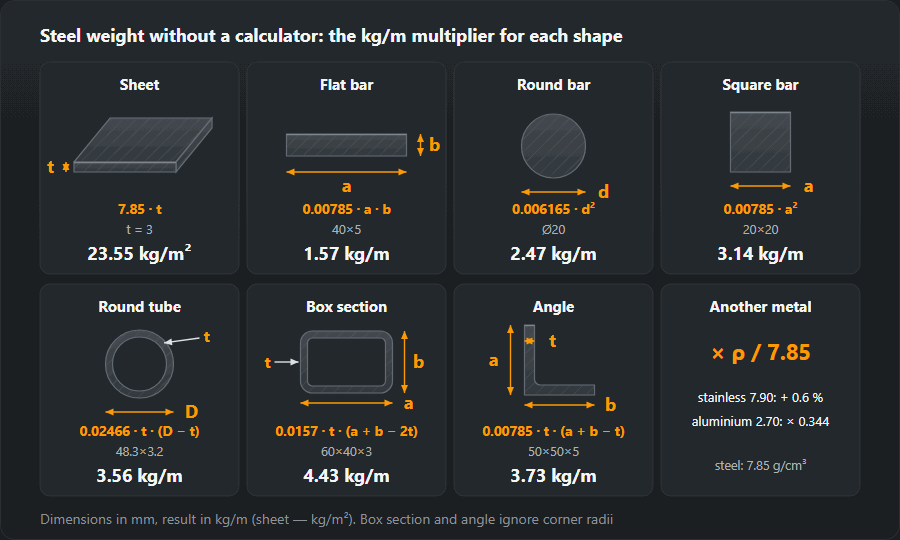
Which formula: what to measure on each shape
A metal weight calculator is only as accurate as the dimensions it is given. Each shape has its own place where people go wrong:
- Sheet — thickness and width in millimetres, length in metres. A 1250×2500 sheet is width 1250 and length 2.5.
- Flat bar — width and thickness; 40×5 is 200 mm² and 1.57 kg/m. The order does not change the answer, but an order line gives the width first.
- Round bar — diameter, not radius. Getting it wrong by a factor of two gets the weight wrong by four: Ø20 is 2.47 kg/m, the same bar entered as 40 is 9.86 kg/m.
- Square bar — the side. Do not confuse it with box section: a solid 20×20 square weighs 3.14 kg/m, a 20×20×2 hollow section 1.05 kg/m.
- Round tube — outside diameter and wall. A pipe sold by the inch has an outside diameter set by the standard, not by its name — the DN table is in the tube and hollow section calculator.
- Hollow section — both sides and the wall, always as side × side × wall.
- Angle — both legs and the thickness. An unequal 80×40×6 angle uses the same formula.
I-beams, channels and tees are not worked out by formula: tapered flanges and root radii shift the area by several per cent. IPE 200 weighs 22.4 kg/m from the section table — take it from the I-beam calculator or from the section tables.
Formula or section table: how far apart they are
The calculator works on geometry with sharp corners. For solid sections that is exact; for rolled and formed sections it is approximate, and the error can go either way:
| Shape | Size, mm | Formula, kg/m | Section table, kg/m | Formula vs table, % |
|---|---|---|---|---|
| Angle | 40×40×4 | 2.39 | 2.42 | −1.4 |
| Angle | 50×50×5 | 3.73 | 3.77 | −1.1 |
| Angle | 60×60×6 | 5.37 | 5.42 | −0.9 |
| Angle | 80×80×8 | 9.55 | 9.63 | −0.9 |
| Box section | 40×40×2 | 2.39 | 2.31 | +3.3 |
| Box section | 60×40×3 | 4.43 | 4.25 | +4.2 |
| Box section | 100×100×5 | 14.92 | 14.40 | +3.6 |
Angle comes out of the formula about 1 % light: a rolled angle has a root fillet in the inside corner that adds more metal than the rounded leg tips take away. Hollow section comes out 3–4 % heavy in the table — its corners are rounded to a radius of roughly two wall thicknesses and the formula counts them square. The error grows on small sections with a thick wall. For an estimate and a lifting check the formula is enough; for tonnage orders and settling up with the stockholder, use the table.
The same size in another metal
The calculator has seven materials but only one operation: the mass in another metal is the steel mass times the density ratio. Four everyday items in six materials:
| Item, mm | Steel | Stainless | Aluminium | Copper | Brass | Titanium |
|---|---|---|---|---|---|---|
| Round bar Ø20 | 2.47 | 2.48 | 0.85 | 2.81 | 2.67 | 1.42 |
| Flat bar 40×5 | 1.57 | 1.58 | 0.54 | 1.79 | 1.70 | 0.90 |
| Round tube 42.4×3.2 | 3.09 | 3.11 | 1.06 | 3.53 | 3.35 | 1.78 |
| Sheet t = 2 | 15.70 | 15.80 | 5.40 | 17.92 | 17.00 | 9.02 |
Two practical points follow. Stainless weighs almost the same as mild steel — 0.6 % vanishes inside the rolling tolerance, so for lifting and transport it can be counted as steel. Copper and brass are 8–14 % heavier than steel, which is easy to miss on busbars and brass fittings. Aluminium and titanium always need their own figure; aluminium has its own pages with size tables, starting with the aluminium weight calculator.
Weight of an order, step by step
More often than one part, you need a kit from a drawing. Example — rebar and a frame for a platform:
- Ø12 bar: 40 lengths of 6 m = 240 m × 0.888 kg/m = 213.1 kg.
- 40×5 flat: 18 m × 1.57 kg/m = 28.3 kg.
- 50×50×5 angle: 24 m, i.e. 4 lengths, × 3.77 kg/m from the table = 90.5 kg (the formula would give 89.5 kg).
- Total about 332 kg. That figure is checked against the payload of the van and the rating of the hoist, and multiplied by the price per kilogram in the quote.
Always count in stock lengths, not in metres off the drawing: 24 m of angle cut into 1.7 m pieces leaves offcuts, and you pay for those too. The cutting calculator nests the pieces into stock lengths and shows the waste, and the bill of materials puts the whole list together with masses.
Common mistakes when working out steel weight
- Length in millimetres in the metres box. 2500 instead of 2.5 gives a thousand times too much — tonnes for a single sheet is the giveaway.
- Centimetres instead of millimetres. A bar of “2” instead of “20” comes out a hundred times light, because area goes with the square of the diameter.
- Material left on steel. For aluminium the answer will be 2.91 times too high; for stainless the error is negligible.
- Formula instead of the table for an I-beam. Web and flanges counted as three flat bars lose the radii and the flange taper — see the section calculators in the table below.
- Quantity. Mass of one piece times the number of pieces — the calculator gives both, and transport needs the second.
Steel calculators by section
This calculator does every shape, but when you already know what you came for it is quicker to open the page for that shape: it starts on it and carries a table of the common sizes.
| Calculator | What it works out |
|---|---|
| Steel beam weight | IPE 200 — 22.4 kg/m, IPE 300 — 42.2, HEB 200 — 61.3, HEA 300 — 88.3. Full EN 10365 and DIN 1025-1 tables and a calculator for length and quantity. |
| Steel channel weight | UPN 100 — 10.6 kg/m, UPN 120 — 13.4, UPN 160 — 18.8, UPN 200 — 25.3. Weight of 6 m and 12 m bars and of a whole order, and UPN vs UPE explained. |
| Steel angle weight | L 50×50×5 — 3.77 kg/m, L 100×100×10 — 15.0. Every size to EN 10056-1 with 6 m and 12 m bar weights and a calculator for length and quantity. |
| Tube and hollow section | Weight of round tube and hollow section from dimensions: diameter or sides plus wall thickness. Common commercial sizes to EN 10219 and the area formulas. |
| Sheet metal weight | Steel 1 mm = 7.85 kg/m², 2 mm — 15.7, 5 mm — 39.25. Weight of a 1250×2500 or 1500×3000 sheet and of a whole batch, with worked examples. |
Frequently asked questions
Which densities are used?
Steel 7.85, stainless 7.9, aluminium 2.70, copper 8.96, brass 8.5, titanium 4.51 and cast iron 7.2 g/cm³. That is close enough for rolled products; thin sheet runs one or two per cent out because of thickness tolerance.
Why does the figure differ from the delivery note?
Thickness tolerance. A sheet sold as 3 mm may sit a few tenths either side under EN 10051, and over a large area that is several per cent. The note gives the weighed mass, the calculator the nominal one.
What is mass per metre for?
For cutting lists and for bench arithmetic. Knowing that a 40×40×3 square tube runs about 3.4 kg/m lets you estimate frame weight and lifting in your head.
How much does a 12 mm round bar weigh per metre?
0.888 kg/m, which is 5.33 kg for a 6 m length. The mass per metre of a steel round bar is 0.006165 · d²: Ø10 is 0.617 kg/m, Ø16 is 1.58 kg/m, Ø20 is 2.47 kg/m. The diameter goes in in millimetres and the answer comes out in kilograms per metre.
Should angle weight come from the formula or from the section table?
For ordering, from the table. The formula (a + b − t) · t gives 3.73 kg/m for a 50×50×5 angle, the rolled-section table 3.77 kg/m. The formula comes out about 1 % low because it does not see the root fillet in the inside corner, which adds metal. For a workshop estimate the difference does not matter.
How do I convert a steel weight to aluminium or copper?
Multiply by the density ratio: aluminium 0.344, titanium 0.575, stainless 1.006, brass 1.083, copper 1.141. A 40×5 flat bar weighs 1.57 kg/m in steel, 0.54 kg/m in aluminium and 1.79 kg/m in copper. That holds for the same dimensions; for the same load-bearing capacity the sections in different metals are different.
Updated: