Steel section weight table
Mass per metre: IPE 200 — 22.4 kg/m; HEB 200 — 61.3 kg/m; UPN 200 — 25.3 kg/m; L 50×50×5 — 3.77 kg/m. A 6 m bar of HEB 200 is 367.8 kg and a 12 m bar 735.6 kg; every other size is below with a ready answer. Mass per metre and dimensions of rolled sections in one place: IPE, INP, HEA and HEB beams, UPN and UPE channels, equal and unequal angles. Nominal values to the standard named above each table.
This is what those sections weigh: IPE 270 — 36.1 kg/m, HEA 280 — 76.4, UPN 200 — 25.3, L 50×50×6 — 4.5. Below is every size in each series with its dimensions and cross-section.
The sections used most
| Section | Mass, kg/m | 6 m length, kg | 12 m length, kg |
|---|---|---|---|
| L 40×40×4 | 2.42 | 14.5 | 29.0 |
| L 50×50×5 | 3.77 | 22.6 | 45.2 |
| L 60×60×6 | 5.42 | 32.5 | 65.0 |
| L 80×80×8 | 9.63 | 57.8 | 115.6 |
| UPN 80 | 8.64 | 51.8 | 103.7 |
| UPN 100 | 10.6 | 63.6 | 127.2 |
| UPN 140 | 16.0 | 96.0 | 192.0 |
| UPN 200 | 25.3 | 151.8 | 303.6 |
| IPE 100 | 8.10 | 48.6 | 97.2 |
| IPE 140 | 12.9 | 77.4 | 154.8 |
| IPE 160 | 15.8 | 94.8 | 189.6 |
| IPE 200 | 22.4 | 134.4 | 268.8 |
| IPE 240 | 30.7 | 184.2 | 368.4 |
| IPE 300 | 42.2 | 253.2 | 506.4 |
| HEA 160 | 30.4 | 182.4 | 364.8 |
| HEA 200 | 42.3 | 253.8 | 507.6 |
| HEB 160 | 42.6 | 255.6 | 511.2 |
| HEB 200 | 61.3 | 367.8 | 735.6 |
| HEB 240 | 83.2 | 499.2 | 998.4 |
| HEB 300 | 117 | 702.0 | 1404.0 |
Common sizes: weight per bar and per tonne

A few of the sizes looked up most in this table, worked out for 6 m and 12 m bars, metres per tonne and a comparison with the neighbouring series. The numbers come from the same table rows below.
IPE 200 weight per metre — 22.4 kg/m
IPE 200 weighs 22.4 kg per metre: a 6 m bar is 134.4 kg, a 12 m bar 268.8 kg, and one tonne buys about 44.6 m of it. Section 200 × 100 mm, web 5.6 mm, flange 8.5 mm, area 28.5 cm². HEA 200 is 89 % heavier (42.3 kg/m).
IPE 270 weight per metre — 36.1 kg/m
IPE 270 weighs 36.1 kg per metre: a 6 m bar is 216.6 kg, a 12 m bar 433.2 kg, and one tonne buys about 27.7 m of it. Section 270 × 135 mm, web 6.6 mm, flange 10.2 mm, area 45.9 cm².
INP 200 weight per metre — 26.2 kg/m
INP 200 weighs 26.2 kg per metre: a 6 m bar is 157.2 kg, a 12 m bar 314.4 kg, and one tonne buys about 38.2 m of it. Section 200 × 90 mm, web 7.5 mm, flange 11.3 mm, area 33.4 cm². IPE 200 is 15 % lighter (22.4 kg/m).
HEA 160 weight per metre — 30.4 kg/m
HEA 160 weighs 30.4 kg per metre: a 6 m bar is 182.4 kg, a 12 m bar 364.8 kg, and one tonne buys about 32.9 m of it. Section 152 × 160 mm, web 6 mm, flange 9 mm, area 38.8 cm². Note: the actual depth is 152 mm, not 160. HEB 160 is 40 % heavier (42.6 kg/m).
HEA 240 weight per metre — 60.3 kg/m
HEA 240 weighs 60.3 kg per metre: a 6 m bar is 361.8 kg, a 12 m bar 723.6 kg, and one tonne buys about 16.6 m of it. Section 230 × 240 mm, web 7.5 mm, flange 12 mm, area 76.8 cm². Note: the actual depth is 230 mm, not 240. HEB 240 is 38 % heavier (83.2 kg/m).
HEA 280 weight per metre — 76.4 kg/m
HEA 280 weighs 76.4 kg per metre: a 6 m bar is 458.4 kg, a 12 m bar 916.8 kg, and one tonne buys about 13.1 m of it. Section 270 × 280 mm, web 8 mm, flange 13 mm, area 97.3 cm². Note: the actual depth is 270 mm, not 280. HEB 280 is 35 % heavier (103 kg/m).
HEB 240 weight per metre — 83.2 kg/m
HEB 240 weighs 83.2 kg per metre: a 6 m bar is 499.2 kg, a 12 m bar 998.4 kg, and one tonne buys about 12 m of it. Section 240 × 240 mm, web 10 mm, flange 17 mm, area 106 cm². HEA 240 is 28 % lighter (60.3 kg/m).
HEB 260 weight per metre — 93 kg/m
HEB 260 weighs 93 kg per metre: a 6 m bar is 558 kg, a 12 m bar 1116 kg, and one tonne buys about 10.8 m of it. Section 260 × 260 mm, web 10 mm, flange 17.5 mm, area 118 cm². HEA 260 is 27 % lighter (68.2 kg/m).
HEB 450 weight per metre — 171 kg/m
HEB 450 weighs 171 kg per metre: a 6 m bar is 1026 kg, a 12 m bar 2052 kg, and one tonne buys about 5.8 m of it. Section 450 × 300 mm, web 14 mm, flange 26 mm, area 218 cm². HEA 450 is 18 % lighter (140 kg/m).
HEB 500 weight per metre — 187 kg/m
HEB 500 weighs 187 kg per metre: a 6 m bar is 1122 kg, a 12 m bar 2244 kg, and one tonne buys about 5.3 m of it. Section 500 × 300 mm, web 14.5 mm, flange 28 mm, area 239 cm². HEA 500 is 17 % lighter (155 kg/m).
HEB 600 weight per metre — 212 kg/m
HEB 600 weighs 212 kg per metre: a 6 m bar is 1272 kg, a 12 m bar 2544 kg, and one tonne buys about 4.7 m of it. Section 600 × 300 mm, web 15.5 mm, flange 30 mm, area 270 cm². HEA 600 is 16 % lighter (178 kg/m).
UPN 300 weight per metre — 46.2 kg/m
UPN 300 weighs 46.2 kg per metre: a 6 m bar is 277.2 kg, a 12 m bar 554.4 kg, and one tonne buys about 21.6 m of it. Section 300 × 100 mm, web 10 mm, flange 16 mm, area 58.8 cm². UPE 300 is 4 % lighter (44.4 kg/m).
L 50×50×6 weight per metre — 4.47 kg/m
L 50×50×6 weighs 4.47 kg per metre: a 6 m bar is 26.8 kg, a 12 m bar 53.6 kg, and one tonne buys about 224 m of it. Legs 50 and 50 mm, thickness 6 mm, area 5.69 cm². L 50×50×5 is 16 % lighter (3.77 kg/m).
L 150×90×10 weight per metre — 18.2 kg/m
L 150×90×10 weighs 18.2 kg per metre: a 6 m bar is 109.2 kg, a 12 m bar 218.4 kg, and one tonne buys about 54.9 m of it. Legs 150 and 90 mm, thickness 10 mm, area 23.2 cm².
Beams
IPE beams — EN 10365
| Section | h, mm | b, mm | s, mm | t, mm | Mass, kg/m | A, cm² |
|---|---|---|---|---|---|---|
| IPE 80 | 80 | 46 | 3.8 | 5.2 | 6 | 7.64 |
| IPE 100 | 100 | 55 | 4.1 | 5.7 | 8.1 | 10.3 |
| IPE 120 | 120 | 64 | 4.4 | 6.3 | 10.4 | 13.2 |
| IPE 140 | 140 | 73 | 4.7 | 6.9 | 12.9 | 16.4 |
| IPE 160 | 160 | 82 | 5 | 7.4 | 15.8 | 20.1 |
| IPE 180 | 180 | 91 | 5.3 | 8 | 18.8 | 23.9 |
| IPE 200 | 200 | 100 | 5.6 | 8.5 | 22.4 | 28.5 |
| IPE 220 | 220 | 110 | 5.9 | 9.2 | 26.2 | 33.4 |
| IPE 240 | 240 | 120 | 6.2 | 9.8 | 30.7 | 39.1 |
| IPE 270 | 270 | 135 | 6.6 | 10.2 | 36.1 | 45.9 |
| IPE 300 | 300 | 150 | 7.1 | 10.7 | 42.2 | 53.8 |
| IPE 330 | 330 | 160 | 7.5 | 11.5 | 49.1 | 62.6 |
| IPE 360 | 360 | 170 | 8 | 12.7 | 57.1 | 72.7 |
| IPE 400 | 400 | 180 | 8.6 | 13.5 | 66.3 | 84.5 |
| IPE 450 | 450 | 190 | 9.4 | 14.6 | 77.6 | 98.8 |
| IPE 500 | 500 | 200 | 10.2 | 16 | 90.7 | 116 |
| IPE 550 | 550 | 210 | 11.1 | 17.2 | 106 | 134 |
| IPE 600 | 600 | 220 | 12 | 19 | 122 | 156 |
INP beams (tapered flange) — DIN 1025-1
| Section | h, mm | b, mm | s, mm | t, mm | Mass, kg/m | A, cm² |
|---|---|---|---|---|---|---|
| INP 80 | 80 | 42 | 3.9 | 5.9 | 5.94 | 7.57 |
| INP 100 | 100 | 50 | 4.5 | 6.8 | 8.34 | 10.6 |
| INP 120 | 120 | 58 | 5.1 | 7.7 | 11.1 | 14.2 |
| INP 140 | 140 | 66 | 5.7 | 8.6 | 14.3 | 18.3 |
| INP 160 | 160 | 74 | 6.3 | 9.5 | 17.9 | 22.8 |
| INP 180 | 180 | 82 | 6.9 | 10.4 | 21.9 | 27.9 |
| INP 200 | 200 | 90 | 7.5 | 11.3 | 26.2 | 33.4 |
| INP 220 | 220 | 98 | 8.1 | 12.2 | 31.1 | 39.5 |
| INP 240 | 240 | 106 | 8.7 | 13.1 | 36.2 | 46.1 |
| INP 260 | 260 | 113 | 9.4 | 14.1 | 41.9 | 53.3 |
| INP 280 | 280 | 119 | 10.1 | 15.2 | 47.9 | 61 |
| INP 300 | 300 | 125 | 10.8 | 16.2 | 54.2 | 69 |
HEA beams — EN 10365
| Section | h, mm | b, mm | s, mm | t, mm | Mass, kg/m | A, cm² |
|---|---|---|---|---|---|---|
| HEA 100 | 96 | 100 | 5 | 8 | 16.7 | 21.2 |
| HEA 120 | 114 | 120 | 5 | 8 | 19.9 | 25.3 |
| HEA 140 | 133 | 140 | 5.5 | 8.5 | 24.7 | 31.4 |
| HEA 160 | 152 | 160 | 6 | 9 | 30.4 | 38.8 |
| HEA 180 | 171 | 180 | 6 | 9.5 | 35.5 | 45.3 |
| HEA 200 | 190 | 200 | 6.5 | 10 | 42.3 | 53.8 |
| HEA 220 | 210 | 220 | 7 | 11 | 50.5 | 64.3 |
| HEA 240 | 230 | 240 | 7.5 | 12 | 60.3 | 76.8 |
| HEA 260 | 250 | 260 | 7.5 | 12.5 | 68.2 | 86.8 |
| HEA 280 | 270 | 280 | 8 | 13 | 76.4 | 97.3 |
| HEA 300 | 290 | 300 | 8.5 | 14 | 88.3 | 112 |
| HEA 320 | 310 | 300 | 9 | 15.5 | 97.6 | 124 |
| HEA 340 | 330 | 300 | 9.5 | 16.5 | 105 | 133 |
| HEA 360 | 350 | 300 | 10 | 17.5 | 112 | 143 |
| HEA 400 | 390 | 300 | 11 | 19 | 125 | 159 |
| HEA 450 | 440 | 300 | 11.5 | 21 | 140 | 178 |
| HEA 500 | 490 | 300 | 12 | 23 | 155 | 198 |
| HEA 550 | 540 | 300 | 12.5 | 24 | 166 | 212 |
| HEA 600 | 590 | 300 | 13 | 25 | 178 | 226 |
HEB beams — EN 10365
| Section | h, mm | b, mm | s, mm | t, mm | Mass, kg/m | A, cm² |
|---|---|---|---|---|---|---|
| HEB 100 | 100 | 100 | 6 | 10 | 20.4 | 26 |
| HEB 120 | 120 | 120 | 6.5 | 11 | 26.7 | 34 |
| HEB 140 | 140 | 140 | 7 | 12 | 33.7 | 43 |
| HEB 160 | 160 | 160 | 8 | 13 | 42.6 | 54.3 |
| HEB 180 | 180 | 180 | 8.5 | 14 | 51.2 | 65.3 |
| HEB 200 | 200 | 200 | 9 | 15 | 61.3 | 78.1 |
| HEB 220 | 220 | 220 | 9.5 | 16 | 71.5 | 91 |
| HEB 240 | 240 | 240 | 10 | 17 | 83.2 | 106 |
| HEB 260 | 260 | 260 | 10 | 17.5 | 93 | 118 |
| HEB 280 | 280 | 280 | 10.5 | 18 | 103 | 131 |
| HEB 300 | 300 | 300 | 11 | 19 | 117 | 149 |
| HEB 320 | 320 | 300 | 11.5 | 20.5 | 127 | 161 |
| HEB 340 | 340 | 300 | 12 | 21.5 | 134 | 171 |
| HEB 360 | 360 | 300 | 12.5 | 22.5 | 142 | 181 |
| HEB 400 | 400 | 300 | 13.5 | 24 | 155 | 198 |
| HEB 450 | 450 | 300 | 14 | 26 | 171 | 218 |
| HEB 500 | 500 | 300 | 14.5 | 28 | 187 | 239 |
| HEB 550 | 550 | 300 | 15 | 29 | 199 | 254 |
| HEB 600 | 600 | 300 | 15.5 | 30 | 212 | 270 |
Channels
UPN channels — DIN 1026-1
| Section | h, mm | b, mm | s, mm | t, mm | Mass, kg/m | A, cm² |
|---|---|---|---|---|---|---|
| UPN 50 | 50 | 38 | 5 | 7 | 5.59 | 7.12 |
| UPN 65 | 65 | 42 | 5.5 | 7.5 | 7.09 | 9.03 |
| UPN 80 | 80 | 45 | 6 | 8 | 8.64 | 11 |
| UPN 100 | 100 | 50 | 6 | 8.5 | 10.6 | 13.5 |
| UPN 120 | 120 | 55 | 7 | 9 | 13.4 | 17 |
| UPN 140 | 140 | 60 | 7 | 10 | 16 | 20.4 |
| UPN 160 | 160 | 65 | 7.5 | 10.5 | 18.8 | 24 |
| UPN 180 | 180 | 70 | 8 | 11 | 22 | 28 |
| UPN 200 | 200 | 75 | 8.5 | 11.5 | 25.3 | 32.2 |
| UPN 220 | 220 | 80 | 9 | 12.5 | 29.4 | 37.4 |
| UPN 240 | 240 | 85 | 9.5 | 13 | 33.2 | 42.3 |
| UPN 260 | 260 | 90 | 10 | 14 | 37.9 | 48.3 |
| UPN 280 | 280 | 95 | 10 | 15 | 41.8 | 53.3 |
| UPN 300 | 300 | 100 | 10 | 16 | 46.2 | 58.8 |
| UPN 320 | 320 | 100 | 14 | 17.5 | 59.5 | 75.8 |
| UPN 350 | 350 | 100 | 14 | 16 | 60.6 | 77.3 |
| UPN 400 | 400 | 110 | 14 | 18 | 71.8 | 91.5 |
UPE channels — DIN 1026-2
| Section | h, mm | b, mm | s, mm | t, mm | Mass, kg/m | A, cm² |
|---|---|---|---|---|---|---|
| UPE 80 | 80 | 50 | 4 | 7 | 7.9 | 10 |
| UPE 100 | 100 | 55 | 4.5 | 7.5 | 9.82 | 12.5 |
| UPE 120 | 120 | 60 | 5 | 8 | 12.1 | 15.4 |
| UPE 140 | 140 | 65 | 5 | 9 | 14.5 | 18.4 |
| UPE 160 | 160 | 70 | 5.5 | 9.5 | 17 | 21.7 |
| UPE 180 | 180 | 75 | 5.5 | 10.5 | 19.7 | 25.1 |
| UPE 200 | 200 | 80 | 6 | 11 | 22.8 | 29 |
| UPE 220 | 220 | 85 | 6.5 | 12 | 26.6 | 33.9 |
| UPE 240 | 240 | 90 | 7 | 12.5 | 30.2 | 38.5 |
| UPE 270 | 270 | 95 | 7.5 | 13.5 | 35.2 | 44.8 |
| UPE 300 | 300 | 100 | 9.5 | 15 | 44.4 | 56.6 |
| UPE 330 | 330 | 105 | 11 | 16 | 53.2 | 67.8 |
| UPE 360 | 360 | 110 | 12 | 17 | 61.2 | 78 |
| UPE 400 | 400 | 115 | 13.5 | 18 | 72.2 | 92 |
Angles
Equal angles — EN 10056-1
| Section | a, mm | b, mm | t, mm | Mass, kg/m | A, cm² |
|---|---|---|---|---|---|
| L 20×20×3 | 20 | 20 | 3 | 0.88 | 1.12 |
| L 25×25×3 | 25 | 25 | 3 | 1.12 | 1.42 |
| L 25×25×4 | 25 | 25 | 4 | 1.45 | 1.85 |
| L 30×30×3 | 30 | 30 | 3 | 1.36 | 1.74 |
| L 30×30×4 | 30 | 30 | 4 | 1.78 | 2.27 |
| L 35×35×4 | 35 | 35 | 4 | 2.09 | 2.67 |
| L 40×40×4 | 40 | 40 | 4 | 2.42 | 3.08 |
| L 40×40×5 | 40 | 40 | 5 | 2.97 | 3.79 |
| L 45×45×5 | 45 | 45 | 5 | 3.38 | 4.3 |
| L 50×50×5 | 50 | 50 | 5 | 3.77 | 4.8 |
| L 50×50×6 | 50 | 50 | 6 | 4.47 | 5.69 |
| L 60×60×6 | 60 | 60 | 6 | 5.42 | 6.91 |
| L 60×60×8 | 60 | 60 | 8 | 7.09 | 9.03 |
| L 70×70×7 | 70 | 70 | 7 | 7.38 | 9.4 |
| L 80×80×8 | 80 | 80 | 8 | 9.63 | 12.3 |
| L 90×90×9 | 90 | 90 | 9 | 12.2 | 15.5 |
| L 100×100×10 | 100 | 100 | 10 | 15 | 19.2 |
| L 100×100×12 | 100 | 100 | 12 | 17.8 | 22.7 |
| L 120×120×12 | 120 | 120 | 12 | 21.6 | 27.5 |
| L 150×150×15 | 150 | 150 | 15 | 33.8 | 43 |
| L 200×200×20 | 200 | 200 | 20 | 59.9 | 76.3 |
Unequal angles — EN 10056-1
| Section | a, mm | b, mm | t, mm | Mass, kg/m | A, cm² |
|---|---|---|---|---|---|
| L 40×20×4 | 40 | 20 | 4 | 1.77 | 2.26 |
| L 50×30×5 | 50 | 30 | 5 | 2.96 | 3.78 |
| L 60×40×5 | 60 | 40 | 5 | 3.79 | 4.79 |
| L 60×40×6 | 60 | 40 | 6 | 4.46 | 5.68 |
| L 65×50×5 | 65 | 50 | 5 | 4.35 | 5.54 |
| L 70×50×6 | 70 | 50 | 6 | 5.41 | 6.89 |
| L 75×50×7 | 75 | 50 | 7 | 6.48 | 8.3 |
| L 80×40×6 | 80 | 40 | 6 | 5.41 | 6.89 |
| L 80×60×7 | 80 | 60 | 7 | 7.36 | 9.38 |
| L 100×50×8 | 100 | 50 | 8 | 8.97 | 11.4 |
| L 100×65×8 | 100 | 65 | 8 | 9.94 | 12.7 |
| L 100×75×8 | 100 | 75 | 8 | 10.6 | 13.5 |
| L 120×80×8 | 120 | 80 | 8 | 12.2 | 15.5 |
| L 150×90×10 | 150 | 90 | 10 | 18.2 | 23.2 |
| L 150×100×10 | 150 | 100 | 10 | 19 | 24.2 |
| L 200×100×10 | 200 | 100 | 10 | 23 | 29.2 |
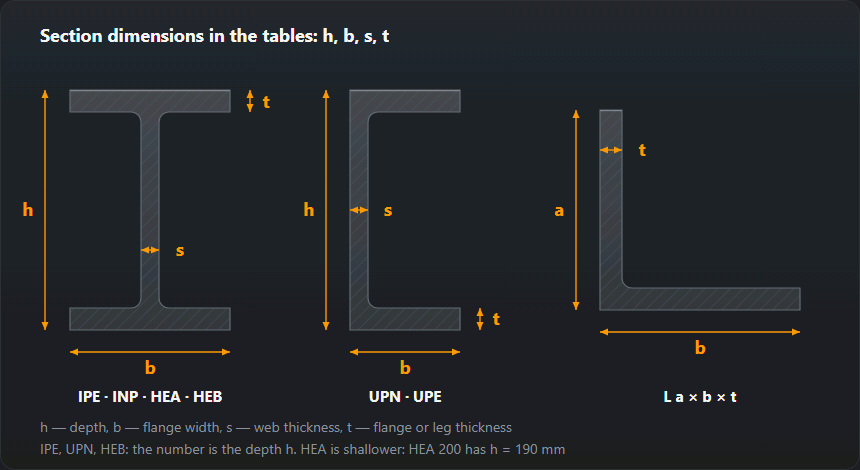
h — section depth, b — flange width,
s — web thickness, t — flange thickness (on an angle
simply the leg thickness), A — cross-sectional area. All
dimensions in millimetres, mass in kilograms per metre, area in square
centimetres.
IPE, INP, HEA, HEB, UPN and UPE are the sections held in stock across the EU and the UK. American W, S, C and L shapes to ASTM A6 form a separate series with different proportions, and matching numbers in a designation do not make two sections interchangeable — for those, use the AISC tables.
How to read this table
The section number is almost always its depth in millimetres — but there are exceptions that catch people out. HEA 200 is 190 mm deep and HEA 300 is 290 mm; only HEB has a depth equal to its number. On an angle the number is the leg length, not a depth, and it is always quoted with the thickness: "50 angle" without the third figure specifies nothing, because 50×50×5 weighs 3.77 kg/m and 50×50×6 weighs 4.47.
Cross-sectional area A earns its keep in two places: checking
stresses, and estimating how much weld it takes for a joint to carry what the
member itself carries. Rule of thumb: the total throat area of the fillet welds
at a node should be of the order of the area of the member being joined.
Where section mass comes from
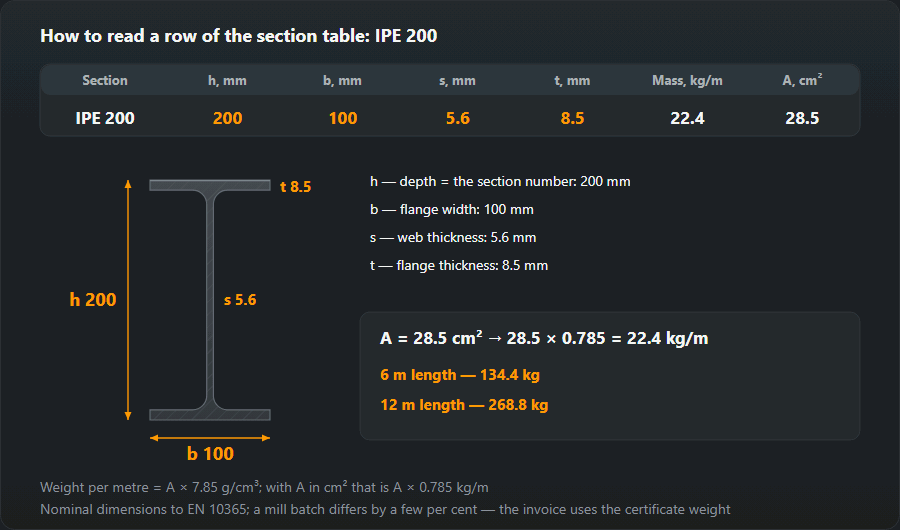
Mass per metre is the cross-sectional area times the density:
m = A · ρ, and with A in cm² and
ρ = 7.85 g/cm³ that becomes m = A · 0.785 kilograms
per metre. Check it on IPE 200:
28.5 × 0.785 = 22.4 kg/m — which is what the table
says.
It does not work the other way round. Working the area out "from the dimensions", as the sum of the web and flange rectangles, comes out several per cent low, because it misses the root radii where the web meets the flange, and on INP and UPN the flange taper as well. That is why the mass of a rolled section is read rather than calculated — and why the calculators in this section take their values from here.

Worked example: the weight of a whole structure from the table
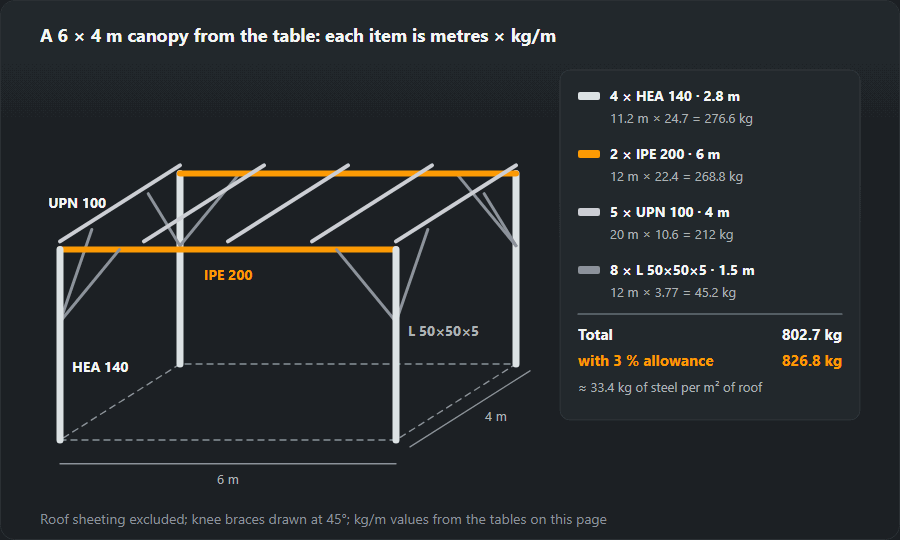
A 6 × 4 m canopy: four HEA 140 columns of 2.8 m, two IPE 200 beams of 6 m, five UPN 100 purlins of 4 m and eight 50×50×5 angle knee braces of 1.5 m. Every line is worked out the same way — metres times mass per metre from the table — and the allowance goes on at the end:
- columns — HEA 140: 4 × 2.8 m = 11.2 m × 24.7 = 276.6 kg
- beams — IPE 200: 2 × 6 m = 12 m × 22.4 = 268.8 kg
- purlins — UPN 100: 5 × 4 m = 20 m × 10.6 = 212 kg
- knee braces — L 50×50×5: 8 × 1.5 m = 12 m × 3.77 = 45.2 kg
- Total: 802.7 kg; with 3 % added for gussets, welds and offcuts — 826.8 kg
That comes to 33.4 kg of structural steel per square metre of roof before the allowance (34.4 kg with it), without the sheeting — a figure worth having before any talk about foundations, transport and price. With many small connections the allowance can be more than 3 %. The bill of materials builds the same list with prices and bar breakdown, and typical layouts of such structures are covered under canopies.

Why the invoice weight does not match the table
The table gives nominal weight, the invoice gives chargeable weight. They differ for a few reasons, and each one can be foreseen:
- Rolling tolerances. Section dimensions and weight sit within the limits of the standards (EN 10034 for beams, EN 10279 for channels, EN 10056-2 for angles). A real batch can be 1–4 % lighter or heavier than the table figure.
- How it is charged. The stockholder charges either on theoretical weight (table times length) or on weighed weight. On theoretical weight the invoice matches the table to the kilogram; on weighed weight it does not. Ask before ordering.
- Whole bars and offcuts. You buy 6 m or 12 m bars, not the metres in the design. The offcuts are on the invoice even though they are not in the structure.
- Coatings. Primer and zinc add weight that the black-steel table does not show; on thin angles it is noticeable.
The working rule: the table is for design, the first estimate and choosing transport and lifting gear. Charge the client on the invoice or certificate weight, and note the difference from the table so the next estimate can allow for it.
Conversions: kilograms, metres, bars
Three formulas cover any conversation with a stockholder. Metres from kilograms:
L = M / G. Number of bars: n = L / 6 (or / 12),
rounded up. Weight bought: M = n · 6 · G. Example: 500 kg of UPN 100
is 47.2 m, which is
8 bars of 6 m or
4 of 12 m.
Steel cost follows the same weight: K = Σ (L · G) · C, where C
is the price per kilogram (with a price per tonne, T / 1000). That gives a simple
check when comparing options: a metre of UPN 100 costs
2.8 times a metre of 50×50×5 angle, because it
weighs that many times more. Cutting, drilling and delivery are added separately — per piece,
per hole and per trip, not per kilogram.
Calculators built on these tables
- Steel beam weight — IPE, INP, HEA, HEB
- Steel channel weight — UPN and UPE
- Steel angle weight — equal and unequal
- Tube and hollow section weight
- Sheet metal weight and aluminium weight
Frequently asked questions
How do I get a structure mass out of the table quickly?
Add up the metres of each section and multiply by its mass per metre. Example: a frame of 24 m of 50×50×5 angle (3.77 kg/m) and 18 m of UPN 100 channel (10.6 kg/m) weighs 24 × 3.77 + 18 × 10.6 = 281 kg. Add 2–3 % for welds, gussets and offcuts.
What is the difference between nominal mass and certified mass?
Nominal follows from the dimensions given in the standard. The actual value sits within the rolling tolerances (EN 10034 for beams, EN 10279 for channels, EN 10056-2 for angles) and usually differs by 1–4 %. The stockholder invoices by the certified mass or by the weighed batch — the table is for design and a first estimate.
Where do I get the mass of a section that is not in the table?
For products with a regular cross-section — sheet, flat bar, round bar, tube, hollow section — mass follows from a formula, and the metal weight calculator gives it. For rolled sections outside the European standard, such as American W and S shapes or older GOST profiles, you need the producer's catalogue: converting "by the dimensions" is out by a few per cent.
What do HEB 240 and HEA 280 weigh?
HEB 240 is 83.2 kg/m, 499.2 kg per 6 m bar. HEA 280 is 76.4 kg/m, 458.4 kg per 6 m bar. Note that HEA 280 is actually 270 mm deep, while HEB 240 is exactly 240 mm.
How do I convert tonnes of a section into metres?
Divide the mass by the mass per metre from the table: L = M / G. A tonne of UPN 200 (25.3 kg/m) is 39.5 m, a tonne of IPE 200 (22.4 kg/m) 44.6 m, a tonne of 50×50×5 angle (3.77 kg/m) 265 m. Round the bar count up.
What does a UPN 300 channel weigh?
46.2 kg/m: a 6 m bar is 277.2 kg, a 12 m bar 554.4 kg. UPE 300 of the same depth weighs 44.4 kg/m.
What do HEB 450, HEB 500 and HEB 600 weigh per metre?
HEB 450 — 171 kg/m (1026 kg per 6 m bar), HEB 500 — 187 kg/m (1122 kg), HEB 600 — 212 kg/m (1272 kg). A 12 m bar of HEB 600 is 2544 kg: it moves only with a crane.
Updated: