Steel beam weight calculator
Mass per metre: IPE 200 — 22.4 kg/m; HEB 200 — 61.3 kg/m; HEA 200 — 42.3 kg/m. A 6 m bar of HEB 200 is 367.8 kg and a 12 m bar 735.6 kg; every other size is below with a ready answer. Pick the section from the range — IPE, INP, HEA or HEB — then enter length and quantity. Mass per metre is not computed from a formula: it is read from the standard's table, which is why the result agrees with what the stockholder will invoice.
Short answer
Beam weight is mass per metre from the table times the length. The sizes people ask for most: IPE 100 — 8.1 kg/m, IPE 160 — 15.8 kg/m, IPE 200 — 22.4 kg/m, IPE 300 — 42.2 kg/m, HEB 200 — 61.3 kg/m, HEA 200 — 42.3 kg/m. Multiplying dimensions by density does not work here: the section has root radii at the web-to-flange transition, and INP and UPN also have a tapered flange, so that sum is out by several per cent.
Steel beam weight: the sizes people look up most
Below are the sizes asked about most often, each under its own anchor
(for example #heb-200). The 6 m and 12 m bar weights, metres per
tonne and the comparison with the neighbouring series come from the same table as
the calculator.
IPE 160 weight per metre — 15.8 kg/m
IPE 160 weighs 15.8 kg per metre: a 6 m bar is 94.8 kg, a 12 m bar 189.6 kg, and one tonne buys about 63.3 m of it. Section 160 × 82 mm, web 5 mm, flange 7.4 mm, area 20.1 cm². HEA 160 is 92 % heavier (30.4 kg/m).
IPE 200 weight per metre — 22.4 kg/m
IPE 200 weighs 22.4 kg per metre: a 6 m bar is 134.4 kg, a 12 m bar 268.8 kg, and one tonne buys about 44.6 m of it. Section 200 × 100 mm, web 5.6 mm, flange 8.5 mm, area 28.5 cm². HEA 200 is 89 % heavier (42.3 kg/m).
IPE 240 weight per metre — 30.7 kg/m
IPE 240 weighs 30.7 kg per metre: a 6 m bar is 184.2 kg, a 12 m bar 368.4 kg, and one tonne buys about 32.6 m of it. Section 240 × 120 mm, web 6.2 mm, flange 9.8 mm, area 39.1 cm². HEA 240 is 96 % heavier (60.3 kg/m).
IPE 270 weight per metre — 36.1 kg/m
IPE 270 weighs 36.1 kg per metre: a 6 m bar is 216.6 kg, a 12 m bar 433.2 kg, and one tonne buys about 27.7 m of it. Section 270 × 135 mm, web 6.6 mm, flange 10.2 mm, area 45.9 cm².
IPE 300 weight per metre — 42.2 kg/m
IPE 300 weighs 42.2 kg per metre: a 6 m bar is 253.2 kg, a 12 m bar 506.4 kg, and one tonne buys about 23.7 m of it. Section 300 × 150 mm, web 7.1 mm, flange 10.7 mm, area 53.8 cm². HEA 300 is 109 % heavier (88.3 kg/m).
IPE 360 weight per metre — 57.1 kg/m
IPE 360 weighs 57.1 kg per metre: a 6 m bar is 342.6 kg, a 12 m bar 685.2 kg, and one tonne buys about 17.5 m of it. Section 360 × 170 mm, web 8 mm, flange 12.7 mm, area 72.7 cm². HEA 360 is 96 % heavier (112 kg/m).
HEA 100 weight per metre — 16.7 kg/m
HEA 100 weighs 16.7 kg per metre: a 6 m bar is 100.2 kg, a 12 m bar 200.4 kg, and one tonne buys about 59.9 m of it. Section 96 × 100 mm, web 5 mm, flange 8 mm, area 21.2 cm². Note: the actual depth is 96 mm, not 100. HEB 100 is 22 % heavier (20.4 kg/m).
HEA 120 weight per metre — 19.9 kg/m
HEA 120 weighs 19.9 kg per metre: a 6 m bar is 119.4 kg, a 12 m bar 238.8 kg, and one tonne buys about 50.3 m of it. Section 114 × 120 mm, web 5 mm, flange 8 mm, area 25.3 cm². Note: the actual depth is 114 mm, not 120. HEB 120 is 34 % heavier (26.7 kg/m).
HEA 200 weight per metre — 42.3 kg/m
HEA 200 weighs 42.3 kg per metre: a 6 m bar is 253.8 kg, a 12 m bar 507.6 kg, and one tonne buys about 23.6 m of it. Section 190 × 200 mm, web 6.5 mm, flange 10 mm, area 53.8 cm². Note: the actual depth is 190 mm, not 200. HEB 200 is 45 % heavier (61.3 kg/m).
HEA 220 weight per metre — 50.5 kg/m
HEA 220 weighs 50.5 kg per metre: a 6 m bar is 303 kg, a 12 m bar 606 kg, and one tonne buys about 19.8 m of it. Section 210 × 220 mm, web 7 mm, flange 11 mm, area 64.3 cm². Note: the actual depth is 210 mm, not 220. HEB 220 is 42 % heavier (71.5 kg/m).
HEA 260 weight per metre — 68.2 kg/m
HEA 260 weighs 68.2 kg per metre: a 6 m bar is 409.2 kg, a 12 m bar 818.4 kg, and one tonne buys about 14.7 m of it. Section 250 × 260 mm, web 7.5 mm, flange 12.5 mm, area 86.8 cm². Note: the actual depth is 250 mm, not 260. HEB 260 is 36 % heavier (93 kg/m).
HEB 200 weight per metre — 61.3 kg/m
HEB 200 weighs 61.3 kg per metre: a 6 m bar is 367.8 kg, a 12 m bar 735.6 kg, and one tonne buys about 16.3 m of it. Section 200 × 200 mm, web 9 mm, flange 15 mm, area 78.1 cm². HEA 200 is 31 % lighter (42.3 kg/m).
HEB 240 weight per metre — 83.2 kg/m
HEB 240 weighs 83.2 kg per metre: a 6 m bar is 499.2 kg, a 12 m bar 998.4 kg, and one tonne buys about 12 m of it. Section 240 × 240 mm, web 10 mm, flange 17 mm, area 106 cm². HEA 240 is 28 % lighter (60.3 kg/m).
HEB 300 weight per metre — 117 kg/m
HEB 300 weighs 117 kg per metre: a 6 m bar is 702 kg, a 12 m bar 1404 kg, and one tonne buys about 8.5 m of it. Section 300 × 300 mm, web 11 mm, flange 19 mm, area 149 cm². HEA 300 is 25 % lighter (88.3 kg/m).
Section tables
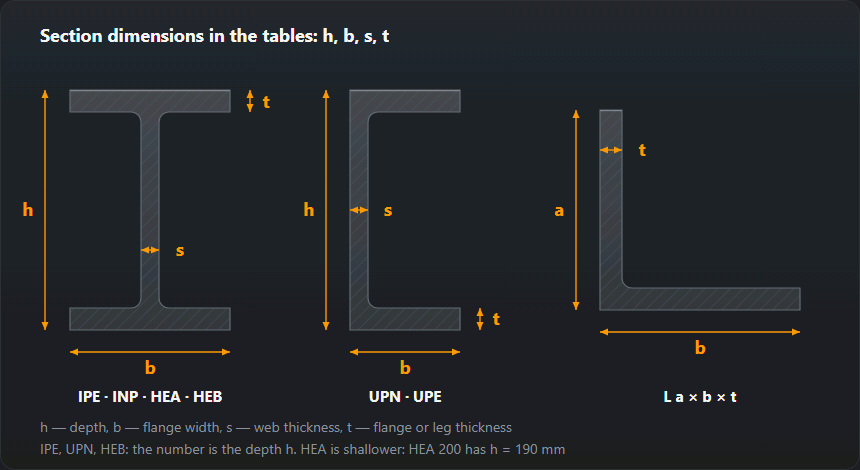
Depth h, flange width b, web thickness
s, flange thickness t, mass per metre and
cross-sectional area A. Nominal values to the standard named
above each table.
IPE beams — EN 10365
| Section | h, mm | b, mm | s, mm | t, mm | Mass, kg/m | A, cm² |
|---|---|---|---|---|---|---|
| IPE 80 | 80 | 46 | 3.8 | 5.2 | 6 | 7.64 |
| IPE 100 | 100 | 55 | 4.1 | 5.7 | 8.1 | 10.3 |
| IPE 120 | 120 | 64 | 4.4 | 6.3 | 10.4 | 13.2 |
| IPE 140 | 140 | 73 | 4.7 | 6.9 | 12.9 | 16.4 |
| IPE 160 | 160 | 82 | 5 | 7.4 | 15.8 | 20.1 |
| IPE 180 | 180 | 91 | 5.3 | 8 | 18.8 | 23.9 |
| IPE 200 | 200 | 100 | 5.6 | 8.5 | 22.4 | 28.5 |
| IPE 220 | 220 | 110 | 5.9 | 9.2 | 26.2 | 33.4 |
| IPE 240 | 240 | 120 | 6.2 | 9.8 | 30.7 | 39.1 |
| IPE 270 | 270 | 135 | 6.6 | 10.2 | 36.1 | 45.9 |
| IPE 300 | 300 | 150 | 7.1 | 10.7 | 42.2 | 53.8 |
| IPE 330 | 330 | 160 | 7.5 | 11.5 | 49.1 | 62.6 |
| IPE 360 | 360 | 170 | 8 | 12.7 | 57.1 | 72.7 |
| IPE 400 | 400 | 180 | 8.6 | 13.5 | 66.3 | 84.5 |
| IPE 450 | 450 | 190 | 9.4 | 14.6 | 77.6 | 98.8 |
| IPE 500 | 500 | 200 | 10.2 | 16 | 90.7 | 116 |
| IPE 550 | 550 | 210 | 11.1 | 17.2 | 106 | 134 |
| IPE 600 | 600 | 220 | 12 | 19 | 122 | 156 |
INP beams (tapered flange) — DIN 1025-1
| Section | h, mm | b, mm | s, mm | t, mm | Mass, kg/m | A, cm² |
|---|---|---|---|---|---|---|
| INP 80 | 80 | 42 | 3.9 | 5.9 | 5.94 | 7.57 |
| INP 100 | 100 | 50 | 4.5 | 6.8 | 8.34 | 10.6 |
| INP 120 | 120 | 58 | 5.1 | 7.7 | 11.1 | 14.2 |
| INP 140 | 140 | 66 | 5.7 | 8.6 | 14.3 | 18.3 |
| INP 160 | 160 | 74 | 6.3 | 9.5 | 17.9 | 22.8 |
| INP 180 | 180 | 82 | 6.9 | 10.4 | 21.9 | 27.9 |
| INP 200 | 200 | 90 | 7.5 | 11.3 | 26.2 | 33.4 |
| INP 220 | 220 | 98 | 8.1 | 12.2 | 31.1 | 39.5 |
| INP 240 | 240 | 106 | 8.7 | 13.1 | 36.2 | 46.1 |
| INP 260 | 260 | 113 | 9.4 | 14.1 | 41.9 | 53.3 |
| INP 280 | 280 | 119 | 10.1 | 15.2 | 47.9 | 61 |
| INP 300 | 300 | 125 | 10.8 | 16.2 | 54.2 | 69 |
HEA beams — EN 10365
| Section | h, mm | b, mm | s, mm | t, mm | Mass, kg/m | A, cm² |
|---|---|---|---|---|---|---|
| HEA 100 | 96 | 100 | 5 | 8 | 16.7 | 21.2 |
| HEA 120 | 114 | 120 | 5 | 8 | 19.9 | 25.3 |
| HEA 140 | 133 | 140 | 5.5 | 8.5 | 24.7 | 31.4 |
| HEA 160 | 152 | 160 | 6 | 9 | 30.4 | 38.8 |
| HEA 180 | 171 | 180 | 6 | 9.5 | 35.5 | 45.3 |
| HEA 200 | 190 | 200 | 6.5 | 10 | 42.3 | 53.8 |
| HEA 220 | 210 | 220 | 7 | 11 | 50.5 | 64.3 |
| HEA 240 | 230 | 240 | 7.5 | 12 | 60.3 | 76.8 |
| HEA 260 | 250 | 260 | 7.5 | 12.5 | 68.2 | 86.8 |
| HEA 280 | 270 | 280 | 8 | 13 | 76.4 | 97.3 |
| HEA 300 | 290 | 300 | 8.5 | 14 | 88.3 | 112 |
| HEA 320 | 310 | 300 | 9 | 15.5 | 97.6 | 124 |
| HEA 340 | 330 | 300 | 9.5 | 16.5 | 105 | 133 |
| HEA 360 | 350 | 300 | 10 | 17.5 | 112 | 143 |
| HEA 400 | 390 | 300 | 11 | 19 | 125 | 159 |
| HEA 450 | 440 | 300 | 11.5 | 21 | 140 | 178 |
| HEA 500 | 490 | 300 | 12 | 23 | 155 | 198 |
| HEA 550 | 540 | 300 | 12.5 | 24 | 166 | 212 |
| HEA 600 | 590 | 300 | 13 | 25 | 178 | 226 |
HEB beams — EN 10365
| Section | h, mm | b, mm | s, mm | t, mm | Mass, kg/m | A, cm² |
|---|---|---|---|---|---|---|
| HEB 100 | 100 | 100 | 6 | 10 | 20.4 | 26 |
| HEB 120 | 120 | 120 | 6.5 | 11 | 26.7 | 34 |
| HEB 140 | 140 | 140 | 7 | 12 | 33.7 | 43 |
| HEB 160 | 160 | 160 | 8 | 13 | 42.6 | 54.3 |
| HEB 180 | 180 | 180 | 8.5 | 14 | 51.2 | 65.3 |
| HEB 200 | 200 | 200 | 9 | 15 | 61.3 | 78.1 |
| HEB 220 | 220 | 220 | 9.5 | 16 | 71.5 | 91 |
| HEB 240 | 240 | 240 | 10 | 17 | 83.2 | 106 |
| HEB 260 | 260 | 260 | 10 | 17.5 | 93 | 118 |
| HEB 280 | 280 | 280 | 10.5 | 18 | 103 | 131 |
| HEB 300 | 300 | 300 | 11 | 19 | 117 | 149 |
| HEB 320 | 320 | 300 | 11.5 | 20.5 | 127 | 161 |
| HEB 340 | 340 | 300 | 12 | 21.5 | 134 | 171 |
| HEB 360 | 360 | 300 | 12.5 | 22.5 | 142 | 181 |
| HEB 400 | 400 | 300 | 13.5 | 24 | 155 | 198 |
| HEB 450 | 450 | 300 | 14 | 26 | 171 | 218 |
| HEB 500 | 500 | 300 | 14.5 | 28 | 187 | 239 |
| HEB 550 | 550 | 300 | 15 | 29 | 199 | 254 |
| HEB 600 | 600 | 300 | 15.5 | 30 | 212 | 270 |
Rolling has tolerances: EN 10034 permits deviations in the section dimensions, and batch mass can differ from nominal by a few per cent. For invoicing and settlement the certified mass applies — the table is for design, first-pass costing and choosing lifting gear.
IPE, INP, HEA and HEB are the European range, the one held in stock across the EU and the UK. American W and S shapes to ASTM A6 are a different series with different proportions, and there is no size-for-size conversion between the two: a W 8×31 is not an HEB 200. For those, take the mass from the AISC tables instead.
IPE, INP, HEA, HEB — how they differ
IPE — a parallel-flange beam with a narrow flange. Width is roughly half the depth, the flanges are parallel, and the section is optimised for bending in one plane. This is the standard floor beam and portal rafter.
INP (normal beam) — the older shape, with the flange tapered 14 % on the inside. Still found in older structures and in rolled products outside the European standard. The sloping surface makes it awkward to seat a flat plate and calls for tapered washers under bolts.
HEA and HEB — wide-flange beams: flange width equals the depth or comes close to it. HEA is the light version, HEB the standard one, heavier and stiffer. They go into columns and anywhere load acts in two planes. Watch the numbering: HEA 200 is actually 190 mm deep, while HEB 200 is exactly 200 mm.
What this means at the torch
Flange thickness decides the procedure more than the section number does. On IPE 200 the flange is 8.5 mm — a fillet weld with no preparation, one or two runs. On HEB 200 it is 15 mm and on HEB 300 19 mm: now you need edge preparation, several runs and control of heat input, and for steel with a higher carbon equivalent also preheat.
The second point is mass. A 6 m HEB 300 weighs 700 kg — you do not turn that by hand or tack it on a single spot. The figure worked out above is at the same time your sling selection and a check on whether the wanted weld position can be held at all, or whether it has to be welded out of position.
The third is how much deposited metal the joint will take. Groove area and weld length are converted by the electrode consumption calculator, and the full cost per metre of weld including gas and labour by the weld cost calculator.
IPE, HEA or HEB: what the choice of series costs
At the same number the series changes the weight — and so the steel price — several times over. A metre of IPE 200 weighs 22.4 kg, HEA 200 42.3 kg, HEB 200 61.3 kg — 2.7 times the IPE. A “200 beam” on a request for quotation without the series letter is a price spread of almost three to one.
The reverse case is more interesting: the same weight, a different shape. IPE 300 (42.2 kg/m) and HEA 200 (42.3 kg/m) carry practically the same steel per metre, but the first is 300 mm deep and the second 190 mm. In a floor beam bending in the vertical plane the deeper IPE puts that steel to far better use; in a column that can buckle either way, the wide HEA flange works better.
The third case is limited construction depth. When the floor build-up will not take an IPE 300, a shallower wide-flange section goes in instead — and every centimetre saved is paid for in steel: HEB 200 weighs 61.3 kg/m, 45 % more than IPE 300. Whether the substitute carries the load is for the structural check to Eurocode 3 — this calculator gives weight, not capacity.

Worked example: the steel weight of a 5 × 4 m mezzanine
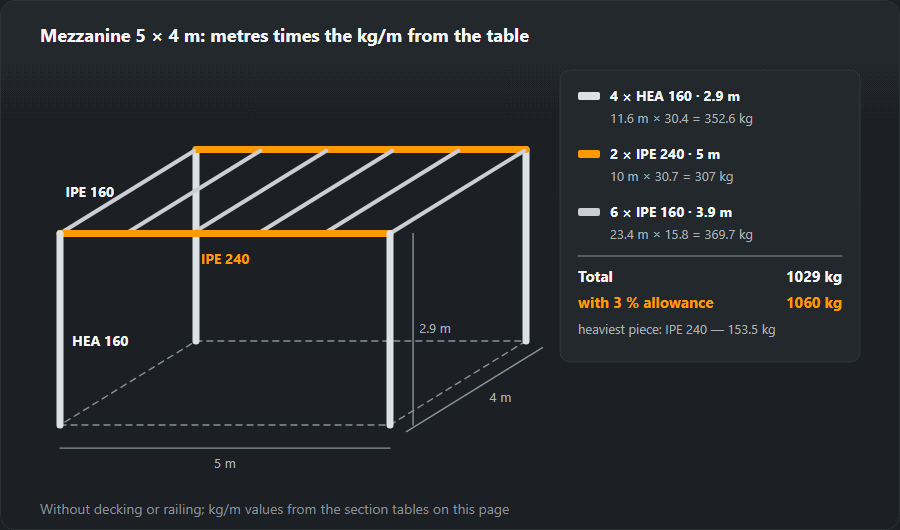
Four HEA 160 columns of 2.9 m, two IPE 240 main beams of 5 m and six IPE 160 secondary beams of 3.9 m (decking and handrail not included):
- columns — HEA 160: 4 × 2.9 m = 11.6 m × 30.4 = 352.6 kg
- main beams — IPE 240: 2 × 5 m = 10 m × 30.7 = 307 kg
- secondary beams — IPE 160: 6 × 3.9 m = 23.4 m × 15.8 = 369.7 kg
- Total: 1029 kg; with 3 % added for gussets, welds and offcuts — 1060 kg
That number drives two shop decisions. The first is handling and erection: the heaviest single piece is an IPE 240 main beam at 153.5 kg — no longer something to carry by hand, and it will not go up onto the columns without a hoist or a forklift. The second is buying: the columns come out of two 6 m bars of HEA 160 with 0.2 m offcuts, and the six 3.9 m IPE 160 beams are either six 6 m bars with six 2.1 m offcuts, or two 12 m bars cut three to a bar with only 0.3 m waste from each. The cutting list calculator checks the nesting, and typical platform and mezzanine layouts are covered under platforms and walkways.

Metres, bars and the cost of a beam
A tonne of IPE 200 is 44.6 m, which is 8 bars of 6 m rounded up; a tonne of HEB 300 is only 8.5 m. A single 12 m bar of HEB 300 weighs 1404 kg — before ordering, find out what will unload it and whether the workshop crane is rated for it.
Steel cost: K = Σ (L · G) · C — the metres of each line times its mass per
metre, summed, times the price per kilogram C. At the same kilogram price a
metre of HEB 200 costs 2.7 times a metre of
IPE 200, because it weighs that much more. Cutting, drilling and corrosion protection
are added separately: cutting per piece, painting by surface area, not by weight.
Common mistakes when working out beam weight
- “200 beam” with no series. IPE 200 is 22.4 kg/m, INP 200 26.2 kg/m (17 % more), with a different flange shape as well. British UB/UC and American W shapes are separate ranges; their designations do not map one to one onto IPE or HE.
- The HEA number taken as the depth. HEA 300 is 290 mm deep, HEA 600 590 mm. Swap a beam for another series and the bearing level of the floor moves.
- A section picked by weight alone. IPE 220 and INP 200 both weigh 26.2 kg/m and are entirely different beams — which is why the calculator selects by designation, not by kilograms.
- HEM treated as HEB. The heaviest wide-flange series, HEM, is not in these tables; at the same number it is markedly heavier than HEB, and its weight comes from the producer’s catalogue.
Frequently asked questions
How much does a 6 m IPE 200 beam weigh?
IPE 200 weighs 22.4 kg per metre, so a 6 m length comes to 134 kg. For comparison HEB 200 at the same depth weighs 61.3 kg/m — 368 kg over 6 m, nearly three times as much.
What is the difference between IPE and HEB at the same depth?
IPE has a narrow flange — width roughly half the depth — and works as a beam bent in one plane. HEB has a flange as wide as the section is deep and carries load in both directions, which is why it goes into columns. For welding the difference is real: the HEB 200 flange is 15 mm thick against 8.5 mm on IPE 200, so the first needs edge preparation and often preheat, the second does not.
Why does the table mass differ from the weighed mass?
Because the table gives the nominal value and the rolling mill works to tolerances: EN 10034 allows deviations in depth, width and flange thickness, and for a batch a mass deviation of a few per cent. Invoicing goes by the mass on the mill certificate, not by the table.
What does HEB 200 weigh per metre and per 12 m bar?
HEB 200 weighs 61.3 kg/m. A 6 m bar is 367.8 kg, a 12 m bar 735.6 kg — so a twelve-metre HEB 200 is not carried by hand or lifted with a garage winch.
What do IPE 240 and IPE 270 weigh per metre?
IPE 240 is 30.7 kg/m (184.2 kg per 6 m), IPE 270 is 36.1 kg/m (216.6 kg per 6 m). The IPE range has no 250 or 260 between them.
What does HEA 120 weigh and how deep is it?
HEA 120 weighs 19.9 kg/m; a 6 m bar is 119.4 kg. Its actual depth is 114 mm with a 120 mm flange — like the whole HEA series, it is shallower than its number.
How much does a 5 m beam weigh?
Mass per metre times five, but only once the section is known. A 5 m IPE 200 weighs 112 kg, an IPE 300 211 kg, a HEA 200 211.5 kg and a HEB 200 306.5 kg. “A 200 beam” without the series is a spread of almost three to one.
Updated: