Welding positions to EN ISO 6947 and their AWS equivalents
The position is not a detail of how you stand. It changes the current, the electrode diameter, the technique and — through the qualification range — what you are allowed to weld at all.
Short answer
The ISO 6947 codes: PA — flat, PC — horizontal, PE — overhead, PF — vertical up. A harder position covers the easier ones, so one certificate closes several kinds of work — the coverage table is below.

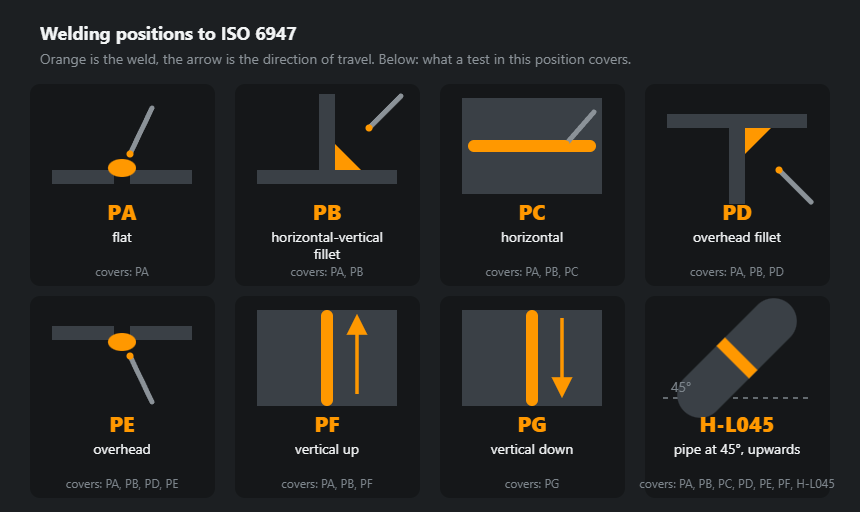
The codes
| ISO 6947 | Name | AWS | What it means |
|---|---|---|---|
| PA | Flat | 1G / 1F | Weld from above onto a horizontal joint. The easiest, and the fastest. |
| PB | Horizontal-vertical | 2F | A fillet in the corner between a horizontal and a vertical plate. |
| PC | Horizontal | 2G | A horizontal weld on a vertical surface. Gravity pulls the pool downwards. |
| PD | Horizontal-overhead | 4F | An overhead fillet. Uncomfortable and slow. |
| PE | Overhead | 4G | Welding above your head. Everything is working against you. |
| PF | Vertical up | 3G up | Vertical, welding upwards. Good penetration, slow. |
| PG | Vertical down | 3G down | Vertical, welding downwards. Fast, shallow penetration. |
| PH | Pipe, vertical up | 5G | Fixed horizontal pipe, welded upwards around it. |
| H-L045 | Pipe at 45° | 6G | Fixed pipe at 45°. The broadest single qualification there is. |
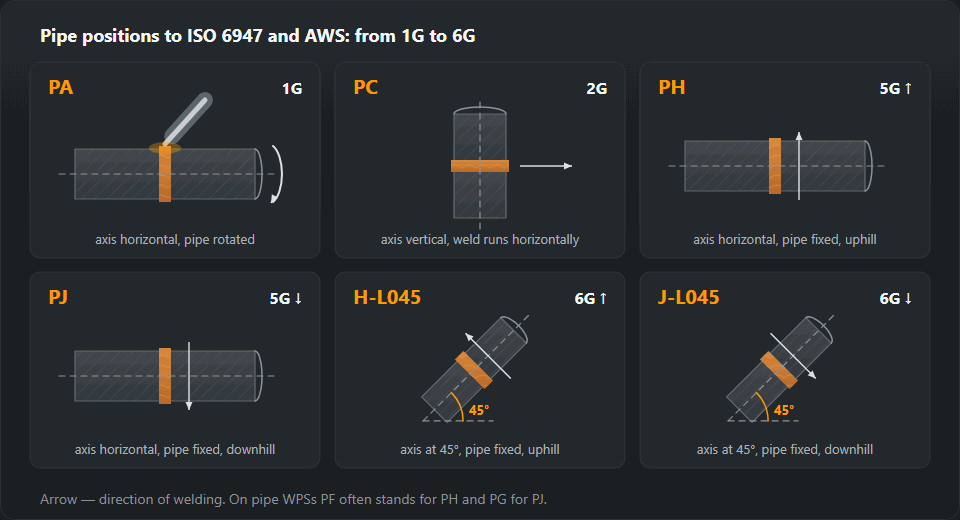
Both notations are in circulation and both end up in documents. PF and PG are strictly plate positions: vertical up and vertical down. For a pipe with a horizontal axis ISO 6947 has its own designations — PH for welding upwards and PJ for welding downwards — but in shop practice and in plenty of WPS documents people simply write PF and PG for pipe as well. The American 5G does not distinguish direction on its own, which is why an arrow gets added to it. A pipe at 45° is H-L045 upwards and J-L045 downwards; AWS calls both 6G.
Why the position changes the settings
Everything follows from one fact: in the flat position, gravity holds the pool in the joint, and in every other position it does not. A pool that gravity is pulling out of the joint has to be small, and a small pool means less current, a smaller electrode and a technique that gives the metal time to freeze.
In practice: drop the current about 10 % for horizontal (PC), 15 % for vertical and 20 % for overhead — the current calculator applies this. Keep the electrode at 4 mm or below: 5 and 6 mm electrodes are effectively unusable vertically because the pool becomes too large to hold.
Each position: set-up, electrode, current, typical fault
The current factors are the ones given above, relative to PA; the PB fillet adds one more, ×0.95, between flat and horizontal. For every position: how the work stands, how to hold the electrode or torch, what current, and the fault you will see most often.
PA — flat
The joint lies horizontal and you weld from above. A fillet in PA is set in the boat: the T is tilted so the corner faces up at 45°. Hold the electrode at 70–80° to the surface with a 10–15° tilt in the direction of travel; in the boat it sits on the bisector, 45° to both legs. Current ×1.0, and from about 4 mm of plate the top of the range is usable. The typical fault is not running but overheating: burn-through on thin plate and slag running ahead of a pool that moves too slowly. More in welding in the flat position.
PB — horizontal-vertical fillet
One plate lies flat, the other stands on it, and the fillet runs horizontally along the corner. Electrode at 45° to both legs, biased slightly towards the vertical leg to balance gravity, 10–15° tilt in the direction of travel. Current ×0.95. The typical fault is an unequal leg: overlap on the bottom plate and undercut on the vertical one, which a fillet gauge shows at once. PB exists only for fillet welds — see the horizontal fillet weld.
PC — horizontal
The plates stand vertical and the joint runs horizontally across them (2G); a vertical pipe with a circumferential weld is also PC. Point the electrode 5–15° upwards from horizontal, keep the arc short and build narrow stringers from the bottom of the groove upwards, each overlapping the one below. Current ×0.9, that is −10 %. The typical fault is undercut along the upper edge with sag onto the lower plate — the price of a wide weave. More in horizontal welding.
PD — horizontal-overhead fillet
The fillet sits in the corner between a vertical plate and a horizontal plate above your head. Electrode on the bisector, biased towards the vertical leg, 10–15° travel tilt, usually 2.5 or 3.2 mm. Current ×0.8 (−20 %) and a very short arc. The typical fault is overlap wherever you pause; nothing above a 6 mm leg goes in one run. See the overhead fillet.
PE — overhead
A butt joint in a horizontal plate welded from below (4G). Electrode nearly square to the plate with a slight drag angle, 2.5 or 3.2 mm, the shortest arc you can hold, narrow straight beads or a small weave with no dwell in the middle. Current ×0.8. The typical fault is a sagging, convex cap and slag left between runs — overhead it clings more readily than anywhere else. Everything that falls lands on you, so the personal protective equipment matters more here than anywhere. Technique in detail: overhead welding.
PF — vertical up
The joint is vertical and the weld climbs from the bottom. The shelf of frozen metal below carries the pool, so the arc can stay in the joint and penetrate. Weave in steps or a zigzag, on fillets in a triangle pointing into the corner, and pause about half a second at each edge — the pause fills the toes and prevents undercut. The root goes in as a straight stringer. Current ×0.85 (−15 %), electrode 4 mm at most. The typical faults are undercut down both sides when you pause in the middle instead of at the edges, and a drop running out when the arc gets long. More in vertical-up welding.
PG — vertical down
The same joint, travelling downwards. Electrode at 70–80° to the plate with the tip pointing up, a short arc aimed into the pool and never ahead of it, fast travel and no weave. The current is not lower than for PF — the speed keeps the pool small. The typical fault is lack of fusion hidden under a neat surface: the arc runs over metal that has slid ahead of it. PG belongs on thin plate up to about 4 mm, cellulosic pipeline roots and galvanised sheet — see welding downhill.

PH and PJ — fixed horizontal pipe
The pipe axis is horizontal and the pipe does not turn (5G). In one circumference the weld passes through overhead at the bottom, vertical at the sides and flat on top, so the current sits in the overhead-vertical group, ×0.8–0.85 of PA. In PH each half is welded upwards, from just past the bottom to the top; in PJ downwards from the top, the usual cellulosic root on pipelines. The typical fault is lack of fusion at the tie-ins at six and twelve o'clock, where the halves meet — grind the start of each half to a taper before closing it. Set-ups 1G to 6G are compared in pipe welding positions.
H-L045 and J-L045 — fixed pipe at 45°
The pipe axis is inclined at 45° and the pipe is fixed (6G): no point on the circumference repeats another, and the joint itself is inclined. H-L045 is welded upwards, J-L045 downwards. The current follows the same ×0.8–0.85 group as PH, with the arc length doing the fine adjustment round the pipe. The typical fault is the pool sliding to the lower side of the bevel — undercut on the upper edge, overlap on the lower — so the electrode is kept aimed slightly towards the upper edge. It is the broadest single test on the coverage table below.
Worked example: a 3.2 mm electrode in every position
The base comes from the current table: a 3.2 mm rutile electrode on 3–6 mm non-alloy steel takes 90–140 A in PA, 115 A in the middle. Multiply by the position factor and round to 5 A, exactly as the calculator does:
- PB, ×0.95: 85–135 A, middle 110 A;
- PC, ×0.9: 80–125 A, middle 105 A;
- PF, ×0.85: 75–120 A, middle 100 A;
- PE and PD, ×0.8: 70–110 A, middle 90 A.
Start in the middle of the band and move 5–10 A at a time by what the pool shows: a pool that bulges and runs means too much current, a narrow humped bead means too little. For 5 and 6 mm electrodes there is no vertical or overhead line at all — they are used flat and horizontal only. Every diameter, already recalculated, is in the current and diameter table.
PF or PG: what the WPS allows
The WPS has a welding position field filled with ISO 6947 codes, and for a vertical weld the code already carries the direction: PF is up, PG is down. If the WPS says PF, running the same joint downwards is outside the procedure even when the surface looks fine — penetration and heat input in PG are lower, and the procedure covers only the direction it lists. When the WPS lists several positions, for example PA, PB, PF, each run may be made in any of them, but never in one that is not listed. What else the card fixes is described on the WPS page.
The certificate has to cover the position too, and there the direction matters just as much: a welder qualified in PF alone may not weld downhill (the coverage table is further down). On pipe the documents often read PF/PG instead of PH/PJ — read the direction, not the letter.
Fillet or butt: which codes go with which joint
Some codes exist for one kind of joint only. PB and PD are fillet positions: the horizontal-vertical corner and the overhead corner. PC and PE are butt positions: a horizontal seam on a wall and a seam above your head. PA, PF and PG serve both: a butt in PA is 1G, a fillet in PA (in the boat) is 1F, the vertical ones are 3G and 3F. PH, PJ, H-L045 and J-L045 describe pipe butt joints. The American suffix says the same: G for groove, F for fillet.
That is why "PB" on a butt joint or "PC" on a fillet is worth querying rather than taking as an exotic variant. In a certificate designation the joint type stands next to the position — BW for butt, FW for fillet — and the two are read together.
How to tell the position from the drawing and the WPS
The weld symbol on a drawing usually does not state the position: its tail carries the process number and often a WPS reference. The position follows from the WPS and from how the part stands when it is welded. Work through it in this order:
- Butt or fillet, from the symbol: a triangle is a fillet; V, bevel and square are butts.
- Where the weld axis runs with the part as it will be welded. A part welded in the shop can often be turned into PA; the same joint on an erected structure cannot.
- Horizontal axis: welding from above is PA (PB for a fillet against a vertical plate); along a vertical wall PC; from below PE for a butt, PD for a fillet.
- Vertical axis: the direction written in the WPS — PF up, PG down. If the WPS gives only PF, you weld up.
- Pipe: does it turn? Rotated and welded on top is PA; fixed with a horizontal axis PH/PJ; fixed vertical PC; fixed at 45° H-L045 or J-L045.
Then check the result against two documents: the position field of the WPS and the position on your certificate. If either does not include it, the joint needs a positioner or another procedure, not a different technique.
The position on your certificate
The position in which you took the test decides which positions your certificate covers, and the rule runs one way: harder covers easier. The table is the conservative reading, the same as in the calculator: where the standard leaves options, only what is covered unambiguously is listed.
| Passed in position | Covers |
|---|---|
| PA — flat | PA |
| PB — horizontal-vertical fillet | PA, PB |
| PC — horizontal | PA, PB, PC |
| PD — overhead fillet | PA, PB, PD, PE |
| PE — overhead | PA, PB, PC, PD, PE |
| PF — vertical up | PA, PB, PF |
| PG — vertical down | PG |
| H-L045 — pipe at 45°, upwards | PA, PB, PC, PD, PE, PF, PH, H-L045 |
| J-L045 — pipe at 45°, downwards | PA, PC, PE, PG, J-L045 |
Two things follow from it. PG stands alone: it covers nothing but itself, and no plate position covers it. And one pipe test in H-L045 covers exactly what three plate tests in PC, PE and PF cover together — PA, PB, PC, PD, PE and PF. Its downhill counterpart J-L045 covers PA, PC, PE, PG and J-L045 — but not PF. The position is only one line of the designation, though: process, thickness, diameter and joint type narrow the range further, which is why the final answer comes from the qualification range calculator.
Frequently asked questions
Does a PF qualification cover PA?
Yes. Positions cover downwards in difficulty: a test in PF covers PA and PB, while a test in PA covers nothing beyond itself. That is why examiners suggest sitting the harder position even though the pass rate is lower.
PF or PG — up or down?
PF is vertical up and PG is vertical down. Up gives penetration and is what structural work asks for; down is fast and shallow and belongs on thin sheet and on cellulosic pipeline root runs. Using PG where the WPS asks for PF is a classic cause of lack of fusion.
How do the ISO and AWS position codes relate?
They describe the same positions with different labels: PA is roughly 1G/1F, PC is 2G, PF is 3G upwards, PE is 4G, and the pipe positions PH and H-L045 correspond to 5G and 6G. The correspondence is close but not exact, so a certificate is read in the system it was issued in.
What is the PF welding position and what current does it take?
PF is vertical up to EN ISO 6947: the joint stands upright and the weld travels from the bottom to the top (3G or 3F uphill in AWS). The current is about 15 % below the flat position: a 3.2 mm rutile electrode takes 75–120 A instead of 90–140 A. Electrodes above 4 mm are not used in PF.
What is the difference between PB and PC?
PB is a fillet weld in the corner between a horizontal and a vertical plate (2F). PC is a butt weld running horizontally across a vertical wall (2G). Both are called horizontal, but PB exists only for fillets and PC only for butts. PB takes about 5 % less current than PA, PC about 10 % less.
Does a PG test cover PF?
No, and it does not work the other way either. On the coverage table PG covers only PG, and PF covers PA, PB and PF. A pipe test in J-L045 covers PA, PC, PE, PG and J-L045, still nothing uphill. A shop that welds both directions needs both on the certificate.
Updated: