Overhead fillet welding PD: the T-joint above your head
PD is PB held up overhead: the same T-joint, except that surface tension alone holds the pool and everything surplus falls on the welder. The whole technique comes down to one thing — the pool has to be small.
Short answer
An overhead fillet in position PD takes 20 % less current than the flat position (factor ×0.8) and a thinner electrode, usually 2.5 or 3.2 mm. For a 3.2 mm rutile that is 70–110 A (middle 90 A), for 2.5 mm 55–80 A. Keep the arc very short and the beads narrow and without pauses, and never lay a leg above 6 mm in one run; anything larger is split into at least three beads: root, vertical plate, then the bead under the top plate. A basic electrode is the best choice. The technique step by step is below.
When PD is unavoidable
When the assembly is already up and cannot be turned: a rib under a beam, a gusset on the underside of a floor, a repair beneath a machine, a joint on a frame already erected. In a shop it is nearly always cheaper to roll the part — in the boat the same weld runs twice as fast and with no burn risk. On site there is no such option, and PD becomes compulsory.

How to run it
Take the current 20 % below the flat position and a thinner electrode — usually 2.5 or 3.2 mm. Keep the arc very short: a long arc means a big droplet, and a big droplet overhead falls. Run narrow beads without pausing, straight or with a small weave; a stop anywhere gives overlap. As in PB, the electrode sits on the bisector with a slight bias towards the vertical leg and a 10–15° tilt in the direction of travel.
Guide settings, current 20 % below the flat position
| Thickness, mm | Electrode diameter, mm | Current, A |
|---|---|---|
| 1–2 | 1.6 | 30–50 |
| 1.5–3 | 2.0 | 40–65 |
| 2–4 | 2.5 | 55–80 |
| 3–5 | 3.0 | 65–105 |
| 3–6 | 3.2 | 70–110 |
| 6–12 | 4.0 | 105–150 |
Angles, current and arc: rutile and basic worked through
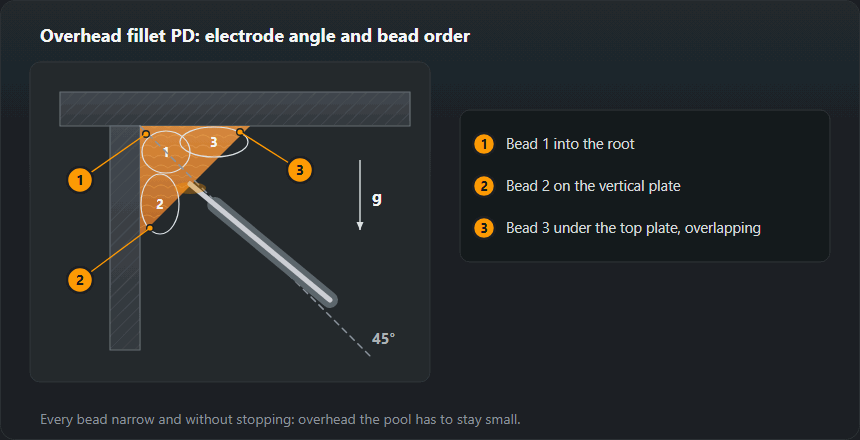
Work angle — on the bisector, 45° to both plates, leaning slightly towards the vertical plate: the arc heats it and keeps the pool from hanging on the top plate. Travel angle — 10–15° in the direction of travel. More tilt lengthens the arc even with the tip close to the root.

Current. The PD factor is ×0.8, i.e. 20 % below flat — the same rule the table on this page and the current calculator use. A 3.2 mm rutile electrode: flat 90–140 A, PD 70–110 A, middle 90 A. A basic electrode gets a further ×1.05 for the coating: 75–120 A, middle 95 A. 2.5 mm in PD: 55–80 A, middle 70 A. Start in the middle and adjust in 5 A steps: the bead sags — less; no root fusion — more, but never below the bottom of the band.
Arc length. 0.8–1.0 × diameter: 2.6–3.2 mm for 3.2 mm, 2.0–2.5 mm for 2.5 mm, kept at the short end in PD. Electrode motion, stance and arm support are the same for any work above your head — see overhead welding.
Bead sequence in PD
- Bead 1 into the root — a straight stringer on the bisector, low end of the band.
- Bead 2 on the vertical plate — overlapping the first; the vertical plate supports it.
- Bead 3 under the top plate — resting on bead 2 instead of hanging from the top plate alone. The reverse order (straight under the top plate) gives a sagging bead.
Leg size per run
Nothing above 6 mm goes in one run overhead: the pool has to stay small or it sags and drops. That is half of what the boat allows and a quarter less than PB — the same item takes about twice as long in PD. A leg of 8 mm and up is split into at least three runs, each narrow, with the slag fully removed between them: overhead the slag clings more readily than anywhere else.
How much per pass: examples from the fillet table
The limit for a single pass in PD is a 6 mm leg (the welding positions overview says the same). From the fillet calculator table (z = a·√2):
- a = 3 — z = 4.2 mm, a = 4 — z = 5.7 mm: one bead.
- a = 5 — z = 7.1 mm, a = 6 — z = 8.5 mm: over a 6 mm leg, so several beads as in the diagram above.
Metal grows with the square: a = 4 takes 0.14 kg of weld metal per metre, a = 6 already 0.31 kg — and in PD every extra bead is another pass above your head with slag to chip. That is why on site the weld size is kept strictly to the drawing. The a-to-z conversion and the design resistance come from the fillet weld size calculator.
What to weld it with
A basic electrode is the best overhead: its slag freezes quickly and props the pool up from below. Rutile spreads and drips — in PD it only suits thin material and small diameters. In MAG the overhead fillet runs in short arc — on an argon mixture or on pure CO₂ — or pulsed on an argon-rich mixture. Above the short-arc range pure CO₂ throws large droplets (it never reaches spray), and a large droplet will not hold overhead. Keep the stick-out as short as it will go.
MAG in PD: short-circuit settings
Overhead, MIG/MAG runs in short-circuit transfer (16–22 V). From the MIG/MAG settings table the thin-plate rows fit within it: 1.5–2 mm — 0.8 mm wire, 70–110 A, 17–19 V; 3 mm — 0.8–1.0 mm wire, 110–150 A, 19–21 V. The 5–6 mm setting (22–25 V) is already outside it, so a larger fillet in PD is welded on lower settings with more beads. Basic electrodes are baked at 300–350 °C for 2 h before use — a damp coating overhead means porosity. More in the MIG/MAG guide.
Protection in the overhead position
This is one of the two positions, along with PE, where sparks and droplets fall straight onto the welder. Button the jacket up to the throat, run the gauntlet cuffs over the sleeves and the trouser legs over the boots, and add a neck cape to the helmet. Burns here come not from the arc but from a droplet that found its way inside a collar or a cuff.
Judging an overhead fillet
- Sagging bead, excessive convexity (503) — for a 10 mm wide weld ISO 5817 allows up to 2 mm at level B, 2.5 mm at C and 3.5 mm at D. PD is where it is easiest to exceed: high current, long arc or a pause.
- Undercut on the top plate — at 10 mm thickness up to 0.5 mm at B, 0.5 mm at C, 1 mm at D. Cause: arc aimed at the top plate or a pause at the top.
- Lack of root fusion — the surface looks clean. Usually the current was cut below the band for fear of drips. Check it with a fracture test on a trial piece.
- Porosity — more likely than flat: a small, fast-freezing pool does not release gas. Dry electrodes and edges cleaned more carefully than usual.
Designation and qualification
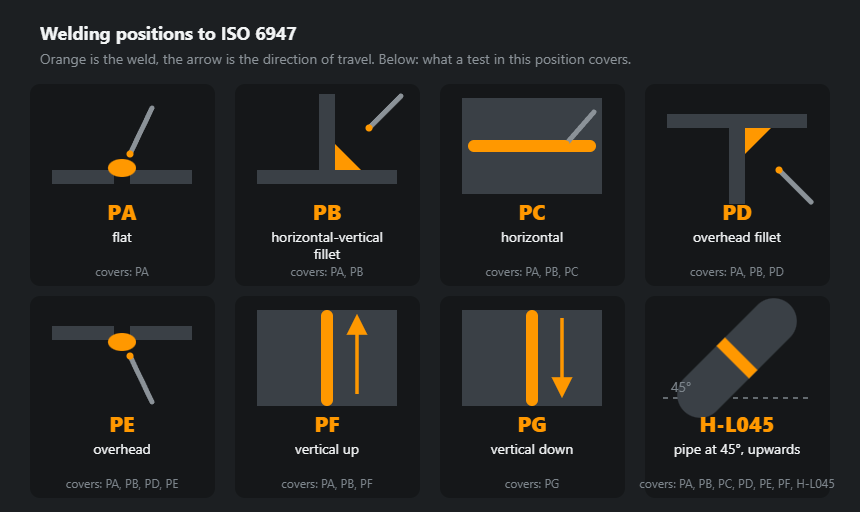
PD to EN ISO 6947, 4F in the American system. A test in PD covers PA, PB, PC, PD and PE — five positions from a single test, which makes it a good-value certificate for a shop that works on site. It does not cover butt welds: those need a separate butt test, for example in PE. A fillet test piece in PE would give the same range as PD.
Practice and the PD qualification
- PB first. The same T lying flat — technique and angles in fillet welding in PB. Only when the legs come out even does the T go overhead.
- One bead in PD. 8–10 mm plates, 2.5 mm electrode, a root bead over the full length of the electrode without stopping.
- Three beads. Sequence as in the diagram; chip all slag after each bead.
- Fracture test. The break shows root fusion and pores.
A fillet test piece in PD covers PA, PB, PC, PD, PE under EN ISO 9606-1 (Table 10). A fillet test piece in PE gives exactly the same range, so for overhead fillet welds PD and PE are equivalent. A butt test in PE covers PA, PC, PE, but for butt welds only: a butt test piece on its own does not qualify fillet welds (clause 5.4). The comparison is in the welding positions overview, and the range for your data in the qualification range calculator.
Frequently asked questions
Why is the current lower overhead?
Because surface tension alone holds the pool. The more current, the bigger the pool and the surer it is to sag and drop. You take 20 % off the flat setting and pick a thinner electrode — the same thing by another route.
What leg goes in one run?
Up to 6 mm. Beyond that, split it: three narrow runs instead of one wide one, with the slag chipped off between them. Trying to lay 8 mm at once gives a sagging bead and lack of fusion at the root.
Rutile or basic?
Basic. Its slag freezes quickly and props the pool from below, which is exactly what overhead needs. Rutile spreads and drips; in PD it is taken only on thin material and in a small diameter.
What does a test in PD cover?
PA, PB, PC, PD and PE to EN ISO 9606-1 — five positions from one test. It does not cover butt welds: those need a separate butt test, for example in PE. A fillet test piece in PE gives the same range.
What current for a 3.2 mm electrode in the PD position?
Rutile: 70–110 A, start at about 90 A (flat 90–140 A). Basic, with the ×1.05 coating correction: 75–120 A. Do not go below the bottom of the band — root fusion is lost.
In what order do the beads go in an overhead fillet?
The root first, then the bead on the vertical plate, and last the bead under the top plate, resting on the previous one. A bead laid straight under the top plate has no support and sags.
Does a PE test cover PD?
It depends on the test piece. A fillet weld in PE covers PA, PB, PC, PD, PE under Table 10 of EN ISO 9606-1 — the same as a PD test piece. A butt test in PE covers PA, PC, PE, but for butt welds only: on its own it does not qualify you for fillet welds.
Updated: