Welding vertical down: when it is allowed and how to run it
A vertical-down weld runs fast and looks tidy, but it forgives far less than welding uphill. Below: when the technique is allowed, when it is not, and what settings to use.
When you weld downhill
Downhill is for thin plate up to roughly 4 mm, where welding uphill would burn through. The second case is the root run on transmission pipelines with cellulosic electrodes, where the downward direction is written into the procedure. The third is galvanised sheet and car body work, where speed and low heat input matter.
When you must not
Not on thick material and not on load-bearing structures. The pool runs ahead of the arc, penetration stays shallow, and under a good-looking bead sits lack of fusion that no eye will catch. Basic electrodes are not made for downhill: the slag overtakes the pool. If the WPS does not allow the downward direction, the WPS decides.
How to run it
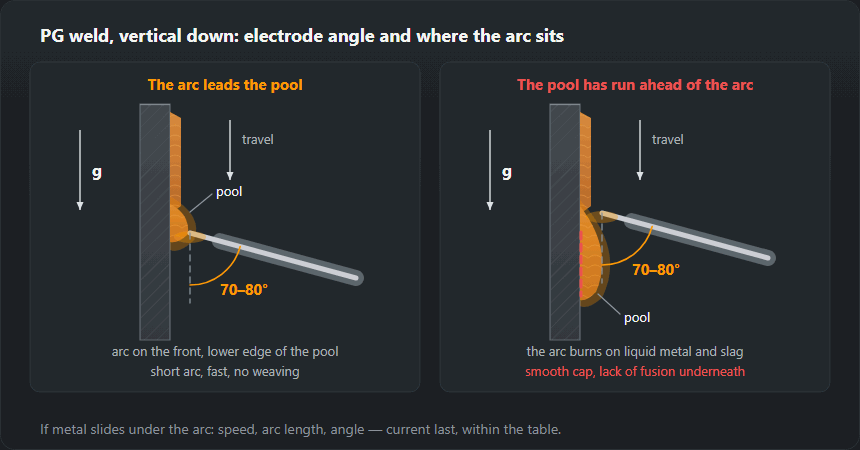
Keep the arc short and aim it into the pool, never ahead of it. Hold the electrode at 70–80° to the plate with the tip pointing up, so the arc pushes the molten metal backwards. Travel fast and without weaving: every pause becomes an overlap. Take more current than for uphill on the same thickness — from the upper part of the range for that diameter, as in the table below.

Guide settings for a cellulosic electrode
| Thickness, mm | Electrode diameter, mm | Current, A |
|---|---|---|
| 1,5 | 2,0 | 55–75 |
| 2,0 | 2,5 | 70–95 |
| 3,0 | 2,5–3,2 | 90–120 |
| 4,0 | 3,2 | 110–140 |
| 5,0 | 3,2–4,0 | 130–170 |
Stick welding vertical down, step by step
For a butt or fillet weld in PG on plate up to roughly 4 mm and for a pipe root. Thicker vertical joints go uphill — see vertical-up welding.
- Electrode. For pipeline roots — cellulosic E6010 or E6011: a hard, digging arc and little slag. For thin sheet — a thin rutile rod or an electrode made specifically for vertical down (German shops call it a Fallnahtelektrode). If PG is not among the positions on the box, the rod is not meant for it.
- Current from the table above. On 3 mm that is a 2.5–3.2 mm rod at 90–120 A, on 4 mm a 3.2 mm rod at 110–140 A. Start mid-range and prove it on vertical scrap.
- Start at the top. Edges cleaned to bright metal. Strike at the top end and hold for a moment until the pool wets both edges — skip that and the first stretch comes out cold-lapped.
- Angles. Along the joint, 70–80° to the plate with the rod tip pointing up into the pool; the holder sits lower than the arc. Across the joint, square to the plate on a butt, splitting the angle on a tee.
- Short arc. No longer than the rod diameter; a cellulosic rod in a root is run almost dragging on the edges.
- Fast, steady, no weave. The arc works on the leading, lower edge of the pool. When metal starts sliding under the arc, speed up or point the rod further up.
- Stops and restarts. At the end, fill the crater and break the arc. To restart, clean the crater, strike just above it on the bead and move down into it before carrying on.
Why the pool must never get ahead of the arc
In PG gravity pulls metal and slag the same way you travel. Once the pool runs ahead, the arc burns on liquid metal and slag instead of the base metal: the weld metal lies on cold edges without fusing into them. Outside you get a smooth bead, inside lack of fusion and slag under the face. Correct in this order: travel speed, arc length, angle, and only then current — inside the table range.
MIG welding vertical down on thin sheet
With MIG/MAG, PG is welded in short-circuit transfer: at 16–22 V the droplet shorts into the pool 50–200 times a second, so the pool stays small and freezes before it can run. Spray transfer (from 26–28 V) is for metal from 5 mm in the flat position, not for downhill.
Starting point from the site's MIG/MAG table: 0.8–1.0 mm sheet — 0.6–0.8 mm wire, 40–70 A, 15–17 V, gas 8–10 l/min; 1.5–2 mm — 0.8 mm wire, 70–110 A, 17–19 V, 10–12 l/min; 3 mm — 0.8–1.0 mm wire, 110–150 A, 19–21 V, 12–14 l/min. Hold the gun at a slight drag angle — nozzle tilted up towards the finished weld, wire aimed at the leading (lower) edge of the pool so the arc props the metal from below — keep stick-out constant and travel in a straight line. Narrow, humped bead and a crackling arc — voltage too low or travel too fast; a running pool — too slow. The thinnest gauges and burn-through are covered in welding thin metal.
Electrodes and wire
For downhill stick welding use cellulosic E6010 and E6011 or thin rutile electrodes. Basic ones are out. In MIG/MAG downhill is run in short arc on thin sheet; a flux-cored wire must carry the downhill position in its designation, otherwise the slag cannot keep up.
Common mistakes
Travelling too slowly — the pool overtakes the arc and leaves an overlap with lack of fusion under it. Too long an arc — slag runs into the bead. Weaving as if welding uphill: on a downhill run it makes no sense and only chills the edge.
What the standard says
The vertical-down position is PG to EN ISO 6947; the American equivalent is 3G downhill. A qualification passed in PG does not cover PF: they are two different positions and two different test pieces.
PG vs PF welding position: side by side
| Feature | PG — vertical down | PF — vertical up |
|---|---|---|
| Travel speed | high, small pool | lower, pool built up by weaving |
| Penetration | shallow | deep |
| Thickness | sheet up to roughly 4 mm, pipe roots | thin to thick, load-bearing work |
| Current | from the table on this page | flat-position current minus 15 % |
| Electrodes | cellulosic, thin rutile, dedicated vertical-down rods | rutile and basic |
| EN ISO 9606-1 | covers PG only | covers PA, PB, PF |
| Main risk | lack of fusion under a good-looking cap | sagging and undercut |
PG is the technique for thin material and roots; anything thicker that carries load goes PF. Position codes and sketches are on the welding positions page.
Reading the bead: faults and how to find lack of penetration
- Narrow, tall bead with a sharp angle at the toes — it has not wetted into the edges and sits like a glued-on rope. The pool got ahead of the arc: travel faster, shorten the arc.
- Slag running ahead of the pool, dark streaks in the face — too slow, long arc, or a rod not made for downhill.
- Sags and drips at restarts and near the bottom — a pause mid-run or too much current.
- Uneven width — the hand is changing pace; in PG bead width depends almost entirely on speed.
Lack of penetration is dangerous in PG because the cap looks fine. On a butt joint, check the back: an unmelted edge or open gap instead of an even root bead means no penetration. Break a practice tee in the vice by bending one leg over the weld — the fracture shows whether metal got into the corner. The third way is to cut the weld across and etch the section.
Where PG is allowed: the WPS and your ticket
The procedure decides the direction, not the welder. If the WPS lists PF and not PG (EN ISO 6947 codes), a downhill weld on that joint is off-procedure. PG turns up in WPSs for thin sheet and for pipeline roots with cellulosic rods. It is not used on load-bearing structures, heavy sections or with basic electrodes.
For the welder, EN ISO 9606-1 applies: per the table on the welder qualification page, PF covers PA, PB and PF, while PG covers PG only. A welder with only PF on the certificate does not weld downhill in production, and a PG test gives no vertical-up.
Practice drills for vertical down
- Stringers on a vertical 2–3 mm plate with a 2.0–2.5 mm rod or with MIG. Goal: even width, no sags, bead edges blending smoothly into the plate.
- Butt joint in 2–3 mm sheet. Check: an even root on the back, no burn-through.
- Tee joint in PG. Check: the break test — metal fused into the corner along the full length.
- Pipe root with a cellulosic rod — after the plates, with an instructor: two halves, each from the top down; inspect the root from inside.
Frequently asked questions
Is a downhill weld weaker?
Not in itself, but it gives less penetration. On thin sheet that is a benefit; on thick plate it is a drawback, because the same number of runs carries less load. That is why load-bearing structures are welded uphill.
Which electrodes are used downhill?
Cellulosic E6010 and E6011, and thin rutile electrodes. Basic electrodes are unsuitable for downhill: the slag overtakes the pool and ends up in the weld.
Does a PF qualification cover downhill welding?
No. PF is vertical up, PG is vertical down; under EN ISO 9606-1 they are separate positions with separate test pieces. Neither replaces the other.
What is the PG welding position?
PG is the vertical position with the weld travelling downwards, as defined in EN ISO 6947. It is used for thin sheet and for pipeline roots with cellulosic electrodes. Under EN ISO 9606-1 a test passed in PG covers PG only — it gives neither PF nor the flat position.
What electrode angle is used for vertical down?
Along the joint, 70–80° to the plate with the tip pointing up into the pool, so the arc props the molten metal from below. Across the joint, square to the plate on a butt and splitting the angle on a tee. Keep the arc no longer than the rod diameter and travel fast without weaving.
Can you MIG weld vertical down?
Yes, but only in short-circuit transfer (16–22 V) and on thin sheet. For 1.5–2 mm the starting point is 0.8 mm wire, 70–110 A, 17–19 V and 10–12 l/min of gas. Spray transfer is not suitable for downhill.
Updated: