Fillet welding in position PB: the T-joint lying down
PB is the commonest position in a fabrication shop: welding a rib, a gusset or a post to a plate is done exactly this way. It is also the most deceptive — it looks easy and produces more overlap at the bottom and undercut at the top than any other.

Short answer
In PB hold the electrode at 45° to both legs and tilt it 10–15° in the travel direction, with a few degrees extra towards the vertical leg to balance gravity dragging the pool down. Keep the arc short (0.8–1.0 electrode diameters) and reaching the root, and never dwell on the bottom leg. Take the current 5 % below the flat position: for a 3.2 mm electrode that is 85–135 A (middle 110 A). A leg up to 8 mm goes in one run; larger ones are split into several beads from the bottom up.
When PB, and when to roll it into the boat
If the part can be turned so the corner faces up, turn it: that is PA, the boat position, where the pool settles into the corner by itself and the same current gives a smoother weld. PB is for when turning is not possible — the part is heavy, already assembled or already welded on the other side. In a shop that is most of the time, which is why PB ends up being the workhorse.
The typical case at home is a bracket arm welded to a plate that is already fixed to the wall; brackets of this kind are covered under brackets and fixings.

How to run it
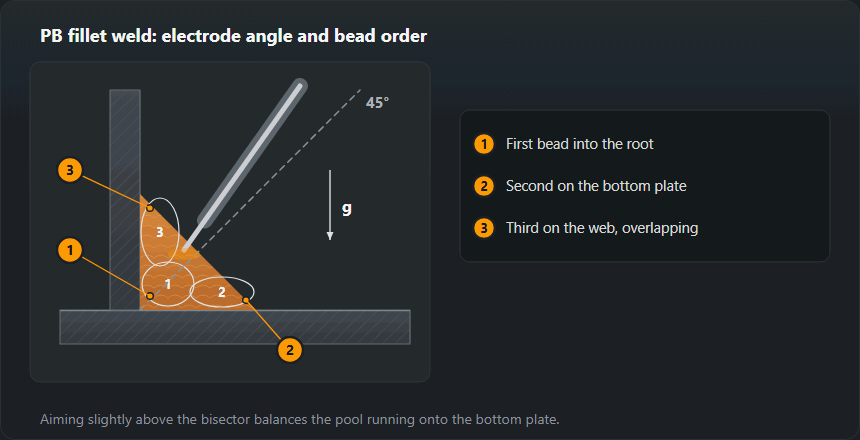
Hold the electrode at 45° to both legs and tilt it 10–15° in the direction of travel. The key correction: take the angle slightly above 45°, towards the vertical leg — that balances gravity, which otherwise drags the pool down. Keep the arc short and never dwell at the bottom leg: any pause down there is overlap. A leg up to 8 mm goes in one run; beyond that, split it — the first into the corner, the rest as a triangle from the bottom up, each overlapping the last by a third.
Guide settings, current 5 % below the flat position
| Thickness, mm | Electrode diameter, mm | Current, A |
|---|---|---|
| 1–2 | 1.6 | 40–55 |
| 1.5–3 | 2.0 | 50–75 |
| 2–4 | 2.5 | 65–95 |
| 3–5 | 3.0 | 75–125 |
| 3–6 | 3.2 | 85–135 |
| 6–12 | 4.0 | 125–180 |
| 10–20 | 5.0 | 170–240 |
| 16+ | 6.0 | 220–305 |
Angles, current and arc: a 3.2 mm electrode worked through
Work angle — the electrode on the bisector, 45° to both plates, leaning slightly towards the vertical plate. Travel angle — 10–15° in the direction of travel. With plates of different thickness aim a little more at the thicker one: the thin one heats faster and that is where undercut appears.

Current. The PB factor is ×0.95, i.e. 5 % below flat — the same rule the table on this page and the current calculator use. A 3.2 mm electrode: flat 90–140 A (middle 115 A), PB 85–135 A (middle 110 A). 2.5 mm in PB: 65–95 A (middle 80 A); 4.0 mm: 125–180 A (middle 150 A). Start in the middle and adjust in 5 A steps: overlap on the bottom plate with steady travel — a little more current and faster; undercut on the web — less.
Arc length. 0.8–1.0 × electrode diameter, 2.6–3.2 mm for 3.2 mm. The tip has to reach into the root — an arc hovering over the weld melts the plates but not the corner.
Multi-pass fillet: the sequence
- Bead 1 into the root — no weave, electrode on the bisector. This is the bead that gives root penetration.
- Bead 2 on the bottom plate — overlapping the first, arc aimed lower.
- Bead 3 on the web — overlapping both, arc aimed higher; run a little faster so the web is not undercut.
Chip all slag between beads, especially from the notches along the web.
Leg size: what to specify and how to measure it
The leg z and the design throat a are different sizes of the same weld: a = z / √2, roughly 0.7 of the leg. The designer sets a and writes it into the ISO 2553 designation; the shop measures z with a gauge. Specifying generously is expensive: deposited metal grows with the square, and z = 8 instead of z = 6 means 78 % more metal, time and distortion. If the strength is short, lengthening the weld is cheaper than thickening it.
Example: a = 4 or a = 6 — how much metal and strength
The fillet calculator table works everything out from the throat a with the same rules: z = a·√2, deposit area with 10 % reinforcement, mass at 7.85 kg/dm³, design resistance to EN 1993-1-8.
- a = 4 mm: leg z = 5.7 mm, area 17.6 mm², 0.14 kg of weld metal per metre, resistance in S235 83.1 kN per 100 mm of weld.
- a = 6 mm: z = 8.5 mm, area 39.6 mm², 0.31 kg/m, resistance 124.7 kN per 100 mm.
Resistance grows linearly with a (×1.5), metal with its square (×2.25). That is why a "just in case" margin is expensive: more electrodes, more time, more distortion. Exact figures for your joint come from the fillet weld size calculator.

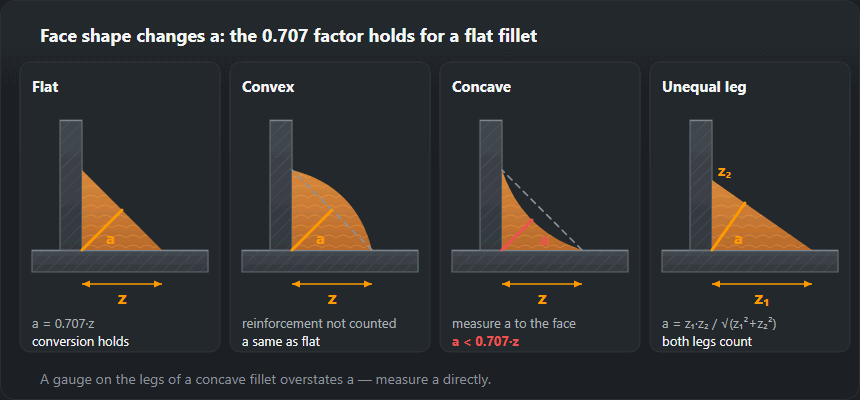
How to measure. The gauge sits on both plates and the weld face. On a flat or convex fillet the leg reading is converted with 0.707; on a concave one read a directly to the face, because the legs overstate it. Unequal legs mean the electrode angle drifted down or up.
What to weld it with
A rutile electrode holds the pool well in PB and gives a smooth toe — this is the position where rutile suits better than basic. Basic is for where toughness is required or thick material under preheat. In MAG the fillet runs on an argon-rich mixture — on thicker plate (from about 8 mm) in spray transfer, on thinner plate in short-arc or mixed transfer. Pure CO₂ never reaches spray: at high current it throws coarse droplets and leaves a rough toe, and the toe is exactly what decides whether you get undercut. Keep the stick-out short — a long one pulls the arc away and cuts penetration into the corner.
MAG in the PB position: settings
From the MIG/MAG settings table: 5–6 mm plate — 1.0–1.2 mm wire, 160–220 A, 22–25 V; 8–10 mm — 1.2 mm wire, 220–280 A, 26–29 V (that is already spray transfer). Torch on the bisector, pushing at 10–15°, wire into the root. Spray is acceptable in PB because the pool rests on the bottom plate, but a large fillet is still split into passes. More on settings in the MIG/MAG guide.
The usual defects and where they come from
Overlap on the bottom leg means the pool ran: current too low, travel too slow, or the electrode held too flat. Undercut on the vertical leg is the opposite: current too high, arc too long, or a pause at the top. Lack of penetration in the corner means the electrode was not aimed into the corner, or was too thick — it has to reach the root, not bridge it. An uneven leg shows up on the gauge at once and almost always means the 45° was not held.
Judging a fillet weld by eye
- Undercut on the web — a groove along the upper toe. Under ISO 5817 at 10 mm thickness: up to 0.5 mm at level B, 0.5 mm at C, 1 mm at D.
- Excessive convexity (503) — a humped face. For a 10 mm wide weld ISO 5817 allows up to 2 mm at B, 2.5 mm at C and 3.5 mm at D. Cause: too cold or too slow; more current or faster travel.
- Overlap on the bottom plate — metal lying on the plate unfused. A pause at the bottom or the electrode held too flat.
- Lack of root fusion — invisible from outside. A fracture test finds it: break the T so that the weld splits lengthways and look at the fracture face.
Designation and qualification
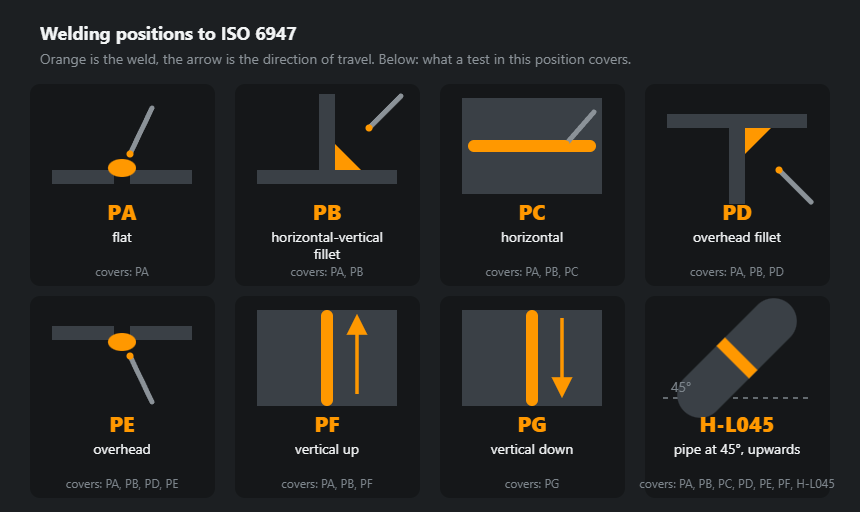
PB to EN ISO 6947, 2F in the American system. A test passed in PB covers PA and PB — the flat position and this horizontal-vertical fillet. It does not work the other way: a test in PA does not cover the horizontal-vertical fillet. So for a shop welding ribs and gussets, PB is the minimum sensible test position.
Practice and the PB test
- Single bead into the root. A T of 8–10 mm plate, 3.2 mm electrode. Goal: equal legs, checked with a gauge every few centimetres.
- Three beads. Sequence as in the diagram above. Goal: no notches between beads and no undercut on the web.
- Fracture test. The break shows root fusion, pores and slag. The same test is used in fillet weld qualification.
A PB test under EN ISO 9606-1 covers PA, PB. When it is better to turn the part into the flat position "in the boat" is covered in flat position welding (PA), and all positions side by side are in the welding positions overview. A fillet above your head is PD — see the overhead fillet weld.
Frequently asked questions
How does PB differ from welding in the boat?
By how the part sits, not by technique. The boat position is PA: the corner faces up and the pool settles by itself. In PB the T lies down and the pool is pulled onto the bottom leg the whole time. If the part can be rolled over, roll it: the same current will give a smoother weld and less distortion.
What leg size can go in a single run?
Up to 8 mm comfortably. Beyond that, split it: the first run into the corner, the rest as a triangle from the bottom up with a third overlap. Trying to lay 10 mm in one run gives overlap at the bottom and a lack of penetration in the root.
Why does it undercut the top leg?
Current too high, arc too long, or the electrode dwelling at the top. Start with the current: take 10–15 A off and shorten the arc. If the undercut stays, check the angle — it should sit slightly above 45°, but not so far that the arc hangs on the vertical leg.
What does a test in PB cover?
PA and PB to EN ISO 9606-1. A test in the flat position does not cover the horizontal fillet, so for welding ribs and gussets PB is the minimum sensible test position.
What current for a 3.2 mm electrode in the PB position?
The PB factor is ×0.95: 85–135 A, start at about 110 A. Flat, the same electrode takes 90–140 A. A 4.0 mm electrode in PB: 125–180 A.
How much weld metal per metre does an a = 4 fillet take?
By the calculator rule (z = a·√2, 10 % reinforcement, steel at 7.85 kg/dm³) about 0.14 kg per metre. At a = 6 it is 0.31 kg — metal grows with the square of the throat.
How do you measure a fillet weld throat?
With a gauge on both plates and the face. On a flat or convex fillet multiply the leg z by 0.707; on a concave one read a directly to the face, because converting from the legs overstates it.
Updated: