Brackets and wall fixings
Everything that hangs on a wall: an outdoor unit, a tank, a boiler, a shelf, an awning. What they share is that the anchor holds them rather than the item, and that what gets calculated is not the weight but the overturning moment from the reach.
How a bracket is built
A bracket is a shelf, a brace and a plate with anchors. The shelf carries the weight, the brace turns the overturning moment into compression, the plate spreads the force into the wall. Take the brace away and the whole load lands on the top anchors, whose pull-out force is three times the weight of the unit.

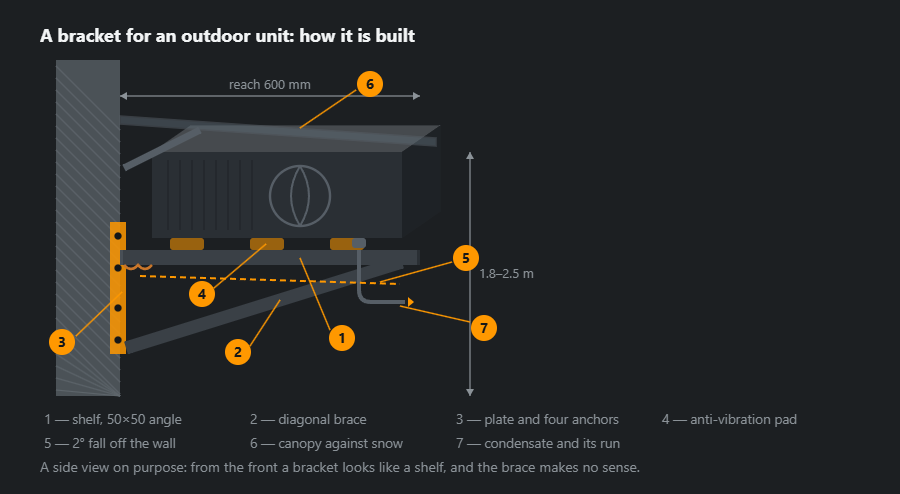
Two details left out of the cheap version. Anti-vibration pads — the compressor runs at 50 Hz, and without them the vibration goes into the wall as into a membrane; the neighbours hear it better than the owner. And the fall: 2° away from the wall is what sends condensate to the drain instead of letting it pool under the unit.
What kinds there are

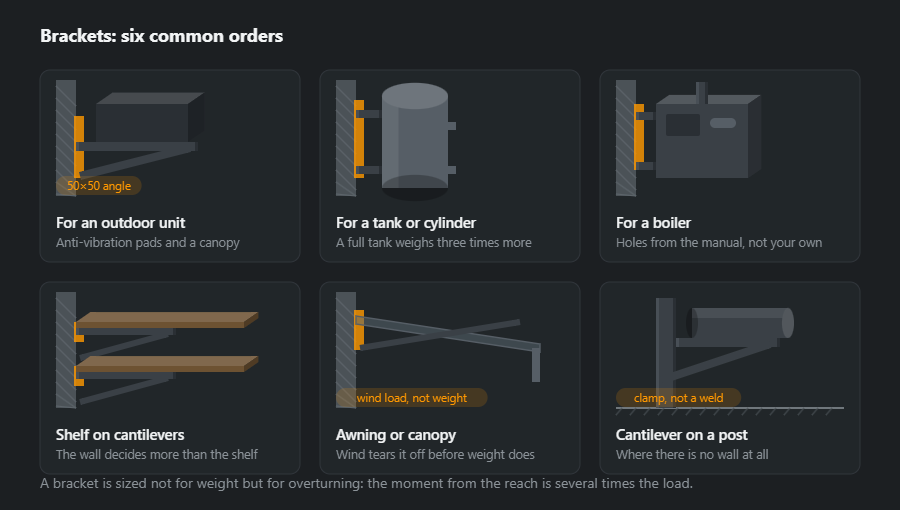
For a tank or a cylinder you size for the full volume, not the empty one: a 100-litre cylinder weighs two hundred kilos full. For a boiler the holes come out of the manual — the maker put them where they are for a reason, and "I'll drill it on site" ends in a skewed heat exchanger.
The awning is the odd one out: its load is wind rather than weight, and it works in uplift. That is why it has more anchors than seems necessary and why its braces point the other way.
Household oddments
A letterbox, a number plate, a flagpole, a hose holder, a cylinder stand, a fold-down table. All of it is an hour of welding, and all of it is held not by what was welded but by what it was bolted with.

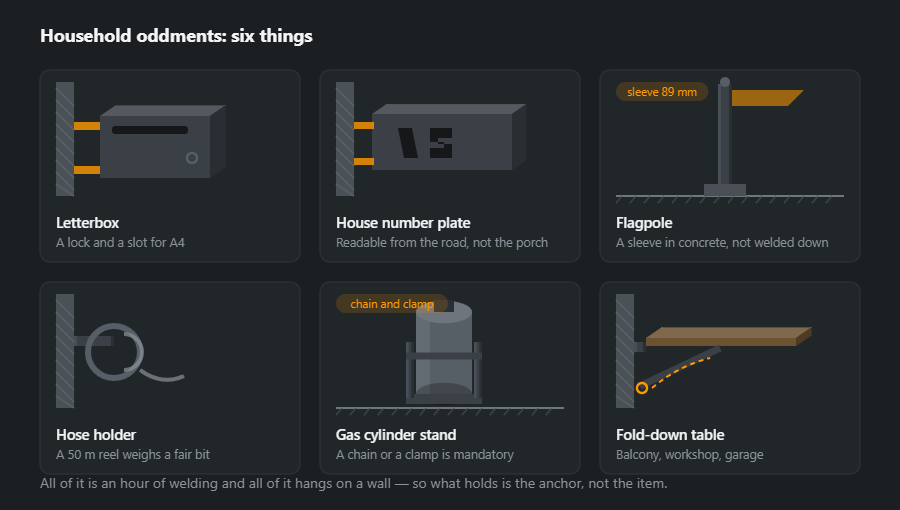
The cylinder stand deserves a word. It is not there for stability — the cylinder stands up by itself — but so that it cannot be knocked over or carried off. The chain or clamp in the design is not decoration: it is a requirement for storing gas in cylinders, and it does get checked.
Which sections, and why
A wall bracket almost always has too much steel and too few anchors. The section is chosen so it does not flex and welds well; the capacity of the whole thing is set by what holds it in the wall.
- Outdoor-unit bracket — L 40×40×4 angle, 2.42 kg/m, for arm, upright and brace; for longer reach L 50×50×5, 3.77 kg/m.
- Shelf for a tank or water heater — L 50×50×5 or UPN 80 channel, 8.64 kg/m, designed for the full tank.
- Wall plate — 60×6 flat, 2.83 kg/m, or drilled plate; the taller it is, the lower the force on the top anchor.
- Flagpole and stands — 48.3×3.2 tube, 3.56 kg/m, in a sleeve of the next size up, 60.3×3.6, 5.03 kg/m.
How anchor spacing works shows in a simple sum: force on the top anchor ≈ weight × lever arm ÷ vertical distance between anchors. In the example from the questions — a 50 kg unit, about 150 kg on the top anchors — a plate twice as tall already gives about 75 kg. A bracket for a boiler, tank or heavy awning is still a load-bearing element: anchors are chosen from the manufacturer’s technical data (ETA) for the actual substrate, and for heavy loads an engineer calculates them. Weights for other sections are in the angle and channel calculators.
Welds and joints
- Brace — welded to arm and upright on both sides; it carries the moment, so the weld is continuous, not tacked.
- Upright to plate — welded all round; anchor holes are drilled before welding so the plate does not distort when drilled.
- Continuous welds outdoors — gaps in a weld are crevices where water sits, and the first places to rust.
- Flagpole sleeve — welded to the embed plate, the pole loose in it with a locking bolt so it can come out.
With 4 mm angle the upper limit of 0.7·t is 2.8 mm, below the a3 minimum of EN 1993-1-8, so load-bearing welds are made a3 — z ≈ 4.2 mm. The fillet weld calculator checks it, and fillet welding covers technique.
Fabrication and fixing sequence
- Wall survey — masonry type, insulation thickness, distance to edges and openings, services in the wall.
- Equipment data — weight (full, for a tank), foot or hole spacing, service clearances.
- Drawing — reach, plate height, anchor spacing, fall on the arm.
- Cutting, drilling, welding — in the shop, as a pair, so both brackets match.
- Galvanising or painting — before fixing.
- Fixing — anchors per the technical data, through insulation on stand-off sleeves, anti-vibration pads, levelling.
Corrosion protection
A bracket on a facade is wet half the year, and under an air conditioner there is condensate on top. Hot-dip galvanising lasts longest; paint is enough under a roof or on a balcony. Bolts and anchors are galvanised or stainless, and every spot drilled or cut after galvanising gets cold zinc. Sealing the bottom edge of the wall plate stops water running down the wall from getting behind it.
Common mistakes
- Anchors in a mortar joint — the mortar crumbles and the bracket starts to rock.
- Too close to an edge — the anchor pulls the corner of the masonry out with it.
- A short wall plate — high force on the top anchor for the same weight.
- Water-heater shelf sized empty — full, it weighs several times more.
- Fixing through insulation without sleeves — the foam crushes and the bracket drops.
How to work out the material: a pair of AC brackets
Two brackets for an outdoor unit with 0.6 m reach: arm, 0.45 m upright and brace on each, plus two 0.9 m cross rails the unit stands on. All in L 40×40×4 angle, no plates or anchors.
| Member | Section | Length, m | Qty | kg/m | kg |
|---|---|---|---|---|---|
| Arm | L 40×40×4 | 0.60 | 2 | 2.42 | 2.9 |
| Upright | L 40×40×4 | 0.45 | 2 | 2.42 | 2.2 |
| Brace | L 40×40×4 | 0.60 | 2 | 2.42 | 2.9 |
| Cross rail | L 40×40×4 | 0.90 | 2 | 2.42 | 4.4 |
| Total | 12.3 | ||||
| With 5 % allowance | 13 | ||||
The pair comes to 13 kg of steel with allowance, less than a third of the unit it carries. That shows where the risk lies: not in the section but in the anchors and the wall. For more brackets the bill of materials calculator totals everything, and planning fixings in different walls is covered in how ordering works.
Where to go next
Gazebos, greenhouses and yard oddments are in yard and garden. Stainless for kitchens and food plants is in stainless equipment. Fixings for different substrates, price and lead time are in how ordering works.
Frequently asked questions
Why is a bracket sized for overturning rather than weight?
Because the load is applied not at the wall but out on the reach. A 50 kg unit on a bracket with a 600 mm reach puts about 150 kg of pull-out on the upper anchors — three times its own weight. That moment is what gets calculated, not the mass, and it is exactly why a bracket has a diagonal brace.
Why does an outdoor unit need anti-vibration pads?
Because the compressor runs at 50 Hz and that vibration goes into the wall as into a membrane. The neighbours on the other side hear it better than the owner does. Rubber pads between the unit and the shelf take out nearly all of it; they cost about as much as lunch and go on in five minutes.
Can a bracket be hung on aerated concrete?
It can, but not with an ordinary expansion anchor. Aerated concrete does not hold an expansion fixing: it wants a chemical anchor with a mesh sleeve, or a through-bolt with a plate on the other side. The same question for every substrate is set out separately — the article on ordering has a section through six kinds of wall.
Does an outdoor unit need a canopy over it?
It does unless it hangs under a balcony. The issue is not snow on the casing but icicles off the roof: they punch through the grille and bend the fan. A canopy overhanging the unit by 100–150 mm settles it, and costs a tenth of the repair.
What angle is an air-conditioner bracket welded from?
For a typical outdoor unit, L 40×40×4 angle for the arm, upright and brace is enough, and L 50×50×5 for heavy units and longer reach. There is always steel to spare here — a pair of brackets weighs about a dozen kilograms — so the capacity of the whole assembly is set by the anchors and the wall, not the section.
How do you reduce the force on bracket anchors?
Spread the anchors vertically. The pull-out force on the top anchor is roughly the weight times the lever arm divided by the distance between the top and bottom anchors. A wall plate twice as tall halves the force — from 150 to about 75 kg in the example with a 50 kg unit. A shorter reach works the same way.
Updated: