Furniture on a steel frame
Tables, shelving, racks, coat stands, bar counters. The steel is never fully visible — timber or stone covers it — but it is the steel that holds the shape for twenty years while the top gets changed twice. So the subject here is not what is on top but the frame underneath.
How a table is put together
A table frame is four legs, an apron round the perimeter under the top, and something that stops that rectangle folding into a rhombus: a diagonal, corner gussets, or the top itself if it is pulled down rigidly. The first is the most dependable, the second the best looking, the third works until the board dries out.

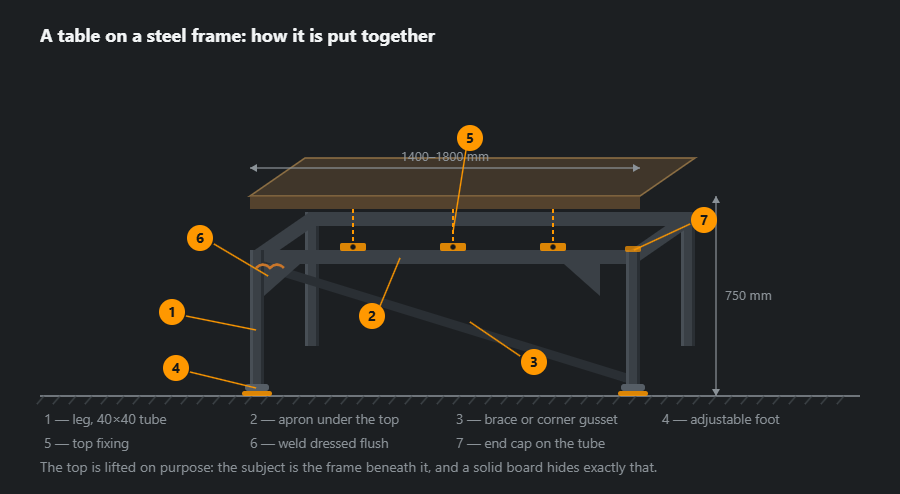
The beginner's saving is always on the brace. A rectangular frame of 40×40 tube with nothing across the diagonal folds under a sideways push, and wall thickness does not rescue it: what works is geometry, not section. An adjustable foot costs less than any rework — a floor in a house is never flat.
Frame joints

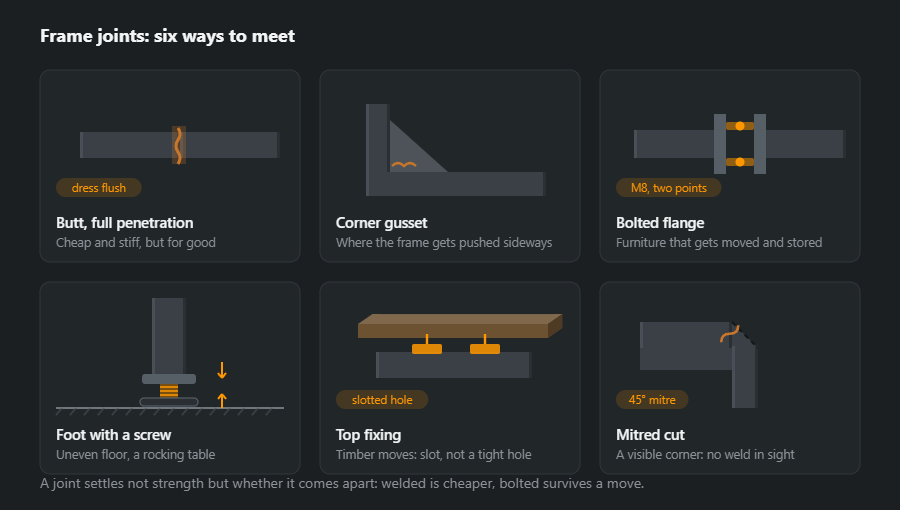
A welded joint is cheaper and stiffer, but permanent: the assembled table either fits through the door or it does not. A bolted flange buys you demountability for two extra plates and ten minutes of work, and it is the only answer for furniture going to a fifth floor without a lift.
A mitre goes where the corner is on show: there is no weld in it and the joint reads as one continuous line. It costs more — a double cut at 45° has to be fitted as well, and a gap in the corner shows from two metres away.
Tops
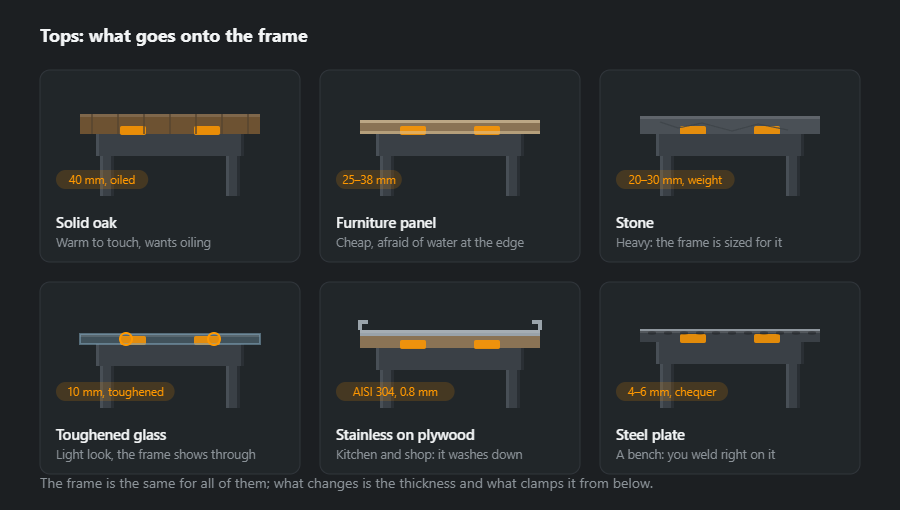
The frame under every top is the same one; what changes is the thickness of the slab and what clamps it from below. Solid oak is warm to the touch and wants oiling once a year. A furniture panel is cheaper and afraid of water at the edge. Stone is handsome and heavy enough that the frame is sized for it rather than taken off the shelf.

A word on the base alone. It is a common order and the sensible one: the customer buys the top and gets a finished base made to its size. It works out cheaper than a whole table and lets you have oak or stone from someone who does that for a living.
What else gets welded for an interior
Shelving, bracket shelves, coat stands, partitions and bar counters — all the same thing: frame, brace, end caps, powder coat. The difference is that here the frame is visible in full, so the weld is dressed flush rather than left as it came.

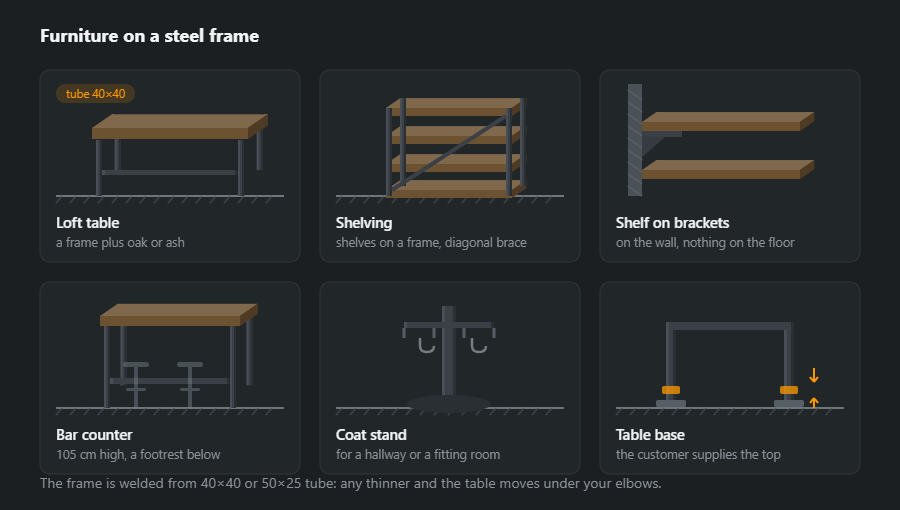
A bracket shelf into a wall is the one item on the list where what has to be worked out is not the frame but the wall: plasterboard carries a cantilever load only through a backing plate, and aerated concrete wants its own anchors. That is covered separately, in the article on fixings for different substrates.
Which sections, and why
In furniture the section is chosen not only for the load but for the look: the tube is visible, so proportion matters. There is usually strength to spare; whether a piece stands firm is down to geometry and bracing.
- Table legs — 40×40×2 box, 2.31 kg/m; 30×30×2, 1.68 kg/m, looks slimmer, but then bracing is a must.
- Apron under the top — 40×20×2, 1.68 kg/m, long side vertical: stiffer for the same weight and hidden under the top.
- Shelving — 30×30×2 uprights, 40×20×2 shelf frames, diagonals in 20×20×2, 1.05 kg/m.
- Bar tops and stone-topped tables — 50×50×3, 4.25 kg/m, or heavier; stone weighs so much that the base is designed for it separately.
Heavy-duty warehouse racking or a mezzanine is load-bearing structure — sections and fixing to the wall or floor are then set by an engineer, not by a furniture sketch. Weights for other sizes are in the hollow section calculator.
Welds that show
- TIG or short MAG runs — on visible corners TIG gives a flat, even bead and little grinding; MAG is faster but the weld then has to be dressed flush.
- A flat table, not the floor — legs are tacked on a flat table with diagonals checked; a twisted base rocks on any floor and no levelling foot will cure it.
- Sequence — tacks in every corner, then welds across the diagonal; a 2 mm wall heated from one side pulls the leg inwards.
- Grinding — weld dressed flush, then the whole frame keyed with the same grit so the ground spot does not show under the paint.
Thin-tube technique is in welding box section, stainless furniture in welding stainless steel.
Fabrication sequence
- Size and top — the top, or its exact size, comes first: the base is made to fit the top, not the other way round.
- Drawing — overhang beyond the frame, knee room, position of fixing plates with slotted holes.
- Cutting — mitred or square, with allowance for fitting the corners.
- Tacking and welding — on a flat table, checking diagonals and plumb.
- Grinding, end caps, feet — before coating, not after.
- Powder coating — after degreasing; colour and gloss chosen on a sample, because matt and gloss show unevenness differently.
- Fitting the top — on plates with slotted holes, with washers.
Corrosion protection
Indoors, powder coat is enough. Garden furniture needs zinc under the powder, and tubes need vent and drain holes, or water that gets into a leg from above has no way out. The fashionable “raw steel” look under clear lacquer works in a dry living room, but in a bathroom or kitchen the lacquer cracks at the edges and rust stains appear underneath — there, go straight for graphite powder coat or stainless.
Common mistakes
- Base welded on the floor — it rocks on every floor.
- Spatter under the powder — a sandpaper surface that shows in any light.
- Grinding only the weld — lighter patches show at the corners under the paint.
- Clear lacquer on steel in a damp room — rust under the lacquer within a season.
- Shelving without a diagonal — it leans sideways under load, and a tall unit not fixed to the wall can topple.
How to work out the material: a table and a shelving unit
Base for a 160×90 cm top: four 0.72 m legs in 40×40×2, an apron in 40×20×2 (two sides of 1.5 m, two of 0.8 m) and one centre rail. No top, feet or plates.
| Member | Section | Length, m | Qty | kg/m | kg |
|---|---|---|---|---|---|
| Leg | 40×40×2 | 0.72 | 4 | 2.31 | 6.7 |
| Apron, long side | 40×20×2 | 1.50 | 2 | 1.68 | 5.0 |
| Apron, short side | 40×20×2 | 0.80 | 2 | 1.68 | 2.7 |
| Centre rail | 40×20×2 | 0.80 | 1 | 1.68 | 1.3 |
| Total | 15.7 | ||||
| With 5 % allowance | 17 | ||||
The base is 16 kg net — often less than a solid-wood top of the same size. A 180×90×40 cm shelving unit is worked out the same way:
| Member | Section | Length, m | Qty | kg/m | kg |
|---|---|---|---|---|---|
| Upright | 30×30×2 | 1.80 | 4 | 1.68 | 12.1 |
| Shelf frame | 40×20×2 | 2.60 | 5 | 1.68 | 21.8 |
| Rear diagonal | 20×20×2 | 2.00 | 2 | 1.05 | 4.2 |
| Total | 38.1 | ||||
| With 5 % allowance | 40 | ||||
In the shelving unit more than half the weight, out of 38 kg net, is shelf frames, not uprights — so it is the shelves, not the legs, worth slimming if the unit must be lighter. The bill of materials calculator totals both, and the cutting plan nests the short pieces into 6 m lengths.
Where to go next
Stainless for kitchens and food plants, tanks and pipework are in shop products. How stainless itself is welded is in welding stainless steel. Price, lead time and fixings by substrate are in how ordering works.
Frequently asked questions
What tube is a table frame welded from?
40×40 or 50×25 tube with a 2 mm wall. Thinner and the table starts to walk under your elbows, and no top will fix that. But wall thickness settles less than the brace does: a rectangular frame with no diagonal folds into a rhombus under a sideways push, however thick the tube.
Why can a top not be bolted down rigidly?
Because timber moves: solid boards change width by a few millimetres between winter and summer. Pulled to a rigid frame through a round hole they split along the grain or cup. The holes in the fixing plates are slotted across the grain — the board moves and the table stands still.
Welded frame or bolted?
Welded is stiffer and cheaper, but it is for good: it either goes through the door and into the lift assembled, or it does not go at all. A flanged frame comes apart in ten minutes and survives a move. The rule is simple: what stands in a workshop or a house gets welded; what will travel between flats is made to come apart.
What closes the ends of the tubes?
An end cap — a welded plate or a plastic push-fit. An open tube indoors does not rust, but it collects dust and cuts your hand on the edge, and outdoors it takes in water as well. Both cost pennies to fix and show at once: an open tube end is the first sign of cheap work.
How much does a steel base for a 160×90 cm table weigh?
The base in the example on this page — four legs in 40×40×2 box and a 40×20×2 apron with a cross rail — weighs about 16 kg net. A solid-wood top of that size can be heavier than the whole frame, so stability comes from bracing, not from the weight of steel.
How do you paint steel furniture so the welds do not show?
With powder coat, but first the welds are ground flush and the whole frame is keyed with abrasive paper: powder goes on at tenths of a millimetre and hides no scratch — it rather highlights it. Weld spatter comes off before coating; left under the powder it looks like sand on the surface.
Updated: