How ordering works
The part that is common to everything in this section: what the price is made of, how the time goes, what the steel is coated with, what it is fixed to different substrates with, and what insulation actually does. All the things that are the same for a carport and for a shelving unit.
What the price is made of

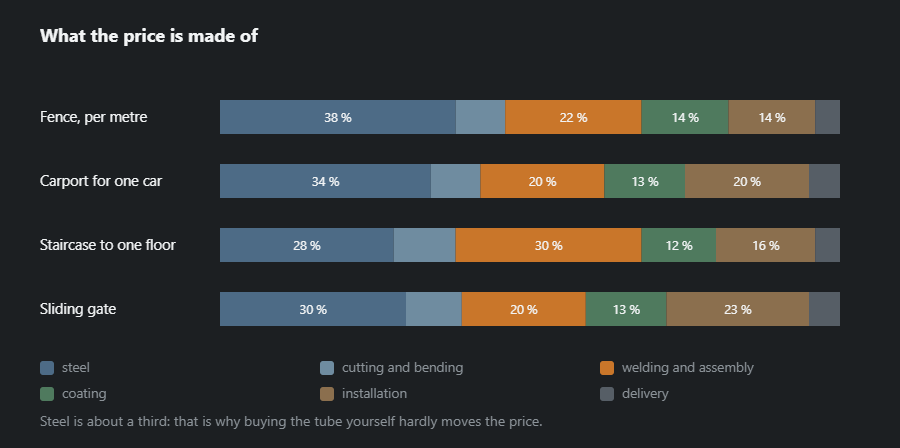
The shares move from product to product, but the order holds. Steel — a third. Cutting, bending, welding and assembly — another third, and the only part where one shop differs from another. Coating, installation and delivery — the remaining third, which grows with distance and with awkward access.
The practical conclusion: quotations are worth comparing on the middle third — on what exactly is included in the fabrication. The price difference between two offers for the same carport almost always sits in the number of joints and in whether installation is included.
Lead time: where the calendar lives

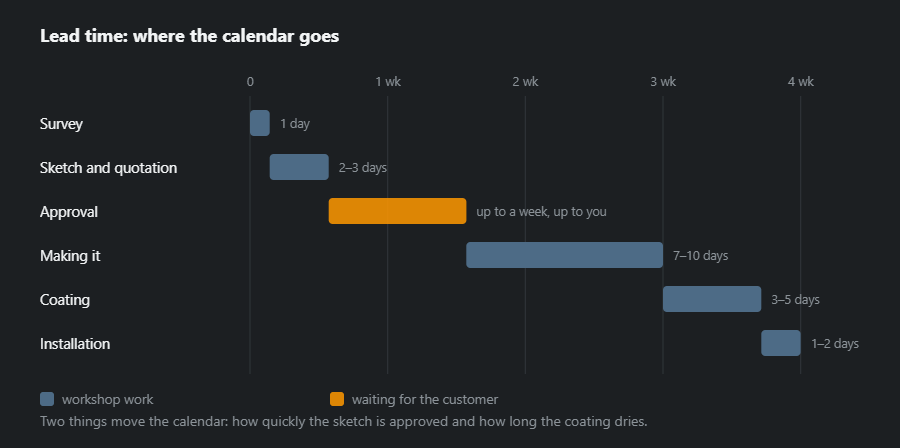
Survey — one day. Sketch and quotation — two or three. Approval — up to a week, and here the calendar belongs entirely to the customer. Fabrication — seven to ten days. Coating — three to five, and the drying cannot be hurried. Installation — a day or two.
It is not welding that eats the time. The shop welds faster than enamel dries, and faster than a decision about colour gets made.
How the order runs

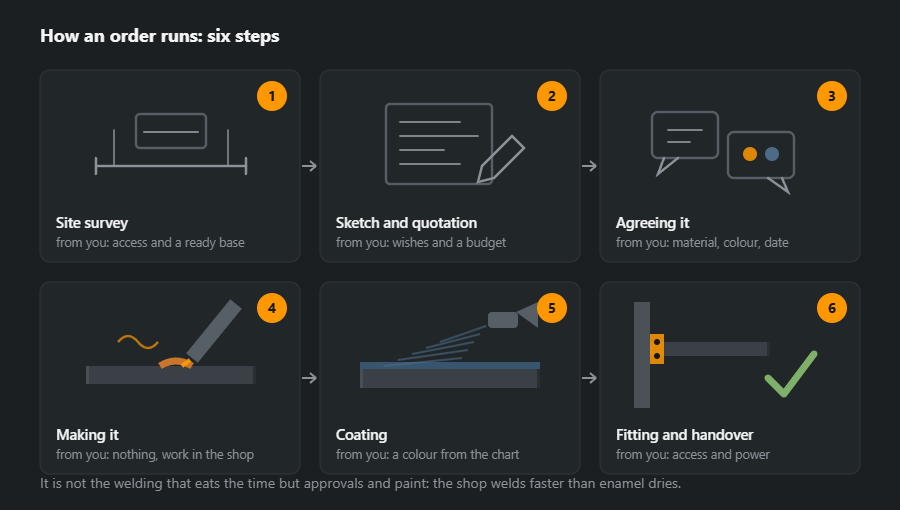
The sequence is the same for every product: survey on site, sketch and quotation, agreement on material and colour, fabrication in the shop, coating, installation with handover. The survey cannot be skipped even where the sizes are "known": openings in finished buildings are rarely rectangular and yards are rarely level.
Coating: how long it lasts

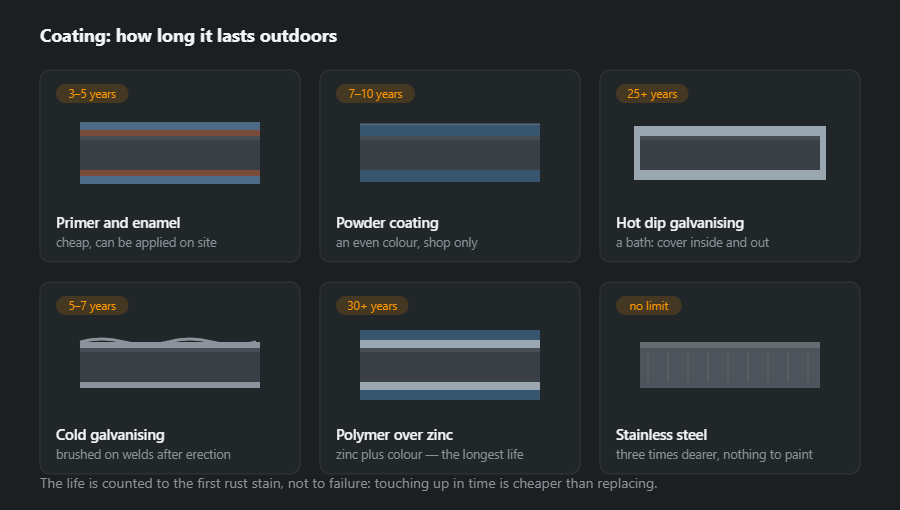
| Coating | Life | Where it makes sense |
|---|---|---|
| Primer and enamel | 3–5 years | cheap, and can be applied on site |
| Powder coating | 7–10 years | even colour, shop only |
| Hot dip galvanising | 25+ years | protects inside the section as well as out |
| Cold galvanising | 5–7 years | brushed onto welds after erection |
| Polymer over zinc | 30+ years | longest life plus a colour |
| Stainless steel | no limit | three times dearer, nothing to paint |
Hot dip galvanising wins where the steel cannot be reached later: inside a section, in a light well, under the eaves. Powder wins on appearance. Zinc plus polymer gives both, and on roadside work it pays for itself within a single replacement cycle.
What we fix into: six substrates

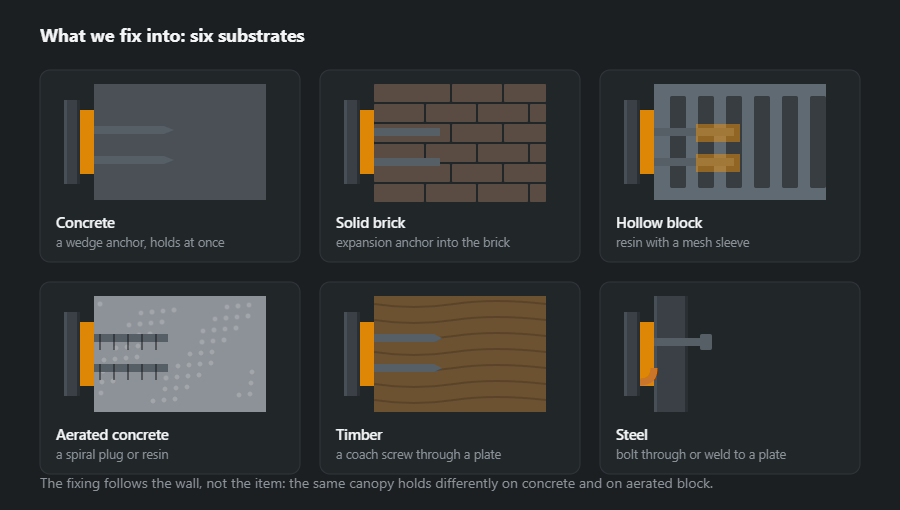
Fixings are chosen by the wall, not by the item. Concrete takes a wedge anchor and holds at once. Solid brick takes an expansion anchor, but into the brick itself and never into the joint. In hollow block and aerated concrete an expansion anchor does not work at all: there it is resin with a mesh sleeve or a spiral plug. Timber takes a coach screw through a plate; steel takes a bolt through or a weld to a plate.
Insulation: where condensation comes from

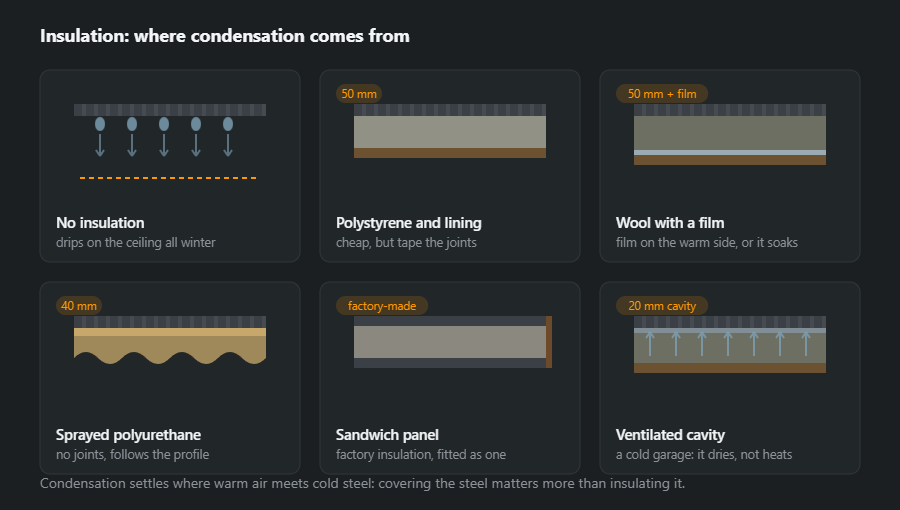
Condensation is not a sign of poor insulation but a sign that warm air has reached cold steel. Hence a rule that runs against intuition: covering the steel matters more than adding thickness. Five centimetres glued with no gaps works better than ten laid with voids at the edges.
In an unheated garage insulation is not wanted at all — a ventilated cavity is. It does not heat, it dries: air passes behind the cladding and carries the moisture away.
Where to go next
The cost of a metre of weld by process is worked out separately in the cost per metre of weld calculator; the mass of steel for a quotation in the metal weight calculator. For the products themselves, start with carports and gates.
Frequently asked questions
Why does buying the steel myself not cut the price?
Because steel is about a third of the quotation. The rest is cutting and bending, welding and assembly, coating, installation and delivery. Tube you buy yourself saves part of one third, takes away the shop's ability to draw the remainder from its own stock, and adds an argument about who is responsible if the material turns out bent.
How long does an order take?
Three to four weeks as a rule. The long parts are not the welding but approving the sketch and drying the coating: the shop welds a carport in a week, and enamel dries in three to five days whoever applied it.
Paint or galvanise?
Primer and enamel 3–5 years, powder coating 7–10, hot dip galvanising 25+, zinc with a polymer coat 30+. The life is counted to the first rust stain, not to failure. Beside a road salted in winter the difference between paint and zinc is visible by the third year.
What is needed from the customer?
Access to the site, a base that is ready, a decision on material and colour, and power for the installation. What moves the date most is approval of the sketch: a week to answer is a week added, and it is the only stage that depends entirely on the customer.
Updated: