Tanks, pipework and ventilation
Everything that holds water, fuel or air and cannot be bought ready-made to size. There is almost no choice of shape here: it is set by the space the thing has to fit into and by what will flow through it.
How a tank is built
A rectangular tank is more interesting than a round one precisely because it does not hold itself. A cylinder is pushed out evenly and its wall works in tension; a flat wall under the same head of liquid bows outwards. So bands of stiffening run across it every 400–600 mm — on the outside, so that there is nothing inside for sediment to catch on.

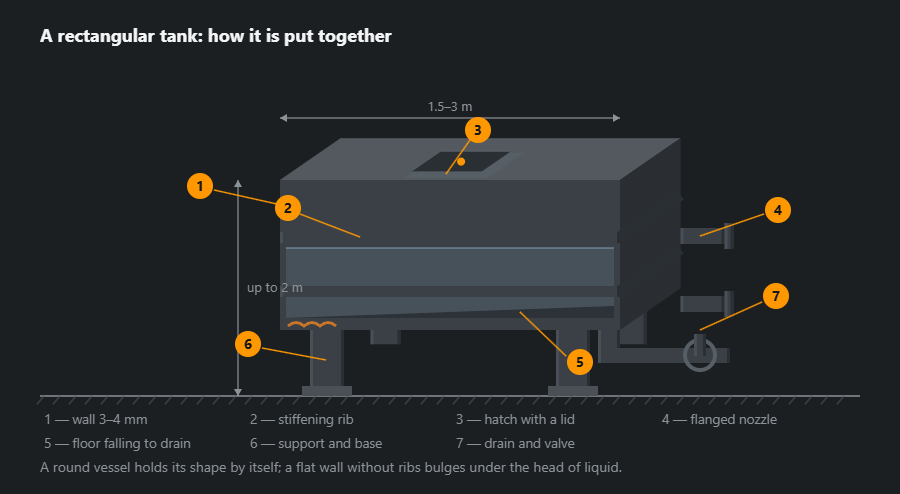
The second thing people forget is the fall of the floor. One or two per cent towards the drain and the tank empties completely. A level floor looks tidier, but a centimetre of liquid and sediment always stays in it, and in winter that remainder splits the welded corner from the inside.
What jobs on vessels look like

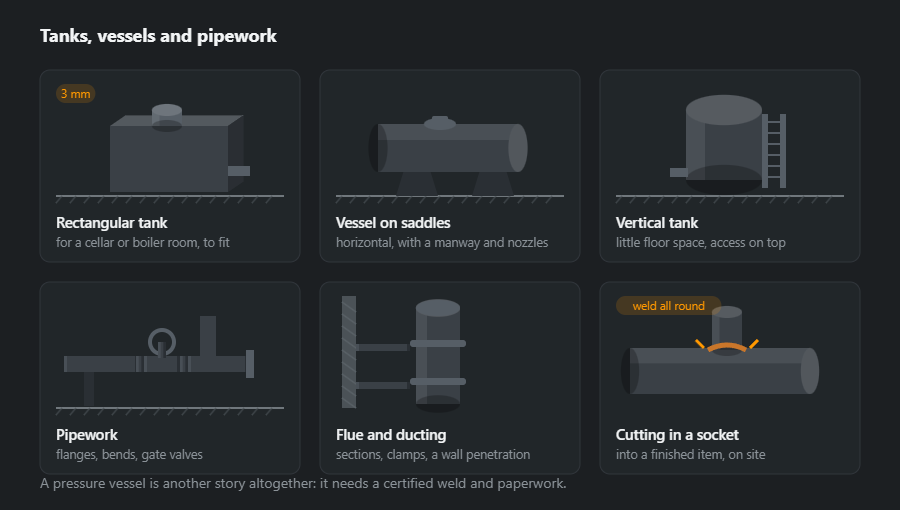
A rectangular tank is made to fit: for a cellar or boiler room where a round vessel will not go through the door. A horizontal vessel on saddles and a vertical tank are factory geometry, but the manways, nozzles and pipework for a particular boiler room are still welded to order.
A word on pressure. Anything working under internal pressure is a different job: a qualified procedure, a qualified welder and documentation for the product. A tank for water, fuel or rainwater needs none of that.
Pipework joints
Six ways of joining two pipes differ not in strength — all of them have enough — but in what happens in ten years' time when the joint has to be opened. A welded joint opens with a grinder; a flange or a union opens with a spanner.

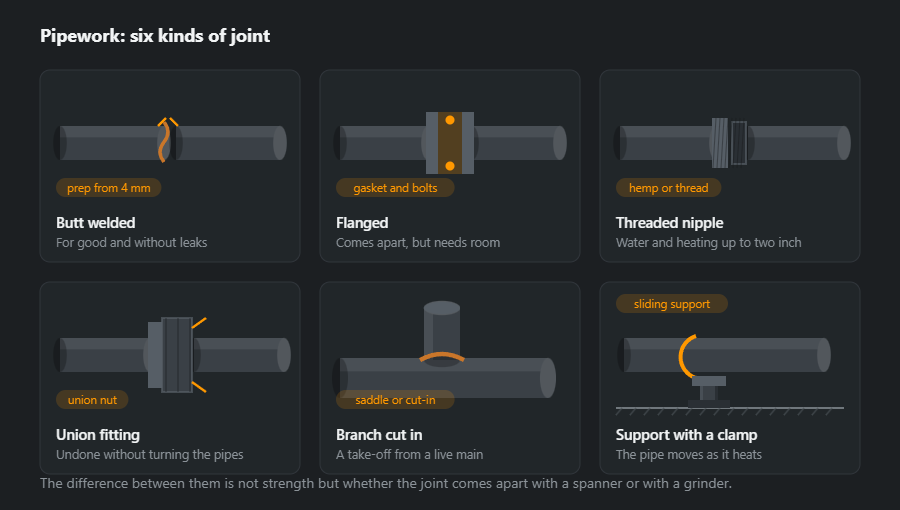
The sliding support is what gets left out most often. A steel pipe twenty metres long grows by a centimetre and a half when it warms by 60 °C. If it is clamped rigidly at two points, that growth pulls the fixings out or bends the pipe itself; a clamp that slides costs pennies and removes the question.
Ventilation
Here a fabrication shop does less than you would think. Ductwork is a catalogue product: spiral pipe and rectangular duct with flanges are cheaper bought than welded. Three things get welded: the hood to fit, cut-ins into finished duct, and transitions nobody sells.

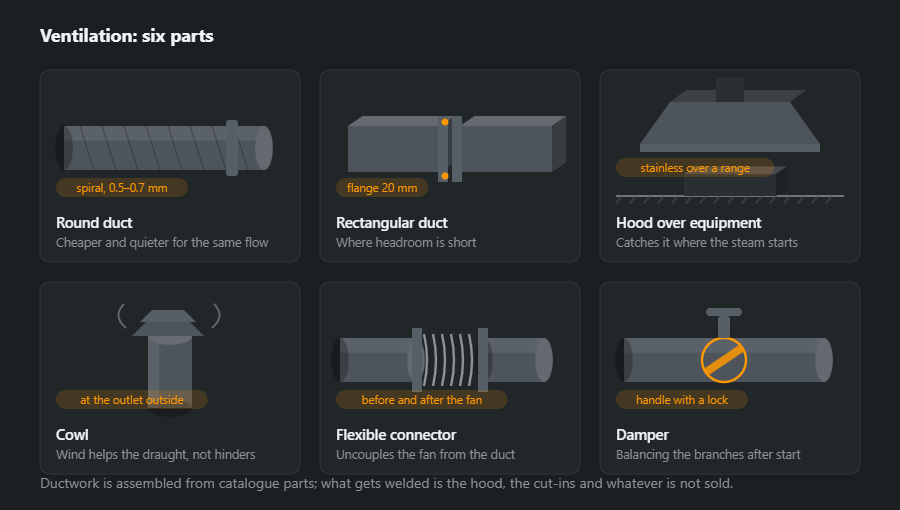
A hood over a range or a wash-up is welded from stainless rather than galvanised sheet, and not for looks: over grease and steam galvanising lasts a couple of years. A cowl at the outlet is needed wherever wind can kill the draught — which is almost any roof lower than the building next door.
What they are made of, and why
In a tank the plate matters most: it holds the liquid. Sections only help — they stiffen the flat wall and provide the lid frame and the legs. So the weight of a tank is worked out mainly from the plate area.
- Walls and bottom — 3 mm plate, 23.5 kg/m², or 4 mm, 31.4 kg/m², for a taller head of liquid; stainless is usually a millimetre thinner.
- Stiffening bands — L 50×50×5 angle, 3.77 kg/m, all round the tank; more of them lower down, where the pressure is highest.
- Lid frame — L 40×40×4, 2.42 kg/m; it also stiffens the top edge, which otherwise ripples.
- Pipework at the tank — tube 33.7×3.2, 2.41 kg/m, 48.3×3.2, 3.56 kg/m, 60.3×3.6, 5.03 kg/m.
Why the stiffeners are needed shows in a simple sum. Water 1 m deep presses at about 0.1 bar (9.81 kPa), and on a whole 1×1 m wall with a force of about 4.9 kN — roughly half a tonne. A cylinder carries that as tension in the wall, a flat wall in bending, and it is the bending the bands have to stop. Plate weights are in the plate calculator, angle weights in the angle calculator.
Welds: tightness first
- Wall and bottom seams — continuous, unbroken, ideally welded both sides. Here the weld is less about carrying load than about not letting a single drop through.
- Stiffening bands — outside, may be intermittent: they do not seal, they hold the wall. Run ends are closed so water does not stand in the gap.
- Nozzles — full penetration or with a reinforcing pad; this is the most common leak point after some years, because pipework vibration arrives here.
- Stainless and pipework — TIG with an argon back purge; without gas inside the root oxidises and loses its corrosion resistance. More in TIG and welding stainless.
Tightness is tested before painting: the classic chalk-and-paraffin test (chalk wash on one side of the weld, paraffin on the other — every leak leaves a stain), then a water fill and inspection of every seam. Painting before the test hides pores under the paint until the first winter.
Pressure vessels: what you do not make yourself
Everything above applies to tanks with no internal pressure. A tank under pressure — compressor receiver, pressure vessel for a pump set, gas cylinder, boiler — is pressure equipment. In the EU, above 0.5 bar allowable pressure it falls under Directive 2014/68/EU: design to standards (e.g. EN 13445 for vessels, EN 13480 for industrial piping), a welding procedure qualified to EN ISO 15614-1, welders certified to EN ISO 9606-1, non-destructive testing, acceptance and periodic inspection by the appropriate body. Repairs to such vessels are also done only by an approved company. Watch fuel too: a diesel or petrol tank is not a pressure vessel, but tanks for flammable liquids may fall under inspection and fire regulations, which is checked before ordering. The same goes for tanks on railway vehicles: welding there follows EN 15085, and the weld performance class is set by the designer.
Fabrication sequence
- Site survey — the doors and corridor the tank has to pass through, space for the drain, manway and connections.
- Drawing — dimensions, thicknesses, band spacing, 1–2 % fall to the bottom, nozzle positions.
- Cutting and folding — folded corners instead of welded ones wherever possible: fewer seams, fewer places to leak.
- Welding the shell — bottom, walls, then bands and frame; in short runs so the flat wall does not buckle.
- Nozzles and manway — into the shell after checking dimensions.
- Leak test — chalk and paraffin, then a water fill.
- Protection — inside to suit the contents, outside primer and paint.
Corrosion protection
The inside is chosen for what goes in. Drinking water — stainless or a coating approved for potable water; rainwater and process water — an epoxy lining; oil and fuel — often bare mild steel inside, because the contents protect it. Small tanks can be hot-dip galvanised, but with vent holes and bearing in mind that flat walls can distort at bath temperature. Outside, the bottom and legs suffer most: the tank stands on packers, not flat on concrete, so no moisture sits under it.
Common mistakes
- Flat wall without bands — a belly of several centimetres once filled, and in time a crack at the corner.
- Painting before the leak test — the pores show up only a month later.
- Level bottom — a residue of liquid and sludge stays for good.
- Stainless welded without purge — a discoloured root rusts from inside.
- A “small” workshop pressure vessel — equipment with no documents or acceptance that must not be put into service.
How to work out the material: a 1 m³ water tank
Rectangular tank 1.0×1.0×1.0 m, unpressurised: bottom and four walls in 3 mm plate (5 m²), lid in 2 mm plate (1 m²), two stiffening bands and a top frame in angle, four short legs. The sizes are illustrative — for taller tanks thicknesses and stiffeners are set by a design engineer.
| Member | Section | Length, m | Qty | kg/m | kg |
|---|---|---|---|---|---|
| Stiffening band | L 50×50×5 | 4.00 | 2 | 3.77 | 30.2 |
| Top frame | L 40×40×4 | 4.00 | 1 | 2.42 | 9.7 |
| Leg | L 50×50×5 | 0.30 | 4 | 3.77 | 4.5 |
| Total | 44.4 | ||||
| With 5 % allowance | 47 | ||||
The angles come to 47 kg with allowance, but the plate is the heavy part: walls and bottom about 118 kg, lid about 16 kg. So the empty tank is just under 200 kg of steel, while full it is over 1.1 t on four legs — the figure to give when choosing the floor or slab it stands on. Plan the sheets so the walls come out of a single fold, and let the bill of materials calculator total the rest.
Where to go next
Stainless for kitchens and food plants, tables and sinks are in stainless equipment. If the vessel already exists and has started leaking, see repairs and rebuilding. Price and lead time are in how ordering works.
Frequently asked questions
Can you weld a pressure vessel?
That is a different job. A pressure vessel needs a qualified welding procedure, a qualified welder and documentation for the product. An ordinary tank for water, fuel or rainwater, working without internal pressure, is made without any of that — and costs a quarter as much.
Why is a rectangular tank dearer than a round one of the same volume?
Ribs. A cylinder holds its own shape: the pressure pushes it out evenly and the wall works in tension. A flat wall under the same head bows outwards, and it has to be stiffened with bands every 400–600 mm. A rectangular tank is not chosen to save money but because a round one will not go through the door.
How much fall should the floor have?
One to two per cent towards the drain — that is enough for the tank to empty completely. A level floor looks tidier, but a centimetre of liquid and sediment always stays in it, and in winter that remainder splits the welded corner.
Is it cheaper to weld extract ductwork or to buy it?
Ductwork is bought: spiral pipe and rectangular duct with flanges cost less than any welding. Three things get welded — the hood to fit, cut-ins into finished duct, and transitions nobody sells. The rule is simple: standard is bought, non-standard is welded.
What plate thickness for a rectangular water tank?
For a tank of about 1 m³ and 1 m high, 3–4 mm mild steel or 2–3 mm stainless is usual, always with angle stiffening bands. Thickness and stiffener spacing depend on the height of liquid, so for taller tanks they are set by a design engineer. For drinking water the inside must be stainless or a coating approved for contact with potable water.
At what pressure does a tank become a pressure vessel?
In the EU the Pressure Equipment Directive 2014/68/EU (PED) covers equipment with a maximum allowable pressure above 0.5 bar; the UK has equivalent regulations. Such a vessel is designed to standards (e.g. EN 13445), welded to a qualified procedure by certified welders and accepted under inspection. It is not something you make by eye in a home workshop.
Updated: