Steel angle weight calculator
Equal and unequal angles to EN 10056-1, from L 20×20×3 to L 200×200×20. Pick the size, enter length and quantity — mass per metre comes from the standard's table.
Short answer
The sizes asked for most: L 30×30×3 — 1.36 kg/m, L 40×40×4 — 2.42 kg/m, L 50×50×5 — 3.77 kg/m, L 60×60×6 — 5.42 kg/m, L 80×80×8 — 9.63 kg/m, L 100×100×10 — 15.0 kg/m. Stock lengths are usually 6 m, less often 12 m.
Angle weight: the sizes people look up most
The equal and unequal sizes asked about most often, each under its own anchor
(for example #l-50x50x5). The 6 m and 12 m bar weights and metres
per tonne come from the same EN 10056-1 table as the calculator.
L 30×30×3 weight per metre — 1.36 kg/m
L 30×30×3 weighs 1.36 kg per metre: a 6 m bar is 8.2 kg, a 12 m bar 16.3 kg, and one tonne buys about 735 m of it. Legs 30 and 30 mm, thickness 3 mm, area 1.74 cm². L 30×30×4 is 31 % heavier (1.78 kg/m).
L 40×40×4 weight per metre — 2.42 kg/m
L 40×40×4 weighs 2.42 kg per metre: a 6 m bar is 14.5 kg, a 12 m bar 29 kg, and one tonne buys about 413 m of it. Legs 40 and 40 mm, thickness 4 mm, area 3.08 cm². L 40×40×5 is 23 % heavier (2.97 kg/m).
L 50×50×5 weight per metre — 3.77 kg/m
L 50×50×5 weighs 3.77 kg per metre: a 6 m bar is 22.6 kg, a 12 m bar 45.2 kg, and one tonne buys about 265 m of it. Legs 50 and 50 mm, thickness 5 mm, area 4.8 cm². L 50×50×6 is 19 % heavier (4.47 kg/m).
L 60×60×6 weight per metre — 5.42 kg/m
L 60×60×6 weighs 5.42 kg per metre: a 6 m bar is 32.5 kg, a 12 m bar 65 kg, and one tonne buys about 185 m of it. Legs 60 and 60 mm, thickness 6 mm, area 6.91 cm². L 60×60×8 is 31 % heavier (7.09 kg/m).
L 80×80×8 weight per metre — 9.63 kg/m
L 80×80×8 weighs 9.63 kg per metre: a 6 m bar is 57.8 kg, a 12 m bar 115.6 kg, and one tonne buys about 104 m of it. Legs 80 and 80 mm, thickness 8 mm, area 12.3 cm².
L 100×100×10 weight per metre — 15 kg/m
L 100×100×10 weighs 15 kg per metre: a 6 m bar is 90 kg, a 12 m bar 180 kg, and one tonne buys about 66.7 m of it. Legs 100 and 100 mm, thickness 10 mm, area 19.2 cm². L 100×100×12 is 19 % heavier (17.8 kg/m).
L 60×40×6 weight per metre — 4.46 kg/m
L 60×40×6 weighs 4.46 kg per metre: a 6 m bar is 26.8 kg, a 12 m bar 53.5 kg, and one tonne buys about 224 m of it. Legs 60 and 40 mm, thickness 6 mm, area 5.68 cm². L 60×40×5 is 15 % lighter (3.79 kg/m).
L 80×40×6 weight per metre — 5.41 kg/m
L 80×40×6 weighs 5.41 kg per metre: a 6 m bar is 32.5 kg, a 12 m bar 64.9 kg, and one tonne buys about 185 m of it. Legs 80 and 40 mm, thickness 6 mm, area 6.89 cm².
L 100×50×8 weight per metre — 8.97 kg/m
L 100×50×8 weighs 8.97 kg per metre: a 6 m bar is 53.8 kg, a 12 m bar 107.6 kg, and one tonne buys about 111 m of it. Legs 100 and 50 mm, thickness 8 mm, area 11.4 cm².
L 150×100×10 weight per metre — 19 kg/m
L 150×100×10 weighs 19 kg per metre: a 6 m bar is 114 kg, a 12 m bar 228 kg, and one tonne buys about 52.6 m of it. Legs 150 and 100 mm, thickness 10 mm, area 24.2 cm².
Section tables
Leg a, second leg b, thickness t,
mass per metre and cross-sectional area A. On an equal angle
a = b.
Equal angles — EN 10056-1
| Section | a, mm | b, mm | t, mm | Mass, kg/m | A, cm² |
|---|---|---|---|---|---|
| L 20×20×3 | 20 | 20 | 3 | 0.88 | 1.12 |
| L 25×25×3 | 25 | 25 | 3 | 1.12 | 1.42 |
| L 25×25×4 | 25 | 25 | 4 | 1.45 | 1.85 |
| L 30×30×3 | 30 | 30 | 3 | 1.36 | 1.74 |
| L 30×30×4 | 30 | 30 | 4 | 1.78 | 2.27 |
| L 35×35×4 | 35 | 35 | 4 | 2.09 | 2.67 |
| L 40×40×4 | 40 | 40 | 4 | 2.42 | 3.08 |
| L 40×40×5 | 40 | 40 | 5 | 2.97 | 3.79 |
| L 45×45×5 | 45 | 45 | 5 | 3.38 | 4.3 |
| L 50×50×5 | 50 | 50 | 5 | 3.77 | 4.8 |
| L 50×50×6 | 50 | 50 | 6 | 4.47 | 5.69 |
| L 60×60×6 | 60 | 60 | 6 | 5.42 | 6.91 |
| L 60×60×8 | 60 | 60 | 8 | 7.09 | 9.03 |
| L 70×70×7 | 70 | 70 | 7 | 7.38 | 9.4 |
| L 80×80×8 | 80 | 80 | 8 | 9.63 | 12.3 |
| L 90×90×9 | 90 | 90 | 9 | 12.2 | 15.5 |
| L 100×100×10 | 100 | 100 | 10 | 15 | 19.2 |
| L 100×100×12 | 100 | 100 | 12 | 17.8 | 22.7 |
| L 120×120×12 | 120 | 120 | 12 | 21.6 | 27.5 |
| L 150×150×15 | 150 | 150 | 15 | 33.8 | 43 |
| L 200×200×20 | 200 | 200 | 20 | 59.9 | 76.3 |
Unequal angles — EN 10056-1
| Section | a, mm | b, mm | t, mm | Mass, kg/m | A, cm² |
|---|---|---|---|---|---|
| L 40×20×4 | 40 | 20 | 4 | 1.77 | 2.26 |
| L 50×30×5 | 50 | 30 | 5 | 2.96 | 3.78 |
| L 60×40×5 | 60 | 40 | 5 | 3.79 | 4.79 |
| L 60×40×6 | 60 | 40 | 6 | 4.46 | 5.68 |
| L 65×50×5 | 65 | 50 | 5 | 4.35 | 5.54 |
| L 70×50×6 | 70 | 50 | 6 | 5.41 | 6.89 |
| L 75×50×7 | 75 | 50 | 7 | 6.48 | 8.3 |
| L 80×40×6 | 80 | 40 | 6 | 5.41 | 6.89 |
| L 80×60×7 | 80 | 60 | 7 | 7.36 | 9.38 |
| L 100×50×8 | 100 | 50 | 8 | 8.97 | 11.4 |
| L 100×65×8 | 100 | 65 | 8 | 9.94 | 12.7 |
| L 100×75×8 | 100 | 75 | 8 | 10.6 | 13.5 |
| L 120×80×8 | 120 | 80 | 8 | 12.2 | 15.5 |
| L 150×90×10 | 150 | 90 | 10 | 18.2 | 23.2 |
| L 150×100×10 | 150 | 100 | 10 | 19 | 24.2 |
| L 200×100×10 | 200 | 100 | 10 | 23 | 29.2 |
Shape and mass tolerances for angles are in EN 10056-2. Settlement goes by the certified mass — the table is for design and estimating.
EN 10056-1 sizes are close to the American L shapes but not identical: the radii differ, and with them the mass per metre for the same numbers in the designation. For angles bought to ASTM, take the mass from that standard's own table.
Where the gap between formula and table comes from
An angle section gets estimated as two rectangles without the overlap:
F = (a + b − t) · t. The formula is convenient and out by
0.5–1.5 %, because it ignores the root radius in the inner corner
(r₁) and the radius at the leg tips (r₂). The corner
radius adds material and the tips take it away, and the two effects do not
cancel.
In practice: for a quick estimate on site the formula will do, for an order and a quotation it will not. The same holds for beams and channels, only there the gap is wider because the flange taper joins in.
The angle in a welded structure
An angle is the cheapest way to stiffen something and the commonest member in a truss, but it has one awkward property: it is not symmetrical. The centroid lies off the leg axis, so a weld on one side pulls the section sideways and the part twists out of plane as it cools.
Hence two shop rules. First, in a truss the welds on the two legs are distributed so their resultant passes through the centroid of the section — unequal weld lengths on the two sides are correct here, not a mistake. Second, long angles are tacked to a marked line and welded in alternating runs, never continuously.
Weld size follows the thinner part; converting leg z to design
throat a is in the
fillet weld size
calculator, and deposited metal and electrodes for a whole truss in the
electrode
consumption calculator.
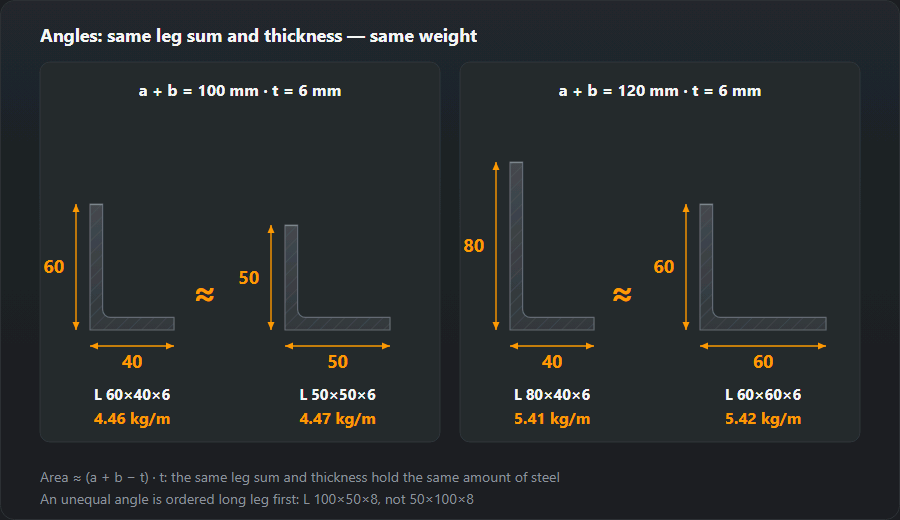
Equal or unequal angle: weight follows the sum of the legs
A 60×40×6 angle weighs 4.46 kg/m and a 50×50×6
4.47 kg/m. The same goes for 80×40×6
(5.41) and 60×60×6 (5.42).
That is no accident: the section area is roughly (a + b − t) · t, so with the
same leg sum and thickness there is the same amount of steel, whatever the proportions.
Choosing between equal and unequal is not about lighter or heavier, but about how the
member has to work.
An unequal angle gives two things an equal one does not. The long leg set vertical is stiffer in bending in that plane — which is why unequal angles go into lintels, shelf brackets and platform edge trims. And two different legs let you put two rows of bolts through one while the other sits against a narrow face. The equal angle, for its part, is symmetrical about its diagonal, simpler in trusses and easier to find in stock in every size.
When ordering an unequal angle, the long leg always comes first: L 100×50×8, not 50×100×8. Mark on the drawing which leg stands vertical — the fitter cannot read that from the parts list.

Worked example: the weight of a workshop rack in angle
A rack 1.0 × 0.5 m, 1.8 m high, four shelves: uprights in L 50×50×5, shelf frames in L 40×40×4, two diagonal braces in L 30×30×3.
- uprights — L 50×50×5: 4 × 1.8 m = 7.2 m × 3.77 = 27.1 kg
- frames — long sides — L 40×40×4: 8 × 1 m = 8 m × 2.42 = 19.4 kg
- frames — short sides — L 40×40×4: 8 × 0.5 m = 4 m × 2.42 = 9.7 kg
- braces — L 30×30×3: 2 × 2 m = 4 m × 1.36 = 5.4 kg
- Total: 61.6 kg; with 3 % added for gussets, welds and offcuts — 63.5 kg
Make the shelf frames from the same 50×50×5 as the uprights and the rack gets 16.2 kg heavier — on 12 m of frame that is 56 % more steel in those lines. Welds hardly change the weight, but they decide whether it stays straight: an angle is asymmetric and pulls after welding on one side, as the welding section above explains. The bill of materials puts together the full list with cost, and the metal weight calculator gives the flat bar and sheet for the shelves.
How racks, trolleys and workshop containers are put together is shown under storage and handling.
Measuring an angle and checking it against the table

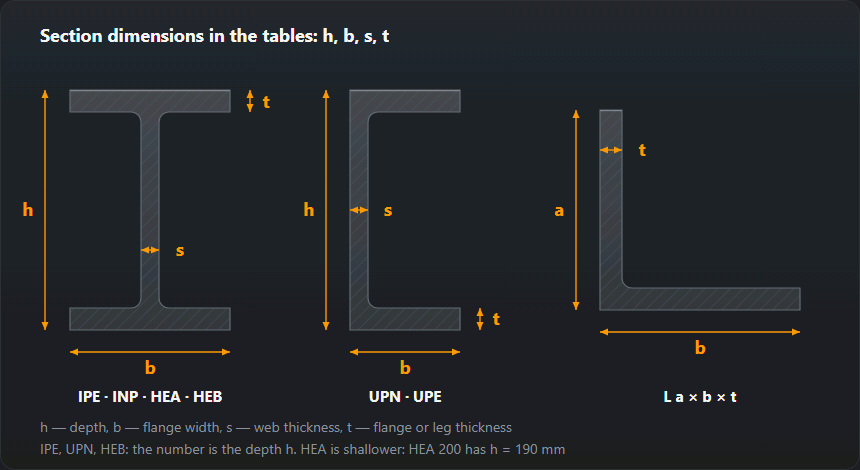
Legs a and b are measured from the outer corner to the end of
the leg. Thickness t is taken with a caliper halfway along the leg, away from
the root radius in the corner (thicker there) and from the rounded toe (thinner there).
One millimetre matters a lot: L 50×50×5 weighs 3.77 kg/m,
L 50×50×6 4.47, which is 19 % more.
The quick check without a caliper is a scale: a piece of known length weighed on a crane scale and divided by its length should come out close to the table. A deviation of a few per cent sits within the EN 10056-2 tolerances and is not a defect; a difference of more than ten per cent usually means a different leg thickness from the one ordered.
Metres, bars and the cost of angle
Angle is usually bought in 6 m bars, less often in 12 m. A tonne of
L 50×50×5 is 265 m, which is
45 bars of 6 m; a tonne of L 100×100×10 is
66.7 m. Steel cost is K = L · G · C
(metres × mass per metre × price per kilogram), and the price of a metre is
G · C: a metre of L 40×40×4 costs 2.42 times
the kilogram price, a metre of L 50×50×5 3.77 times.
The table earns its keep a second time after welding: hot-dip galvanisers usually price by weight, so the structure weight from the calculator is straight away the basis for the galvanising quote. Painting is priced differently — by surface area, and a light angle has a lot of it for its weight.
Frequently asked questions
How much does a 50×50×5 angle weigh?
3.77 kg per metre, so 22.6 kg over a 6 m length. A 40×40×4 angle weighs 2.42 kg/m and a 60×60×6 weighs 5.42 kg/m.
Why does the angle mass not match the formula (a + b − t) · t?
Because the formula knows nothing about the radii. An angle has a root radius in the inner corner and a radius at the leg tips, so the real section differs slightly from two rectangles. For 50×50×5 the formula gives 3.73 kg/m against 3.77 in the table. The gap grows on thicker sections, which is why the calculator above reads values from the EN 10056-1 table rather than computing them.
How do I size a fillet weld on an angle?
Design throat a should not exceed 0.7 of the thinner part. For a 50×50×5 angle that is a ≈ 3.5 mm, i.e. a leg of z = 5 mm. A larger weld adds nothing to the strength of the joint but does put in more heat and pull the part out of shape.
What does a 100×50×8 unequal angle weigh?
8.97 kg per metre, which is 53.8 kg per 6 m bar. For comparison, 100×65×8 weighs 9.94 kg/m and 100×75×8 weighs 10.6 kg/m.
Does a 60×40×6 angle weigh the same as a 50×50×6?
Practically yes: 4.46 against 4.47 kg/m. Angle weight depends on the sum of the legs and the thickness, not on whether the legs are equal — both have a + b = 100 mm and t = 6 mm. They differ in stiffness and in what you can bolt to them.
What do 80×80×8 and 100×100×10 angles weigh?
L 80×80×8 is 9.63 kg/m (57.8 kg per 6 m), L 100×100×10 is 15.0 kg/m (90 kg per 6 m). A 12 m bar weighs 115.6 and 180 kg respectively.
Updated: