Steel channel weight calculator
Mass per metre: UPN 100 — 10.6 kg/m; UPN 200 — 25.3 kg/m; UPN 300 — 46.2 kg/m. A 6 m bar of UPN 200 is 151.8 kg and a 12 m bar 303.6 kg; every other size is below with a ready answer. UPN and UPE, the whole range from 50 to 400. Pick the section, enter length and quantity — mass per metre is taken from the standard's table, not calculated from a cross-section formula.
Short answer
The sizes asked for most: UPN 65 — 7.09 kg/m, UPN 80 — 8.64 kg/m, UPN 100 — 10.6 kg/m, UPN 120 — 13.4 kg/m, UPN 160 — 18.8 kg/m, UPN 200 — 25.3 kg/m. UPE at the same depth is 4–10 % lighter all the way to 300; only at 400 does it come out marginally heavier (72.2 against 71.8 kg/m).
Steel channel weight: the sizes people look up most
The 6 m and 12 m bar weights and the metres per tonne come from the same standard table the calculator above uses.
UPN 80 weight per metre — 8.64 kg/m
UPN 80 weighs 8.64 kg per metre: a 6 m bar is 51.8 kg, a 12 m bar 103.7 kg, and one tonne buys about 116 m of it. Section 80 × 45 mm, web 6 mm, flange 8 mm, area 11 cm². UPE 80 is 9 % lighter (7.9 kg/m).
UPN 100 weight per metre — 10.6 kg/m
UPN 100 weighs 10.6 kg per metre: a 6 m bar is 63.6 kg, a 12 m bar 127.2 kg, and one tonne buys about 94.3 m of it. Section 100 × 50 mm, web 6 mm, flange 8.5 mm, area 13.5 cm². UPE 100 is 7 % lighter (9.82 kg/m).
UPN 120 weight per metre — 13.4 kg/m
UPN 120 weighs 13.4 kg per metre: a 6 m bar is 80.4 kg, a 12 m bar 160.8 kg, and one tonne buys about 74.6 m of it. Section 120 × 55 mm, web 7 mm, flange 9 mm, area 17 cm². UPE 120 is 10 % lighter (12.1 kg/m).
UPN 140 weight per metre — 16 kg/m
UPN 140 weighs 16 kg per metre: a 6 m bar is 96 kg, a 12 m bar 192 kg, and one tonne buys about 62.5 m of it. Section 140 × 60 mm, web 7 mm, flange 10 mm, area 20.4 cm². UPE 140 is 9 % lighter (14.5 kg/m).
UPN 160 weight per metre — 18.8 kg/m
UPN 160 weighs 18.8 kg per metre: a 6 m bar is 112.8 kg, a 12 m bar 225.6 kg, and one tonne buys about 53.2 m of it. Section 160 × 65 mm, web 7.5 mm, flange 10.5 mm, area 24 cm². UPE 160 is 10 % lighter (17 kg/m).
UPN 180 weight per metre — 22 kg/m
UPN 180 weighs 22 kg per metre: a 6 m bar is 132 kg, a 12 m bar 264 kg, and one tonne buys about 45.5 m of it. Section 180 × 70 mm, web 8 mm, flange 11 mm, area 28 cm². UPE 180 is 10 % lighter (19.7 kg/m).
UPN 200 weight per metre — 25.3 kg/m
UPN 200 weighs 25.3 kg per metre: a 6 m bar is 151.8 kg, a 12 m bar 303.6 kg, and one tonne buys about 39.5 m of it. Section 200 × 75 mm, web 8.5 mm, flange 11.5 mm, area 32.2 cm². UPE 200 is 10 % lighter (22.8 kg/m).
UPN 220 weight per metre — 29.4 kg/m
UPN 220 weighs 29.4 kg per metre: a 6 m bar is 176.4 kg, a 12 m bar 352.8 kg, and one tonne buys about 34 m of it. Section 220 × 80 mm, web 9 mm, flange 12.5 mm, area 37.4 cm². UPE 220 is 10 % lighter (26.6 kg/m).
UPN 240 weight per metre — 33.2 kg/m
UPN 240 weighs 33.2 kg per metre: a 6 m bar is 199.2 kg, a 12 m bar 398.4 kg, and one tonne buys about 30.1 m of it. Section 240 × 85 mm, web 9.5 mm, flange 13 mm, area 42.3 cm². UPE 240 is 9 % lighter (30.2 kg/m).
UPN 260 weight per metre — 37.9 kg/m
UPN 260 weighs 37.9 kg per metre: a 6 m bar is 227.4 kg, a 12 m bar 454.8 kg, and one tonne buys about 26.4 m of it. Section 260 × 90 mm, web 10 mm, flange 14 mm, area 48.3 cm².
UPN 300 weight per metre — 46.2 kg/m
UPN 300 weighs 46.2 kg per metre: a 6 m bar is 277.2 kg, a 12 m bar 554.4 kg, and one tonne buys about 21.6 m of it. Section 300 × 100 mm, web 10 mm, flange 16 mm, area 58.8 cm². UPE 300 is 4 % lighter (44.4 kg/m).
UPE 160 weight per metre — 17 kg/m
UPE 160 weighs 17 kg per metre: a 6 m bar is 102 kg, a 12 m bar 204 kg, and one tonne buys about 58.8 m of it. Section 160 × 70 mm, web 5.5 mm, flange 9.5 mm, area 21.7 cm². UPN 160 is 11 % heavier (18.8 kg/m).
UPE 200 weight per metre — 22.8 kg/m
UPE 200 weighs 22.8 kg per metre: a 6 m bar is 136.8 kg, a 12 m bar 273.6 kg, and one tonne buys about 43.9 m of it. Section 200 × 80 mm, web 6 mm, flange 11 mm, area 29 cm². UPN 200 is 11 % heavier (25.3 kg/m).
UPE 240 weight per metre — 30.2 kg/m
UPE 240 weighs 30.2 kg per metre: a 6 m bar is 181.2 kg, a 12 m bar 362.4 kg, and one tonne buys about 33.1 m of it. Section 240 × 90 mm, web 7 mm, flange 12.5 mm, area 38.5 cm². UPN 240 is 10 % heavier (33.2 kg/m).
Section tables
Depth h, flange width b, web thickness
s, flange thickness t, mass per metre and
cross-sectional area A.
UPN channels — DIN 1026-1
| Section | h, mm | b, mm | s, mm | t, mm | Mass, kg/m | A, cm² |
|---|---|---|---|---|---|---|
| UPN 50 | 50 | 38 | 5 | 7 | 5.59 | 7.12 |
| UPN 65 | 65 | 42 | 5.5 | 7.5 | 7.09 | 9.03 |
| UPN 80 | 80 | 45 | 6 | 8 | 8.64 | 11 |
| UPN 100 | 100 | 50 | 6 | 8.5 | 10.6 | 13.5 |
| UPN 120 | 120 | 55 | 7 | 9 | 13.4 | 17 |
| UPN 140 | 140 | 60 | 7 | 10 | 16 | 20.4 |
| UPN 160 | 160 | 65 | 7.5 | 10.5 | 18.8 | 24 |
| UPN 180 | 180 | 70 | 8 | 11 | 22 | 28 |
| UPN 200 | 200 | 75 | 8.5 | 11.5 | 25.3 | 32.2 |
| UPN 220 | 220 | 80 | 9 | 12.5 | 29.4 | 37.4 |
| UPN 240 | 240 | 85 | 9.5 | 13 | 33.2 | 42.3 |
| UPN 260 | 260 | 90 | 10 | 14 | 37.9 | 48.3 |
| UPN 280 | 280 | 95 | 10 | 15 | 41.8 | 53.3 |
| UPN 300 | 300 | 100 | 10 | 16 | 46.2 | 58.8 |
| UPN 320 | 320 | 100 | 14 | 17.5 | 59.5 | 75.8 |
| UPN 350 | 350 | 100 | 14 | 16 | 60.6 | 77.3 |
| UPN 400 | 400 | 110 | 14 | 18 | 71.8 | 91.5 |
UPE channels — DIN 1026-2
| Section | h, mm | b, mm | s, mm | t, mm | Mass, kg/m | A, cm² |
|---|---|---|---|---|---|---|
| UPE 80 | 80 | 50 | 4 | 7 | 7.9 | 10 |
| UPE 100 | 100 | 55 | 4.5 | 7.5 | 9.82 | 12.5 |
| UPE 120 | 120 | 60 | 5 | 8 | 12.1 | 15.4 |
| UPE 140 | 140 | 65 | 5 | 9 | 14.5 | 18.4 |
| UPE 160 | 160 | 70 | 5.5 | 9.5 | 17 | 21.7 |
| UPE 180 | 180 | 75 | 5.5 | 10.5 | 19.7 | 25.1 |
| UPE 200 | 200 | 80 | 6 | 11 | 22.8 | 29 |
| UPE 220 | 220 | 85 | 6.5 | 12 | 26.6 | 33.9 |
| UPE 240 | 240 | 90 | 7 | 12.5 | 30.2 | 38.5 |
| UPE 270 | 270 | 95 | 7.5 | 13.5 | 35.2 | 44.8 |
| UPE 300 | 300 | 100 | 9.5 | 15 | 44.4 | 56.6 |
| UPE 330 | 330 | 105 | 11 | 16 | 53.2 | 67.8 |
| UPE 360 | 360 | 110 | 12 | 17 | 61.2 | 78 |
| UPE 400 | 400 | 115 | 13.5 | 18 | 72.2 | 92 |
Dimensional and mass tolerances for rolled channels are in EN 10279. Within a batch the difference reaches a few per cent, so settlement goes by the certified mass, and the table serves the design, the estimate and the choice of slings.
UPN and UPE are the DIN 1026 range held across the EU and the UK. American C and MC channels to ASTM A6 are a separate series with different proportions and different mass per foot; the numbers in the designation do not translate between the two systems.
UPN against UPE
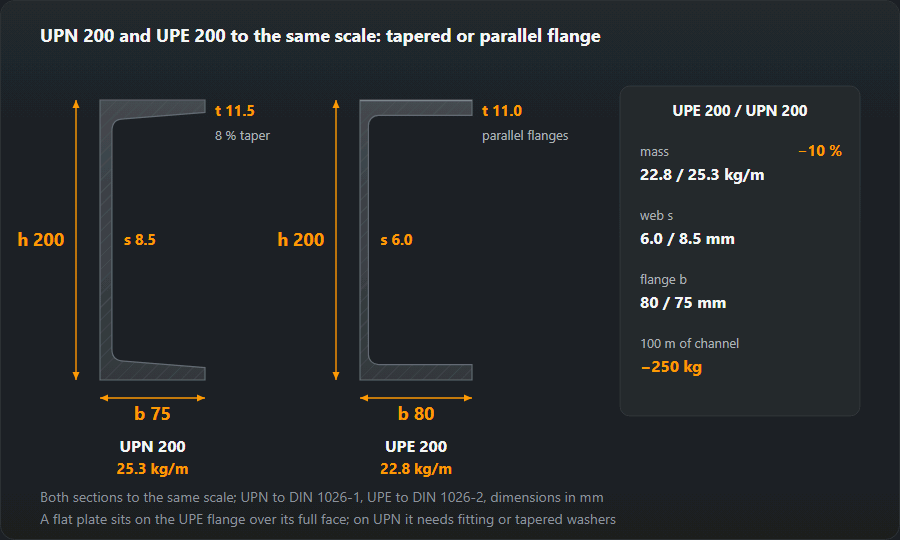
UPN (DIN 1026-1) is the classic channel with the flange tapered 8 % on the inside. The shape dates from a time when rolling a tapered flange was the simpler operation. The consequence is entirely practical: the flange face is not parallel to the web, so a flat plate touches along an edge only, and a bolt needs a tapered washer or a machined seat.
UPE (DIN 1026-2) has parallel flanges. A plate beds on the full face, the fillet weld sits in an ordinary corner rather than in a wedge, and it is easier to inspect. At equal depth UPE is usually a little lighter and has a larger second moment of area about the weak axis — a section designed later and for present-day connections.

Where it gets welded
Channel turns up in three places above all: as a purlin or side rail in wall cladding, as a frame under equipment, and as a box element made from two sections web to web. In each of them the point is the welding sequence rather than the weld itself — an open section twists under one-sided heating far more than a closed one.
The working rule: lay the welds alternately on both sides, in runs, not continuously from one end to the other. A box of two channels is tacked every 300–400 mm and only then welded in 100–150 mm runs, working from the middle outwards. Weld size is set by the thinner of the parts joined — that conversion is in the fillet weld size calculator.
From UPN 320 upwards the flange is 16–18 mm thick and this stops being single-run work: edge preparation appears, several layers, control of heat input, and for steel with a higher carbon equivalent also preheat.
UPN or UPE: the weight difference at the same depth
Up to a depth of 300 the parallel-flange channel is the lighter one: UPE 100 weighs 9.82 kg/m against 10.6 kg/m for UPN 100 (7 % less), UPE 200 weighs 22.8 against 25.3 kg/m (10 % less). Most of the saving is in the web: 8.5 mm on UPN 200, 6 mm on UPE 200. At the very top of the range it flips: UPE 400 weighs 72.2 kg/m, UPN 400 71.8.
On an order that means 100 m of 200 channel in UPE is 250 kg less steel. At a price per kilogram that is the same percentage cheaper — provided the stockholder carries UPE at the same rate per kilogram, which is not always the case.
Weight is not the only criterion. Do not mix the two in one member because “the weight is about the same”: the UPN 200 flange is 75 mm wide, the UPE 200 flange 80 mm, so swapping one section in an existing frame throws out the holes and cover plates. On a new welded structure UPE wins with its flat flange; on a repair you stay with whatever series is already there.
Telling UPN from UPE in the yard

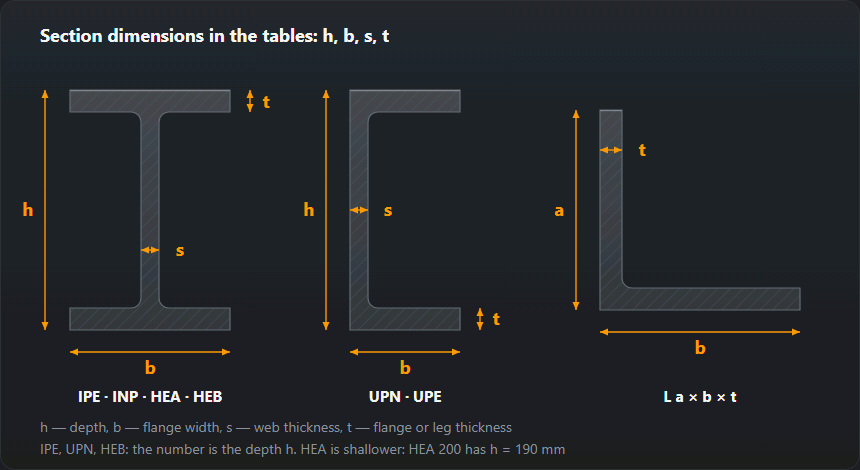
The paint mark on the bar end is often worn off, and from a distance both look the same. A caliper settles it. Start with the flange: on UPN its inner face is tapered, so the flange is visibly thicker at the web than at the toe; on UPE the thickness is constant across the width. Then the web and flange width — at a depth of 160, UPN has a 7.5 mm web and a 65 mm flange, UPE 5.5 mm and 70 mm.
Measure the UPN flange thickness halfway across the flange, not at the toe: at
the toe the reading comes out below the table t, and a perfectly good
section looks “underweight”. The depth h equals the section number
in both series.
Worked example: the weight of a machine base frame
A 2.9 × 1.2 m frame: two longitudinal members in UPN 160, four cross members in UPN 100 and four 0.8 m legs in UPN 120. Weight from the table:
- longitudinals — UPN 160: 2 × 2.9 m = 5.8 m × 18.8 = 109 kg
- cross members — UPN 100: 4 × 1.2 m = 4.8 m × 10.6 = 50.9 kg
- legs — UPN 120: 4 × 0.8 m = 3.2 m × 13.4 = 42.9 kg
- Total: 202.8 kg; with 3 % added for gussets, welds and offcuts — 208.9 kg
That is the weight of the structure. The weight you buy is different, because the stockholder ships whole bars: both longitudinals come out of one 6 m bar of UPN 160, the cross members (4.8 m) out of one bar of UPN 100, the legs (3.2 m) out of one bar of UPN 120. The invoice will say 256.8 kg, and the 1.2 m and 2.8 m offcuts stay in the shop. The cutting list calculator nests the pieces on bars with the least waste, and the bill of materials adds up the whole list with weight and cost.
Metres, bars and tonnes when you order
From kilograms to metres: L = M / G, where G is the
mass per metre from the table. A tonne of UPN 120 is 74.6 m,
which is 13 bars of 6 m or
7 of 12 m — always round up, nobody sells 0.4 of
a bar. The other way round: 20 bars of UPN 140 at 6 m are 120 m, or
1920 kg — a load for which you check the truck
payload and the slings.
Steel cost follows weight: K = L · G · C, where C is
the price per kilogram; with a price per tonne, C = T / 1000. The price
of one metre is simply G · C, so a metre of UPN 200 costs
25.3 times the kilogram price and a metre of UPE 200
22.8 times. Cutting to length, blasting and priming are
charged separately, per cut or per metre, and do not depend on weight.
Common mistakes when working out channel weight
- “100 channel” with no series. UPN 100 is 10.6 kg/m, UPE 100 9.82. Small per metre, but tens of kilograms over a few hundred metres, and a different flange. British PFC and American C channels are separate ranges with their own weights — a number does not translate one to one.
- A cold-formed channel taken from this table. A channel pressed from sheet has a different shape and weighs far less than a rolled one of the same depth. Work it out from the sheet thickness and developed width, for instance in the metal weight calculator as a flat of that width.
- A size that does not exist. There is no UPN 270 in the standard — there is UPE 270 (35.2 kg/m). Such a line on a list is a designer’s or copier’s error.
- Weight per metre read as weight per bar. “UPN 200 — 25 kg” is one metre, not one piece: a 6 m bar is six times that, which matters for manual handling and choosing a sling.
Frequently asked questions
How much does a 6 m channel 100 weigh?
UPN 100 weighs 10.6 kg/m, so a 6 m length is 63.6 kg. UPE 100 at the same depth weighs 9.82 kg/m, that is 58.9 kg — lighter, because it has a thinner web and parallel flanges.
UPN or UPE — which one?
UPN has a flange tapered 8 % on the inside, UPE a parallel one. Wherever a flat plate is bolted or welded to the flange, UPE saves packers and fitting. UPN is often cheaper and more readily in stock, and at the larger depths it has a thicker web, so it takes concentrated load better. For welded structures UPE is usually the easier one to work with.
How do I work out two channels welded into a box?
Simply twice over: section mass times two times the length. The welds add little — a metre of fillet weld at a = 4 mm is about 0.13 kg of deposited metal, so six metres on both sides comes to roughly 1.5 kg. In costing that counts as consumable usage, not as structure mass.
What does UPN 200 weigh per metre, per 6 m and per 12 m bar?
UPN 200 weighs 25.3 kg/m. A 6 m bar is 151.8 kg, a 12 m bar 303.6 kg. UPE 200 of the same depth weighs 22.8 kg/m, which is 136.8 kg per 6 m.
Is there a UPN 270 channel?
No. In the DIN 1026-1 UPN range, UPN 260 (37.9 kg/m) is followed directly by UPN 280 (41.8 kg/m). Only the parallel-flange channel comes in 270 mm — UPE 270, 35.2 kg/m. A “UPN 270” on a cutting list is almost certainly a series mix-up and has to be cleared before ordering.
How many metres of UPN 120 are in a tonne?
1000 / 13.4 ≈ 74.6 m, which is 13 bars of 6 m (12.4 rounded up) or 7 bars of 12 m. The stockholder will ship whole bars anyway, so turn an order in tonnes into a bar count straight away.
What does UPE 160 weigh, and how does it compare with UPN 160?
UPE 160 weighs 17 kg/m: 102 kg for a 6 m bar and 204 kg for 12 m. UPN 160 is 18.8 kg/m (112.8 kg per 6 m), so at the same depth the UPE is 1.8 kg/m lighter: its web and flange are thinner.
Updated: