Storage and handling
Racking, trolleys, stillages, pallets and ramps. This is the last kind of work a fabrication shop does and the most underestimated: the customer treats racking as furniture, the inspector as a load-bearing structure with a notice plate.
How a racking bay is built
Pallet racking is two braced frames with beams between them. Everything else follows from that: the perforation in the upright sets the pitch of the levels, the connector on the beam keeps it from lifting out when a pallet is raised from below, and the base plate with its anchor stops the frame moving under impact.

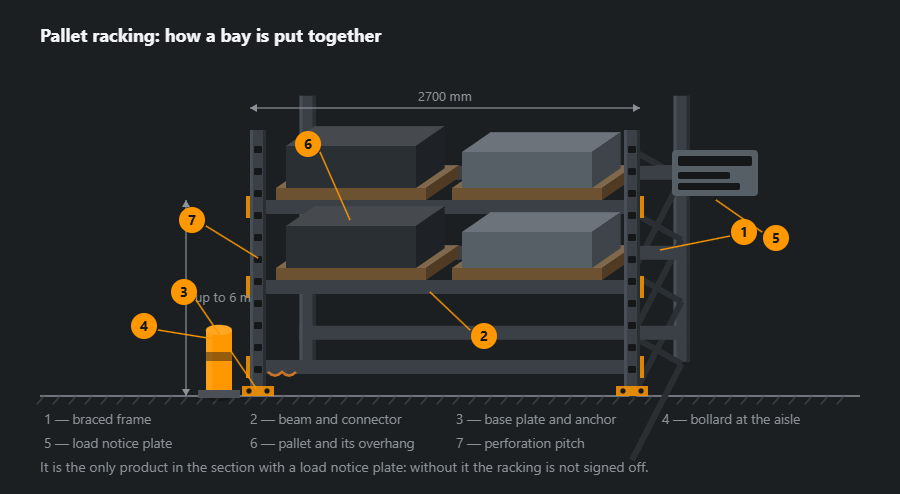
The anchors deserve a word, because they are often taken for over-caution. Racking does not fall over from its load — the more that sits on it, the more stable it stands. What tips it is a forklift catching an upright, and it is that impact the anchors are there for.
Six ways of storing
The kind of racking is set by the truck, not the goods. A counterbalance forklift with a standard mast takes a pallet up to six metres and needs a three-metre aisle; a reach truck goes higher and passes in two. That determines what can go in at all, and only then what will sit on it.

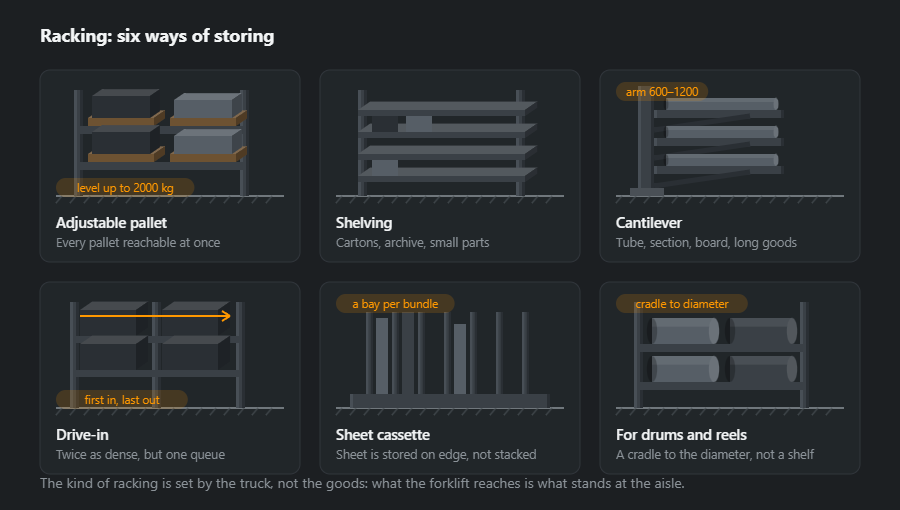
Cantilever racking is the only one with no shelf: tube and section rest on arms, and the length of the load is limited by nothing but the length of the run. A sheet cassette solves a different problem: sheet is stored on edge, because from a stack the bottom one cannot be reached without lifting off everything above it.
Trolleys and stillages
A stillage has a harder life than racking: it gets dropped, stacked, wheeled across uneven floors and lifted by a crane from lugs it was never given. So what matters in it is not wall thickness but how the corners and the base are made.

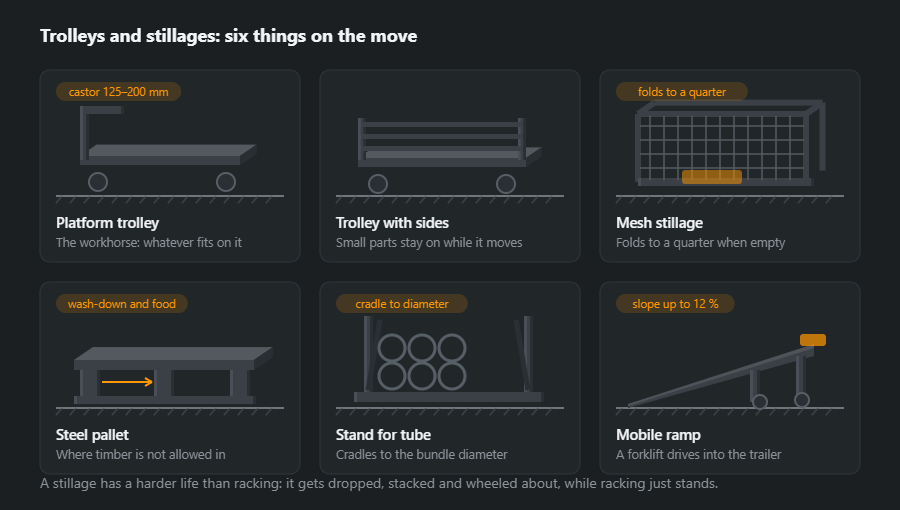
Castors are chosen for the floor rather than the load. On flat concrete polyurethane at 125–160 mm works; on block paving with joints and outdoors you want 200 and up in rubber, or the trolley jams at every joint and ends up being dragged.
Which sections, and why
For warehouses a shop mainly welds what racking systems do not offer: trolleys, containers, made-to-size cantilever racks, sheet cassettes, ramps. Each carries a load and takes knocks, so sections are chosen with margin for rough handling, not just for weight.
- Platform trolley frame — 50×50×3 box, 4.25 kg/m; for heavy loads 60×60×4, 6.71 kg/m.
- Trolley handle — 33.7×3.2 tube, 2.41 kg/m, round because hands grip it every day.
- Mesh container — 30×30×2 frame, 1.68 kg/m, with welded mesh; corners reinforced, because that is where forks hit.
- Cantilever rack — column in I-section, e.g. IPE 160, 15.8 kg/m, arms in 80×40×3 box, 5.19 kg/m; an engineer sets the sizes for the arm load.
- Trolley deck and ramp — 3 mm sheet, 23.5 kg/m²; thicker chequer plate on ramps.
Pallet and cantilever racks are load-bearing structures: system racking is designed to EN 15512 and its condition in use checked to EN 15635. A custom-welded item for heavy loads gets a calculation and a load sign just like a system product. Weights for other sections are in the hollow section and I-beam calculators.
Joints and welds
- Castor plates — welded all round to the frame, with castor holes drilled after welding so the pattern lines up; swivel and fixed castors have different hole patterns.
- Handle — welded into the frame or on sleeves and bolts; on sleeves it comes off for transport and is replaced after a knock.
- Lifting lugs on containers — lifting points: designed by an engineer, welded by a qualified welder and inspected before the first lift.
- Container corners — gusseted; forks hit there and welds crack there.
With a 3 mm wall the upper limit of 0.7·t is only 2.1 mm, below the a3 minimum of EN 1993-1-8, so load-bearing joints are welded a3 — z ≈ 4.2 mm, 0.078 kg of weld metal per metre. The fillet weld calculator checks it.
Fabrication sequence
- Load and equipment — what is moved or stored, its weight, what lifts it, what the floor is.
- Drawing — sizes to suit the pallet or tote, castors, handles, load sign.
- Cutting and tacking — frame on a flat table, diagonals checked.
- Welding — frame, castor plates, deck, handle.
- Protection — powder coating, or galvanising for outdoor use.
- Castors and trial — a loaded run on the real floor, brakes checked.
Corrosion protection
Warehouse equipment loses paint mechanically: fork strikes, pushed pallets, chains. So safety-yellow powder coat on columns and corners does two jobs — it protects and it is visible. Containers and trolleys used outdoors or in cold stores are galvanised, because paint chips rust there within a week. Chequer-plate decks hold water in the grooves, so outdoor trolleys get drain holes.
Common mistakes
- Castors sized on load divided by four — one hangs, three are overloaded.
- Pallet racking welded by eye — no calculation, no load sign, no inspection.
- Lifting lugs from whatever is to hand — they snap at the first jerk of the crane.
- No column guards — the first forklift strike bends a rack upright.
- Handle welded in solid — after a knock, half the trolley gets replaced.
How to work out the material: a 120×80 cm platform trolley
Platform trolley 1200×800 mm: 50×50×3 perimeter frame (4 m) and two 0.8 m cross members, a handle in 33.7×3.2 tube (two 0.9 m uprights and a 0.8 m top rail), a 3 mm sheet deck (0.96 m²). No castors or castor plates.
| Member | Section | Length, m | Qty | kg/m | kg |
|---|---|---|---|---|---|
| Frame | 50×50×3 | 4.00 | 1 | 4.25 | 17.0 |
| Cross member | 50×50×3 | 0.80 | 2 | 4.25 | 6.8 |
| Handle upright | 33.7×3.2 | 0.90 | 2 | 2.41 | 4.3 |
| Handle top rail | 33.7×3.2 | 0.80 | 1 | 2.41 | 1.9 |
| Total | 30.1 | ||||
| With 5 % allowance | 32 | ||||
The sections come to 32 kg with allowance and the deck to about 23 kg — the trolley alone is over 50 kg, and that weight is added to the load when choosing castors. Several trolleys at once go through the bill of materials calculator, and tube nesting through the cutting plan.
Where to go next
Frames under equipment and machine guards are in frames and jigs. Platforms, mezzanines and the stairs to them are in platforms and walkways. Price, lead time and coating are in how ordering works.
Frequently asked questions
Is a load notice plate on racking mandatory?
Yes, and it is the only product in the section anyone asks for one on. The plate carries the load per level and per bay, the height of the first beam level and the date of installation. Without it the racking is not formally signed off, and after a collapse the question "how much was on it" has no answer.
Does racking have to be anchored to the floor?
It does. Racking does not fall over from the load — it falls over from a forklift catching an upright. The anchors hold the frame against that impact rather than against the weight, which is why they go in even on two-level racking.
What is drive-in racking worse at than adjustable pallet racking?
The queue. Pallets drive in one behind another and only the last one placed can come out. Storage density works out twice as high, but a mixed range cannot be kept that way — only identical goods in batches. Adjustable racking costs more per square metre and is far better for access.
Why a steel pallet when wooden ones exist?
Where timber is not allowed in: food production, clean areas, warehouses that get washed down. And where a pallet circulates for years — a wooden one falls apart in a season, a steel one outlives ten. In an ordinary warehouse it is unnecessary and costs five times as much.
Can you weld your own pallet racking?
Pallet racking is a load-bearing structure: system racking is designed to EN 15512 and inspected in use to EN 15635. Racking welded on site with no calculation and no load sign will not pass inspection, and it behaves unpredictably when a forklift hits it. What a shop does weld well is what the catalogues lack: made-to-size cantilever racks, sheet cassettes, trolleys and containers — with a design if they carry heavy loads.
What castors should a workshop trolley have?
Size each castor as if the load plus trolley were carried by three wheels out of four — on an uneven floor one always hangs. So a 55 kg trolley with a 300 kg load needs castors of at least about 120 kg each. Diameter and material follow the floor: polyurethane on smooth concrete, larger rubber on paving and outdoors.
Updated: