What a shop welds for the yard and garden
Half of a fabrication shop's orders are not structures but things that stand in the yard: a gazebo, a greenhouse, a bench, a swing, a wood store. They carry almost no load, yet they stand outdoors all year — and what decides their fate is not a calculation but the section, the joint and the coating.
A gazebo: how it differs from a carport
From the outside there is no visible difference: the same four posts and the same roof. The difference is at the bottom. A carport has neither floor nor railing, and nobody pushes it, so the top frame gives all the stiffness it needs. A gazebo has a rail people lean on and a floor people cross carrying dishes — so the posts must be tied at the bottom too.

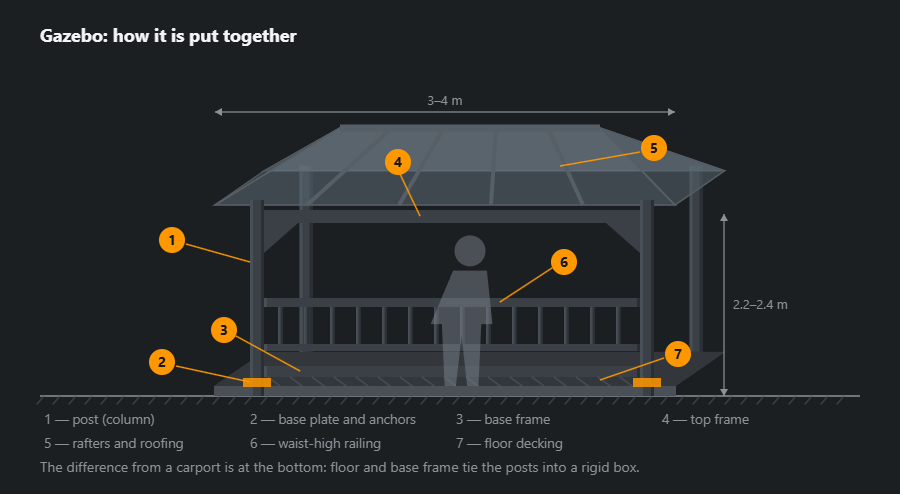
Anchor plates go into the slab before the pour, not after: an anchor set into finished concrete works worse and costs more, and on a thin screed it spalls the edge as well. If there is no slab yet, the gazebo goes on screw piles with the floor laid on joists — that can be taken apart and moved, which a slab cannot.
What kinds there are

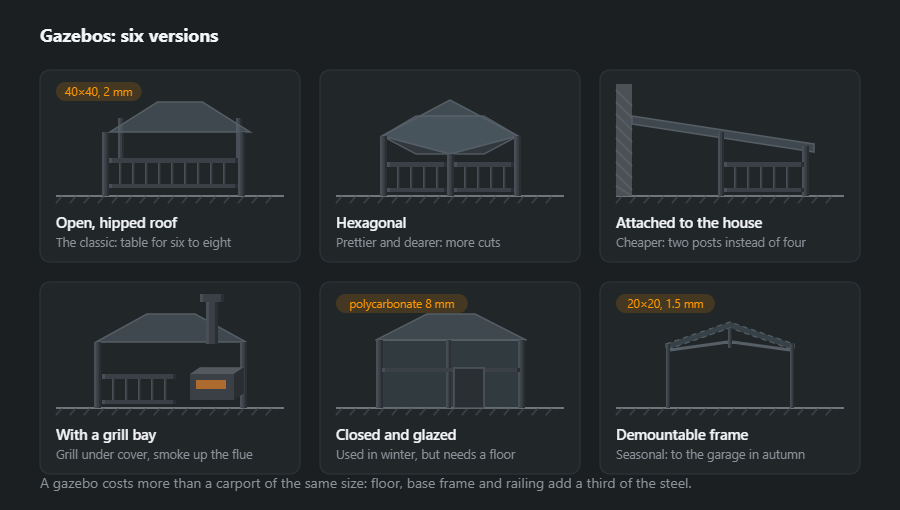
Open with a hipped roof is what gets ordered most: a table for six to eight, a draught from every side, a roof against the rain. Attached to the house is cheaper for exactly one reason — the wall replaces two of the four posts — but it cannot go where the wall is blank and has no apron.
A closed, glazed gazebo is no longer a gazebo but a small building: it needs a real floor rather than boards on joists, and it cannot be set without a fall on the slab. A demountable frame lives the opposite way — three months a year standing, the rest in the garage; it is welded from thin 20×20 tube and bolted together.
Greenhouses and cold frames
Here the arch spacing decides everything, not the thickness of the covering. Polycarbonate is replaced every seven or eight years, film every two, and the frame stays. Arches every 0.65 m carry wet snow; every metre and the frame folds in the first winter, taking the covering with it.

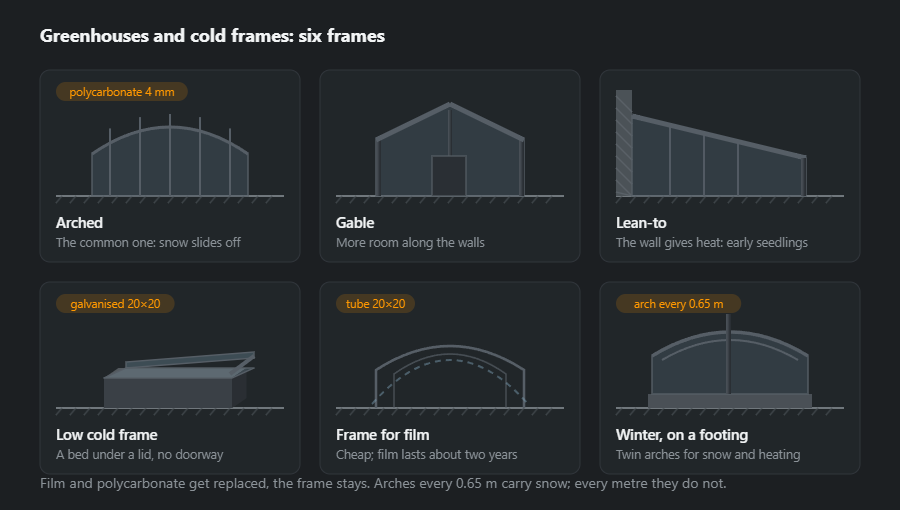
A cold frame is not a small greenhouse but a different object: you do not walk into it, you lift the lid. So it has no door, no aisle down the middle, and all the saving comes out of the metal rather than the size. A winter greenhouse needs a footing, twin arches and heating at once — as a rule two ordinary ones come out cheaper.
Benches, tables, bins and planters

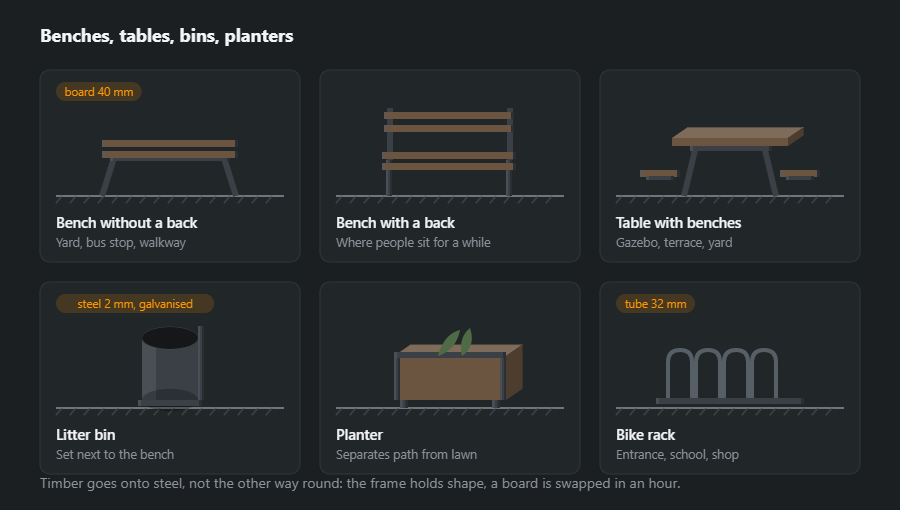
All outdoor furniture has the same fault in its cheap version: the board is screwed to the frame from above, straight through. Water sits in the dish around the head, the timber rots there first, and after three years the board breaks exactly along the fixings. The bolt should be pulled from underneath, from below the frame.
A planter and a bin differ from a bench in that they always hold water. Their bottoms are not made solid but perforated and on feet: there has to be a gap between the bottom and the paving, otherwise what rusts is not the product but the ground under it.
Yard oddments
These are the day-long jobs, and together they make up more than half the orders for a yard: a swing, a washing line stand, a wood store, a kennel run, a compost bin, a bin shelter. They share one thing — they stand outdoors all year, so they are coated all over, inside surfaces and tube ends included.

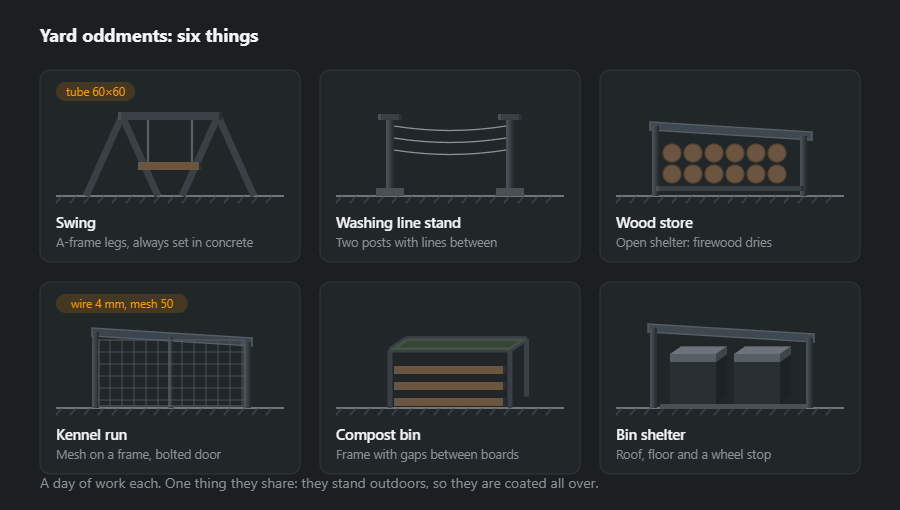
End caps on tubes are not decoration. An open tube takes in water, winter splits it along the seam, and it always happens where nobody looks: at the bottom end of a post, below ground. The cap can be welded or a plastic push-fit, but it goes on every time.
Which sections, and why
For garden items the section is chosen for welding and outdoor life first, weight second. A wall that is too thin burns through at the corners and the whole piece twists from the heat, so going below 2 mm is only for light take-down frames.
- Gazebo posts — 60×60×3 box, 5.19 kg/m; 80×80×4, 9.22 kg/m, for larger gazebos.
- Top and bottom frames — 40×40×3, 3.30 kg/m; the bottom frame is what separates a gazebo from a carport.
- Rafters and battens — 40×20×2, 1.68 kg/m, long side vertical.
- Greenhouse hoops — 20×20×2, 1.05 kg/m, or 40×20×2 for wider spans; spacing matters more than section.
- Swing beam — round tube 76.1×3.6, 6.44 kg/m, or 88.9×4.0, 8.38 kg/m; legs 48.3×3.2, 3.56 kg/m.
A gazebo and a greenhouse carry snow on the roof and a swing carries dynamic load — at larger sizes or in a public place the sections are checked by calculation, not copied from the neighbour’s garden. Weights for other sections are in the hollow section calculator.
Welds and joints
- Frame corners — mitred, or butted with a cap; thin wall is welded in short runs so the edge does not burn away.
- Hexagonal gazebo — six 60° cuts on every level; check the angle with a template before welding, because the error adds up round the perimeter.
- Greenhouse hoops — bent, not welded from pieces; a weld mid-hoop is where it will snap under snow.
- Swing hangers — bought in, with a rated load, bolted through a sleeve in the beam; a hook welded from bar is the weakest link in the whole structure.
With a 3 mm wall the upper limit of 0.7·t is only 2.1 mm, below the a3 minimum of EN 1993-1-8, so post joints are welded a3 — z ≈ 4.2 mm. Thin-tube welding is covered in welding box section, and a gazebo on a simple frame can be built yourself with the carport guide.
Fabrication and erection sequence
- Foundation — slab with cast-in anchor plates, or screw piles; levels are set before ordering steel.
- Drawing — post spacing to the plates, roof pitch, entrance in the bottom frame, hoop spacing.
- Panels in the shop — frames and roof trusses on a flat table.
- Protection — galvanising with vent holes, then paint.
- Erection — posts on anchors, bottom frame, top frame, roof; bolted joints, site welding only as an exception.
- Roofing and finishing — polycarbonate, sheet or boards; caps, packers under timber.
Corrosion protection
Everything in a garden stands in the rain, and posts and legs sit in the damp at ground level too. Hot-dip galvanising with powder coat on top lasts longest; paint alone needs renewing after a few seasons, starting at the post feet. Tubes for galvanising get vent holes, tubes for painting get caps so they do not fill with water. Timber does not sit directly on steel: a packer or gap lets both surfaces dry after rain.
Common mistakes
- Greenhouse hoops welded from pieces — they crack at the weld under the first wet snow.
- Gazebo without a bottom frame — posts spread when people lean on the balustrade.
- Swing hook made from bar — the weld on the hook works in fatigue and fails without warning.
- Anchors in a thin screed — the edge crumbles and the post starts to wander.
- Timber flat on steel — water sits between them and both surfaces rot.
How to work out the material: a 3×3 m gazebo
Hipped gazebo 3×3 m with 2.5 m posts: four 60×60×3 posts, a 40×40×3 top frame all round (12 m), a bottom frame less the entrance (11 m), four 2.3 m hip rafters and eight 1.6 m common rafters in 40×20×2. No roofing, floor or balustrade.
| Member | Section | Length, m | Qty | kg/m | kg |
|---|---|---|---|---|---|
| Post | 60×60×3 | 2.50 | 4 | 5.19 | 51.9 |
| Top frame | 40×40×3 | 12.00 | 1 | 3.30 | 39.6 |
| Bottom frame | 40×40×3 | 11.00 | 1 | 3.30 | 36.3 |
| Hip rafter | 40×20×2 | 2.30 | 4 | 1.68 | 15.5 |
| Common rafter | 40×20×2 | 1.60 | 8 | 1.68 | 21.5 |
| Total | 164.8 | ||||
| With 5 % allowance | 173 | ||||
That makes 165 kg net and 173 kg with allowance, about 19 kg per square metre. The bottom frame is more than a fifth of all the steel — exactly the item that separates a gazebo from a carport of the same area. The bill of materials calculator adds the roofing, and the cutting plan nests the rafters.
Where to go next
If what the yard actually needs is cover for a car, that is carports, with the footings and the fall. A barbecue, a stainless table and a tank are shop products. What things cost and how long they take is in how ordering works.
Frequently asked questions
How does a gazebo differ from a carport?
By the floor and the base frame. A carport holds itself together at the top: posts, truss, roofing — and that is enough, because nobody pushes it. A gazebo has a railing people lean on and a floor people walk across, so the posts have to be tied into a rigid box at the bottom as well. That is where the price difference comes from, about a third for the same footprint.
What tube is a gazebo welded from?
Posts 60×60 or 80×80 with a 2–3 mm wall, frame 40×40, rafters 40×20. On a 3×3 gazebo that is generous. Thinner is avoided not for strength but for welding: a thin wall burns through at the corners, and the heat pulls the whole assembly out of square.
Does a greenhouse need a footing?
An ordinary one does not — ground anchors or screw piles are enough. A footing is needed for a winter greenhouse: it is heated, and the strip cuts frost off the bed. It is also needed on heaving ground, where a frame without support goes out of plane in two winters and the polycarbonate starts cracking at the fixings.
Why must a swing be set in concrete?
Because the load on it is not vertical but swinging. A-frame legs are stable on static load alone; once it swings, the front leg tries to lift out of the ground. Two 40 litre blocks of concrete under each pair of legs is enough — but without them the swing walks out of the soil in one season.
How much steel goes into a 3×3 m gazebo?
In the example on this page — four 60×60×3 posts, top and bottom frames in 40×40×3, rafters in 40×20×2 — about 165 kg net and a little over 170 kg with allowance, just under 20 kg per square metre. Roofing, floor and balustrade come on top.
Does a garden swing have to meet a standard?
Swings in public playgrounds fall under EN 1176 and periodic inspection. A home swing is not formally covered, but the same principles are a sound starting point: secure anchoring, chains and hangers with a rated load, no gaps that can trap a finger, and clear space around it. The beam and hangers work dynamically, so they are sized with a large margin.
Updated: