How much a tube or hollow section weighs
Mass per metre of a hollow section: 40×40×3 — 3.30 kg/m, 60×40×3 — 4.25 kg/m, 100×100×5 — 14.4 kg/m; of a round tube: 42.4×3.2 — 3.09 kg/m (a 6 m length is 18.6 kg). Enter your own dimensions and wall thickness — the calculator gives one piece, the whole batch and a running metre, and below are tables of the usual commercial sizes to EN 10219.
Short answer
Mass per metre of a hollow section is F · ρ / 1000, where
F is the cross-sectional area in mm² and
ρ = 7.85 g/cm³ for steel. For a round tube the
formula shortens to m = π · t · (D − t) · 0.00785 kilograms per
metre. Most asked for: section 50×50×3 — 4.25 kg/m, 80×40×4 — 6.71 kg/m, 80×80×4 — 9.22 kg/m; tube 33.7×3.2 — 2.41 kg/m, 60.3×3.6 — 5.03 kg/m, 76.1×3.6 — 6.44 kg/m.
Circular hollow section weight formula, worked through
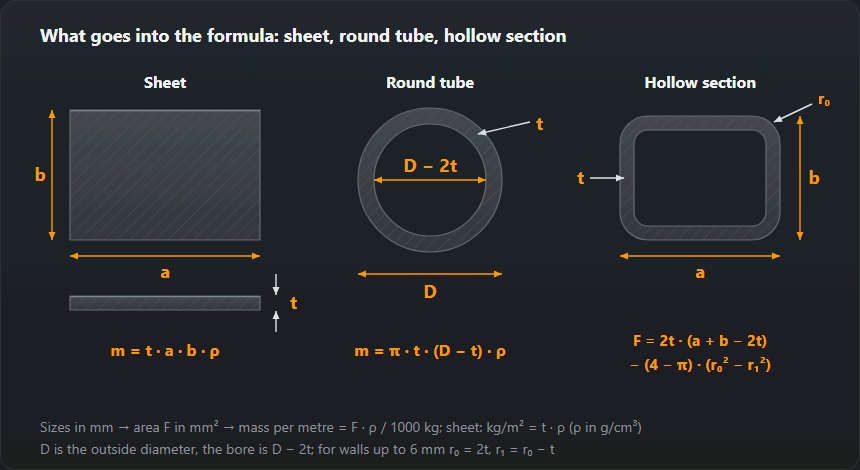
Mass per metre of a round tube is the ring area times density:
m = π · t · (D − t) · ρ / 1000, where D is the outside
diameter and t the wall, both in mm, giving kg/m. For steel the constants
collapse into one multiplier: m = 0.02466 · t · (D − t).
Example: 42.4×3.2 CHS.
- D − t = 42.4 − 3.2 = 39.2 mm.
- 0.02466 × 3.2 × 39.2 = 3.09 kg/m — the same as the table below.
- Check it another way: bore d = D − 2t = 36.0 mm, area π/4·(42.4² − 36.0²) = 394.1 mm², times 7.85/1000 — 3.09 kg/m again.
- A 6 m length weighs 18.6 kg; twelve lengths for a handrail run, 223 kg.
A second example, 60.3×3.6: 0.02466 × 3.6 × 56.7 = 5.03 kg/m, and 76.1×3.6 comes to 6.44 kg/m. The same tube in stainless is 1.006 times heavier (42.4×3.2 — 3.11 kg/m), in aluminium 1.06 kg/m; common aluminium tube sizes are in the aluminium tube weight calculator.

Hollow section weight chart: square and rectangular, kg per metre
| Section, mm | A, mm² | Mass, kg/m | 6 m length, kg |
|---|---|---|---|
| 20×20×2 | 134 | 1.05 | 6.3 |
| 25×25×2 | 174 | 1.36 | 8.2 |
| 30×30×2 | 214 | 1.68 | 10.1 |
| 30×30×3 | 301 | 2.36 | 14.2 |
| 40×20×2 | 214 | 1.68 | 10.1 |
| 40×40×2 | 294 | 2.31 | 13.9 |
| 40×40×3 | 421 | 3.30 | 19.8 |
| 40×40×4 | 535 | 4.20 | 25.2 |
| 50×30×3 | 421 | 3.30 | 19.8 |
| 50×50×3 | 541 | 4.25 | 25.5 |
| 50×50×4 | 695 | 5.45 | 32.7 |
| 60×40×3 | 541 | 4.25 | 25.5 |
| 60×40×4 | 695 | 5.45 | 32.7 |
| 60×60×3 | 661 | 5.19 | 31.1 |
| 60×60×4 | 855 | 6.71 | 40.3 |
| 80×40×3 | 661 | 5.19 | 31.1 |
| 80×40×4 | 855 | 6.71 | 40.3 |
| 80×80×4 | 1175 | 9.22 | 55.3 |
| 80×80×5 | 1436 | 11.3 | 67.6 |
| 100×50×4 | 1095 | 8.59 | 51.6 |
| 100×100×4 | 1495 | 11.7 | 70.4 |
| 100×100×5 | 1836 | 14.4 | 86.5 |
| 100×100×6 | 2163 | 17.0 | 101.9 |
| 120×60×4 | 1335 | 10.5 | 62.9 |
| 120×80×5 | 1836 | 14.4 | 86.5 |
| 120×120×5 | 2236 | 17.6 | 105.3 |
| 150×100×5 | 2336 | 18.3 | 110.0 |
| 150×150×6 | 3363 | 26.4 | 158.4 |
Rectangular hollow section weight: why the calculator reads higher than the table
The calculator at the top of the page treats the section as the difference of two
rectangles: a·b − (a − 2t)·(b − 2t), which simplifies to
2t · (a + b − 2t). A real EN 10219 section has rounded corners: outer
radius r₀ = 2t, inner r₁ = t (for walls up to 6 mm). Each of the four
corners is missing a sliver of steel, together (4 − π)·(r₀² − r₁²).
| Section, mm | No radii, kg/m | EN 10219, kg/m | Difference, % |
|---|---|---|---|
| 20×20×2 | 1.13 | 1.05 | +7.7 |
| 40×40×2 | 2.39 | 2.31 | +3.3 |
| 40×40×3 | 3.49 | 3.30 | +5.6 |
| 40×40×4 | 4.52 | 4.20 | +7.7 |
| 60×40×3 | 4.43 | 4.25 | +4.2 |
| 80×80×4 | 9.55 | 9.22 | +3.5 |
| 100×100×5 | 14.92 | 14.40 | +3.6 |
| 150×150×6 | 27.13 | 26.40 | +2.8 |
Step by step for 60×40×3. Simplified: 2 · 3 · (60 + 40 − 6) = 564 mm², i.e. 4.43 kg/m. Corners: r₀ = 6, r₁ = 3, (4 − π) · (36 − 9) = 23.2 mm² to take off. That leaves 540.8 mm² and 4.25 kg/m — exactly the table.
The gap is widest on small sections with a thick wall (30×30×3 +7.8 %, 40×40×4 +7.7 %) and narrows on big ones (150×150×6 +2.8 %). Rule of thumb: orders, quotes and settling up with the stockholder go by the EN table; the calculator figure can stay where a margin does no harm — choosing a sling or checking a trolley's rating.
Round tube weight chart: kg per metre by diameter and wall
| Tube D×t, mm | A, mm² | Mass, kg/m | 6 m length, kg |
|---|---|---|---|
| 21.3×2.6 | 153 | 1.20 | 7.2 |
| 26.9×2.6 | 199 | 1.56 | 9.4 |
| 33.7×3.2 | 307 | 2.41 | 14.5 |
| 42.4×3.2 | 394 | 3.09 | 18.6 |
| 48.3×3.2 | 453 | 3.56 | 21.4 |
| 60.3×3.6 | 641 | 5.03 | 30.2 |
| 76.1×3.6 | 820 | 6.44 | 38.6 |
| 88.9×4.0 | 1067 | 8.38 | 50.3 |
| 114.3×4.5 | 1552 | 12.2 | 73.1 |
| 139.7×5.0 | 2116 | 16.6 | 99.7 |
| 168.3×5.6 | 2862 | 22.5 | 134.8 |
| 219.1×6.3 | 4212 | 33.1 | 198.4 |
The tables are worked out for a density of 7.85 g/cm³. For hollow
sections the EN 10219 formula was used with an outer corner radius of
2t for walls up to 6 mm — which is why they come out
3–7 % below the plain subtraction of rectangles that the calculator above
performs. The product also carries a wall thickness tolerance, so settlement
goes by the certificate.
Pipe sizes in inches and DN: the actual outside diameter
Threaded and service pipe is ordered in inches or by nominal size DN, but the formula needs the outside diameter. The inch in the name is a nominal figure that matches no dimension of the pipe; the table lines both up with the tube masses from the table above.
| DN | Inches | Outside diameter D, mm | Tube in the table D×t, mm | Mass, kg/m |
|---|---|---|---|---|
| DN 15 | 1/2″ | 21.3 | 21.3×2.6 | 1.20 |
| DN 20 | 3/4″ | 26.9 | 26.9×2.6 | 1.56 |
| DN 25 | 1″ | 33.7 | 33.7×3.2 | 2.41 |
| DN 32 | 1 1/4″ | 42.4 | 42.4×3.2 | 3.09 |
| DN 40 | 1 1/2″ | 48.3 | 48.3×3.2 | 3.56 |
| DN 50 | 2″ | 60.3 | 60.3×3.6 | 5.03 |
| DN 65 | 2 1/2″ | 76.1 | 76.1×3.6 | 6.44 |
| DN 80 | 3″ | 88.9 | 88.9×4.0 | 8.38 |
| DN 100 | 4″ | 114.3 | 114.3×4.5 | 12.2 |
| DN 125 | 5″ | 139.7 | 139.7×5.0 | 16.6 |
| DN 150 | 6″ | 168.3 | 168.3×5.6 | 22.5 |
| DN 200 | 8″ | 219.1 | 219.1×6.3 | 33.1 |
The classic mistake is an "inch" pipe worked out at 25.4 mm. A 1″ pipe is DN25 with a 33.7 mm outside diameter; with a 3.2 mm wall it weighs 2.41 kg/m, whereas 25.4×3.2 would give 1.75 kg/m — 27 % light. The wall of such pipe depends on the series (light, medium, heavy), so take it from the order or the mill certificate before you calculate.
Cross-section formulas
| Shape | Cross-sectional area |
|---|---|
| Round tube | F = π · t · (D − t) |
| Hollow section, simplified | F = a·b − (a − 2t)·(b − 2t) |
| Hollow section to EN 10219 | F = 2t·(a + b − 2t) − (4 − π)·(r₀² − r₁²) |
In the last formula r₀ is the outer corner radius (taken as
2t for walls up to 6 mm) and r₁ =
r₀ − t. Mass per metre is always F · ρ / 1000
kilograms with F in mm².
Metres per tonne and what a frame weighs
Stockholders price by the tonne, drawings are in metres. Metres per tonne is 1000 divided by mass per metre: 40×40×2 box — 433 m, 40×40×3 — 303 m, 60×40×3 — 235 m, 80×80×4 — 108 m, 42.4×3.2 tube — 324 m. In 6 m lengths a tonne of 40×40×2 is 71.9 lengths, of 60×40×3 39.2.
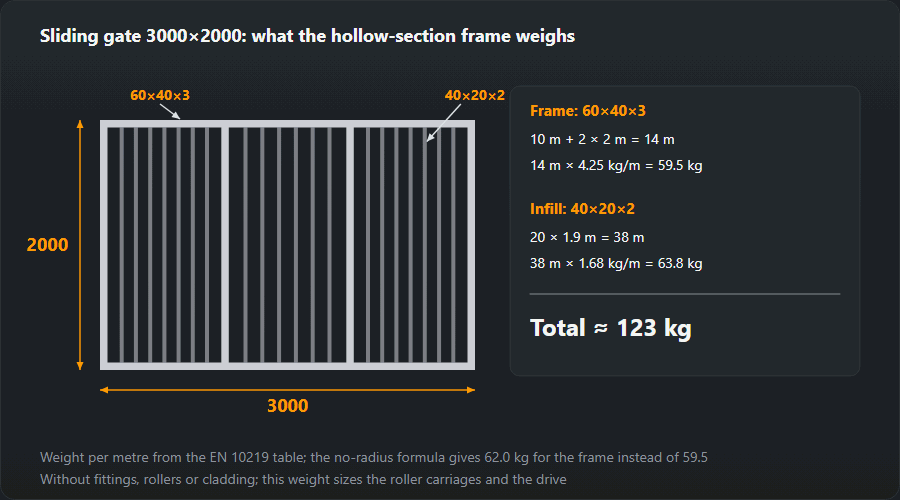
Example: a 3000×2000 sliding gate.
- Frame in 60×40×3: perimeter 10 m plus two intermediate uprights of 2 m — 14 m in all.
- 14 m × 4.25 kg/m = 59.5 kg from the EN table (the no-radius calculator shows 62.0 kg).
- Infill in 40×20×2: 20 pieces of 1.9 m = 38 m × 1.68 kg/m = 63.8 kg.
- About 123 kg in total before hardware, wheels and any sheet — the figure the rollers and the operator are chosen by.
Nesting those pieces into 6 m lengths with the least waste is what the cutting list optimiser does, and the bill of materials totals the whole schedule with an allowance and a price.
The same sum works for a table frame in box section or a barbecue chimney — how those pieces are built is shown under furniture and interior and barbecues and stoves.

Common mistakes with tube and hollow section weight
- Bore instead of outside diameter. Take 42.4 as the bore and enter 48.8 as the outside, and you get 3.60 instead of 3.09 kg/m.
- An inch as 25.4 mm. A 1″ pipe is 33.7 mm outside — see the DN table above.
- Wall in the wrong unit. 3.2 mm is 0.32 cm; typed as 32 it turns the tube into a solid bar and the calculator returns nonsense.
- Dimension order. The trade notation is a×b×t with the wall last: 60×40×3, not 3×40×60.
- Calculator instead of table for tonnage. On 20 t of section a 3–8 % overstatement is 600 kg to 1.6 t of steel that will not be on the lorry.
- Stainless and aluminium at 7.85. For stainless the error is 0.6 %, for aluminium nearly threefold.
Welding hollow sections
The thin wall is the main problem: at 2 mm a burn-through is a matter of a second, and on a corner half a second, because the heat has nowhere to go. Current follows the thinnest part, not the overall size of the section: 40×40×2 is 60–80 A work with a 2.0 mm electrode, or short-arc MAG at 90–110 A with 0.8 mm wire.
The second problem is the frame pulling out of square. A closed section is stiff in torsion, but a frame built from it bows under uneven heating just like any other. Tacks go closer than on a beam — every 200–300 mm — and welding alternates: opposite sides first, then the rest.
The third is moisture and rust inside. A closed section collects condensate, and a fully sealed frame bursts from pressure the first time it is heated hard if it has no vent. In hot-dip galvanised work vent holes are mandatory; in ordinary work they are simply sensible.
Cutting and fitting sections to each other is covered in welding hollow sections; matching current to thickness in the welding current calculator.
Frequently asked questions
How much does a 40×40×3 hollow section weigh?
3.30 kg per metre, so 19.8 kg over a 6 m length. A 40×40×2 weighs 2.31 kg/m and a 50×50×3 weighs 4.25 kg/m.
How much does a 42.4×3.2 tube weigh?
3.09 kg/m. The formula is short: mass per metre of tube is π · t · (D − t) · 7.85 / 1000, where D is the outside diameter and t the wall thickness, both in millimetres.
Why does the calculator overstate hollow section mass?
Because it takes the section as the difference of two rectangles and knows nothing about the corner radii. A real section has corners of roughly twice the wall thickness in radius, so there is less material there. The discrepancy is 3–8 % and is largest on small sections with a thick wall. The tables below are worked out from the EN 10219 formula with the radii included — use those when the figure has to be exact.
How many metres of 40×40×2 box section are there in a tonne?
433 m. It is one division: 1000 kg / 2.31 kg/m, or about 72 lengths of 6 m. For 40×40×3 it is 303 m, for 60×40×3 235 m, for 80×80×4 108 m and for 42.4×3.2 tube 324 m.
What is the outside diameter of a 1 inch pipe?
33.7 mm, not 25.4. The inch in the name is the nominal size DN25, not a dimension of the pipe. A 33.7×3.2 tube weighs 2.41 kg/m; worked out wrongly as 25.4×3.2 it would come to 1.75 kg/m — 27 % light. A ½″ pipe is 21.3 mm, ¾″ is 26.9 mm and 2″ is 60.3 mm outside.
What is the rectangular hollow section weight formula?
Simplified: m = 2t · (a + b − 2t) · 0.00785 kg/m, sides and wall in mm. For 60×40×3: 2·3·94 = 564 mm² → 4.43 kg/m. The exact EN 10219 version also takes off the metal missing at the corners, (4 − π)·(r₀² − r₁²): 540.8 mm² and 4.25 kg/m. For orders by the tonne use the table value.
Updated: