Barbecues, smokers and stoves
This is the thing most often ordered from a welder, and the most underestimated. From outside a barbecue is a box on legs, and it looks as though dearer and cheaper differ in prettiness. They differ in wall thickness, in whether there are grate bars, and in where the smoke goes.
How a firebox is built
A firebox has four layers up its height and each answers for its own thing: the cooking grate on top, the coals, the grate bars under them and the ash pan at the bottom. A barbecue built without the bars technically works, but the charcoal sits in its own ash and dies, and the floor burns through first, because all the heat rests straight on it.

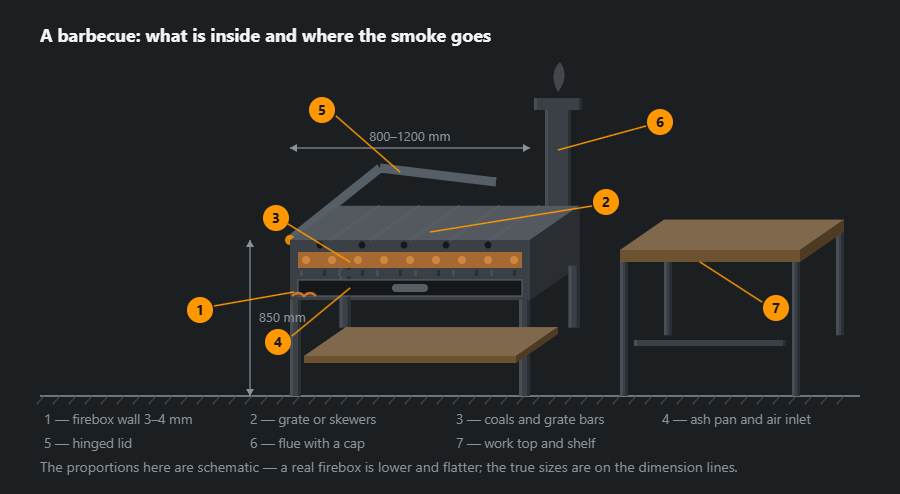
Wall thickness settles everything else. Two millimetres burns through in two seasons: steel does not burn, it oxidises and thins with every firing, and the floor goes first. Three to four millimetres lasts years and holds the heat more evenly — a thick wall works as a store and does not pull out of shape.
What kinds there are

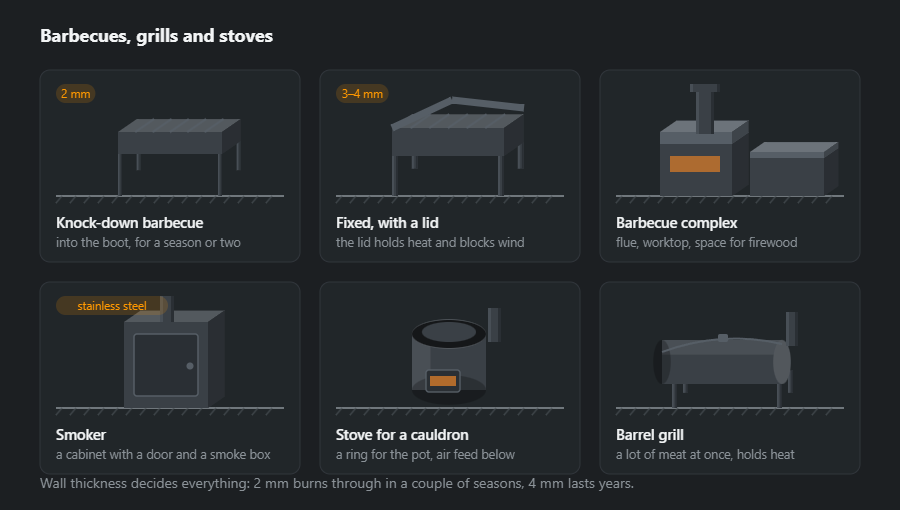
A knock-down one is a season and a car boot: light, thin, and it lasts exactly as long as you do not mind. A fixed one with a lid is already something that stays put and outlives its owner. A drum grill and a cauldron stove are not barbecues at all but different appliances: in the first the heat comes from below and the side, in the second it is the base of the pot that is heated.
The barbecue set
A set differs from a barbecue not in size but in what stands around the fire: a top to cut on, a shelf for wood, a sink, sometimes a cauldron and a smoker. The point of it is one thing — not walking across the yard with plates.

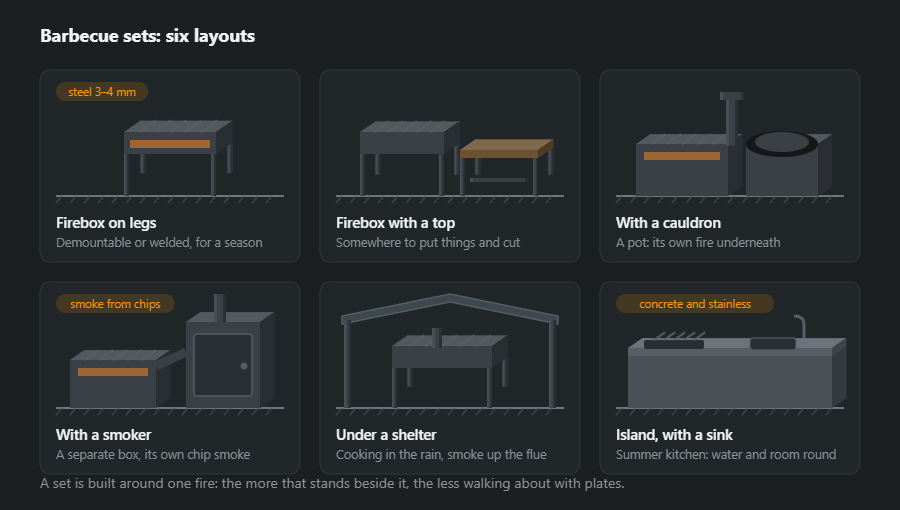
A smoker cannot be merged with the firebox into one body, though people ask for it often. Smoking runs at 30–90 °C on smoke from smouldering chips, while over charcoal the temperature is three times that and the smoke is different. So the smoker is a separate cabinet with its own smoke generator, and all that joins them is a shared work top.
Flue and draught
Draught comes from the difference in height, not from the diameter of the pipe. A metre and a half above the coals is the minimum at which smoke goes up on a still day too. If there is a roof nearby, the pipe has to come out above the ridge, or the wind will kill it with a downdraught and the smoke will come back in your face.

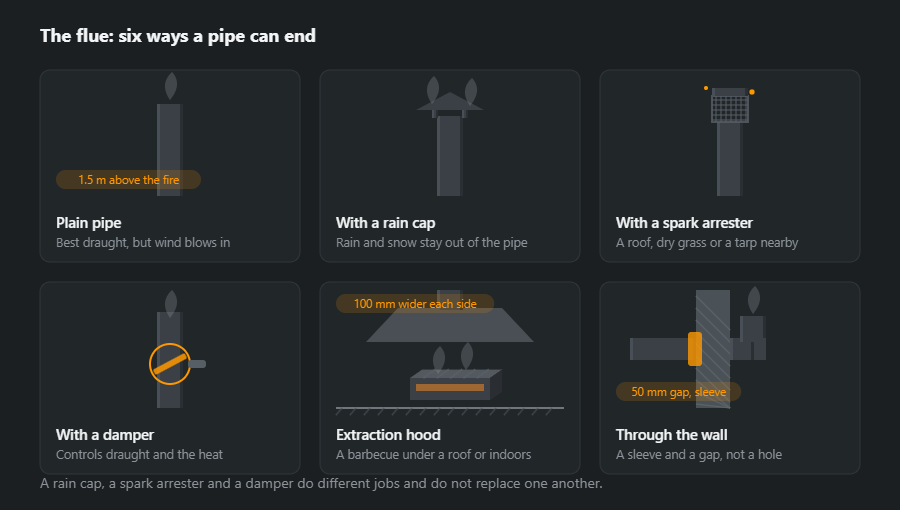
Three pipe ends get confused constantly. A cap keeps out rain and snow. A spark arrester is a mesh that stops burning particles getting out, and it is required wherever there is roofing, dry grass or a tarpaulin nearby. A damper sits not at the top but in the pipe itself and controls the draught: close it down and the charcoal burns slower and the heat lasts longer.
What it is welded from, and why
In a barbecue the firebox decides how long it lasts, and the frame round it how easy it is to use. The plate is chosen for the fire, the sections for stiffness and so that nothing heats your hands.
- Firebox — 4 mm plate, 31.4 kg/m², or 3 mm, 23.5 kg/m²; 2 mm sheet is only 15.7 kg/m², which is why it burns through so fast.
- Legs and frame — L 40×40×4 angle, 2.42 kg/m, or 40×40×3 box, 3.30 kg/m. Angle is easier to lap-weld onto the box.
- Fire grate — 12 mm square bar, 1.13 kg/m, at about 3 cm centres; thinner bar warps in the heat.
- Handles — 21.3×2.6 tube, 1.20 kg/m, held a few centimetres off the firebox wall so they stay cool.
Galvanised steel is not used anywhere the fire reaches: zinc vaporises and its fumes are harmful. The cooking grate is stainless or mild steel seasoned with oil. Plate weights are in the plate calculator, and welding fumes are covered in welding fumes.
Welds and thermal expansion
- Firebox box — continuous welds on the outside so ash does not fall through gaps; strength is not the issue here, tightness is.
- Grate loose, not welded — steel grows in the heat, and a grate welded in rigidly bows after a few fires and pulls the walls.
- Lapped legs — angle to the box corner with two welds; a joint near the fire works thermally, so a longer weld beats a thicker one.
- Thick to thin — with 4 mm plate and 12 mm bar, keep the arc on the thicker part; a thin handle burns through more easily.
3–4 mm plate welds with MAG or a rutile electrode without special difficulty; tips for thinner sheet are in welding thin metal.
Fabrication sequence
- Size to the grate — firebox length and depth follow the cooking grate or skewers, not the other way round.
- Plate layout — walls folded from one sheet where possible: fewer welds in the fire zone.
- Box — tacking, checking corners, welding on the outside.
- Frame and legs — on a flat table, then the box onto the frame.
- Holes — air inlet under the fire grate, water drain in the ash pan.
- Grates and handles — grates loose on supports, handles stood off.
- Paint and burn-in — heat-resistant paint, first fire kept small.
Corrosion protection
The firebox is painted with a silicone heat-resistant paint that cures at the first fire; ordinary paint and powder coat burn and peel off in sheets. The inside of the firebox is usually left bare — the fire would destroy paint anyway, and the burnt-on oxide layer protects better than you might think. The ash pan rusts fastest: ash and moisture make a corrosive mix, so the ash comes out after every fire and a drain hole goes in the pan. Over winter the barbecue is covered or kept under a roof.
Common mistakes
- Galvanised sheet in the firebox — toxic fumes from the first fire.
- Grate welded in solid — bowed after a few fires, with cracked welds.
- Powder coat on the firebox — peeling sheets and a burning smell.
- No drain hole in the ash pan — rainwater and ash eat through the bottom in a season.
- Handle welded straight to the wall — you cannot touch it without a glove.
How to work out the material: an 80×40 cm freestanding barbecue
Freestanding barbecue with an 80×40×25 cm firebox in 4 mm plate (bottom and four walls, about 0.92 m²), on four angle legs, with a top frame and a lower shelf, a fire grate of 24 bars in 12 mm and two handles. No lid, flue or cooking grate.
| Member | Section | Length, m | Qty | kg/m | kg |
|---|---|---|---|---|---|
| Leg | L 40×40×4 | 0.80 | 4 | 2.42 | 7.7 |
| Top frame | L 40×40×4 | 2.40 | 1 | 2.42 | 5.8 |
| Shelf frame | L 40×40×4 | 2.40 | 1 | 2.42 | 5.8 |
| Fire grate bar | □12 | 0.38 | 24 | 1.13 | 10.3 |
| Handle | 21.3×2.6 | 0.40 | 2 | 1.20 | 1.0 |
| Total | 30.6 | ||||
| With 5 % allowance | 32 | ||||
The sections come to 32 kg with allowance, and the 4 mm firebox alone to about 29 kg; in 2 mm it would be 14 kg, and that difference is what decides whether the barbecue lasts two seasons or ten. The bill of materials calculator recalculates the whole thing, and the cutting plan fits the grate bars into a 6 m length.
Where to go next
A barbecue under cover and a gazebo with a grill bay are in yard and garden. Stainless for kitchens, tanks and pipework are in shop products. What it costs and how long it takes is in how ordering works.
Frequently asked questions
How thick does the steel need to be?
From 3 mm, better 4. A two-millimetre wall burns through in two seasons: the metal does not so much burn as oxidise and thin out with every firing. Four millimetres lasts years and holds the heat more evenly — a thick wall works as a heat store and does not distort from overheating.
Does a barbecue need grate bars in the bottom?
It does if you cook long and often. The bars lift the coals off the floor and let air in from below — the charcoal burns evenly and does not smother in its own ash. Without them the ash settles on the coals and chokes them, and the floor of the firebox burns through first, because all the heat sits straight on it.
How tall does the flue have to be?
At least a metre and a half above the coals, and above the ridge if there is a roof nearby. Draught comes from the difference in height: a short pipe only pulls in wind, and on a still day the smoke goes in your face. A rain cap does not stop downdraught — it only keeps the wind from beating straight down the pipe.
Can a barbecue stand under a shelter?
It can, if there is a flue or an extraction hood and the roofing is not combustible. Polycarbonate over a fire melts from the rising heat even without flames, and a tarpaulin catches from a single spark. Under a shelter the barbecue gets a pipe taken above the roofing, with a spark arrester on it.
Can a barbecue be made from galvanised sheet?
No. Zinc vaporises at firebox temperature, and breathing its oxide causes flu-like symptoms known as metal fume fever. The firebox, grates and anything touching the fire or the food are made of mild steel or stainless; galvanised sheet belongs at most on a roof or a shelf well away from the fire. Welding galvanised sheet also means removing the zinc first and good ventilation.
How much does a 4 mm plate barbecue firebox weigh?
An 80×40×25 cm box with a bottom and four walls is about 0.9 m² of plate, so at 4 mm nearly 30 kg — twice as much as in 2 mm. With legs, frame and fire grate it comes to around 60 kg of steel, which is why a heavy-plate barbecue gets a permanent spot or wheels.
Updated: