Welding fume and ventilation
Welding fume is condensed metal vapour with a particle size in the sub-micron range, which means it goes to the deepest part of the lung. Since 2017 all of it is classified as a Group 1 carcinogen.
What is welding fume and what is in it
Fume is not smoke from burning. It is metal that vaporised in the arc and condensed into extremely fine particles, plus gases created by the arc from the surrounding air and from any coating on the metal.
| Material | What is in the fume | Main hazard |
|---|---|---|
| Non-alloy steel | Fe₂O₃, MnO, SiO₂ | Dust bronchitis and pneumoconiosis; manganese attacks the nervous system |
| Stainless steel | Cr(VI), Ni, Fe₂O₃ | Hexavalent chromium and nickel — carcinogens |
| Galvanised steel | ZnO, Fe₂O₃ | Metal fume fever, hours after the job |
| Aluminium | Al₂O₃, O₃ | Ozone is created by the arc radiation and irritates the lungs |
| Coatings and paint | CO, NOₓ | Thermal breakdown of coatings: toxic gases, not just fume |
How much fume your process makes
Before working out whether you are inside the limit, it is worth knowing how much fume there is at all. The difference between processes is larger than anything you will later do with ventilation.
| Process | ISO 4063 | Fume, mg/s |
|---|---|---|
| TIG | 141 | < 1 |
| Gas welding | 311 | < 1 |
| Rutile electrode | 111 | 3–8 |
| Basic electrode | 111 | 5–12 |
| MAG, solid wire | 135 | 2–8 |
| Flux-cored, gas-shielded | 136 | 5–20 |
| Self-shielded flux-cored | 114 | 10–25 |
The figure depends on current, wire and gas, so a risk assessment takes it from the consumable datasheet or from DGUV Information 209-016. What matters here is the ratio: between TIG and self-shielded wire it is tens of times, and that is what decides whether general ventilation is enough.
How to use the fume-rate table: a worked example
The table gives milligrams per second of arc time; multiplied by 3,600 that becomes grams per hour of arc. MAG with solid wire at 8 mg/s: 8 × 3,600 = 28,800 mg, i.e. 28.8 g of fume per hour of arc (7.2 g at 2 mg/s). TIG below 1 mg/s: under 3.6 g. Self-shielded wire at 25 mg/s: 90 g.
Assumption: an 8-hour shift with the arc burning 30 % of the time, i.e. 8,640 seconds. One welder then produces 17.3–69.1 g with MAG solid wire, under 8.6 g with TIG and 86.4–216 g with self-shielded wire. Put in your own arc time; the ratio of tens of times stays.
Why this decides whether general ventilation is enough
General ventilation dilutes: fume per hour divided by fresh air per hour gives the room average. Take a round target of 1 mg/m³ — chosen for the arithmetic, not a limit value. Averaged over the shift above, MAG at 8 mg/s emits 8,640 mg per hour and needs 8,640 m³ of fresh air per hour: in a 20 × 10 × 6 m bay (1,200 m³) that is 7.2 air changes an hour, for one torch. TIG needs under 1,080 m³/h (0.9 air changes), self-shielded wire at 25 mg/s 27,000 m³/h (22.5).
Dilution is realistic for occasional TIG in a large room, not for MAG, flux-cored or stick in production — and it only holds the average, while the plume passes your breathing zone first. Component limits are far below 1 mg/m³ (manganese 0.05 mg/m³ respirable, table below). The arithmetic leads to extraction at source.
How much is allowed: welding fume exposure limits
| Substance | Limit, mg/m³ | Fraction | Status | Where it comes from |
|---|---|---|---|---|
| Hexavalent chromium Cr(VI) | 0.005 | respirable | binding in the EU | Stainless and chromium-bearing electrodes — the worst line on the list |
| Nickel and its compounds Ni | 0.01 | respirable | binding in the EU | Stainless, nickel alloys, cast-iron filler wire |
| Manganese Mn | 0.2 / 0.05 | inhalable / respirable | indicative (IOELV) | Almost any steel: manganese is in both the wire and the coating |
| Nitrogen dioxide NO₂ | 0.96 | gas | indicative (IOELV) | The arc makes it out of air; worst in gas welding and plasma cutting |
| Carbon monoxide CO | 23 | gas | indicative (IOELV) | CO₂ breaking down in the arc in MAG; dangerous in a confined space |
| Ozone O₃ | 0.2 | gas | national | Arc ultraviolet acting on the oxygen in air: TIG and MIG on aluminium |
| Zinc oxide ZnO | 0.1 | respirable | national | Galvanising — this is what causes metal fume fever |
| Iron oxides Fe₂O₃ | 5 | inhalable | national | Any steel; counted as dust, with no EU value of its own |
European values. National limits can be stricter and it is those that apply at the bench — check your own regulator’s list. Extraction is selected to ISO 21904; half masks are marked to EN 149.
Is welding fume dangerous? Why fume comes first in welding safety
Other hazards announce themselves: arc flash hurts within hours, a spark starts a fire in minutes, a shock is felt at once (fire safety, electrical safety). Fume, zinc aside, does nothing you notice on the day; lung disease, manganese damage to the nerves and cancer build up over years. That is why a risk assessment, and TRGS 528, starts with fume. A respirator is one link in that chain (respiratory protection).
Welding fume control: the hierarchy

1. Eliminate. Grind galvanising and paint back at least 25 mm from the joint before welding — this also improves the weld, since those coatings cause porosity.
2. Substitute. A lower-fume process or consumable where the job allows. TIG produces far less fume than flux-cored wire; a low-fume electrode produces less than a standard one.
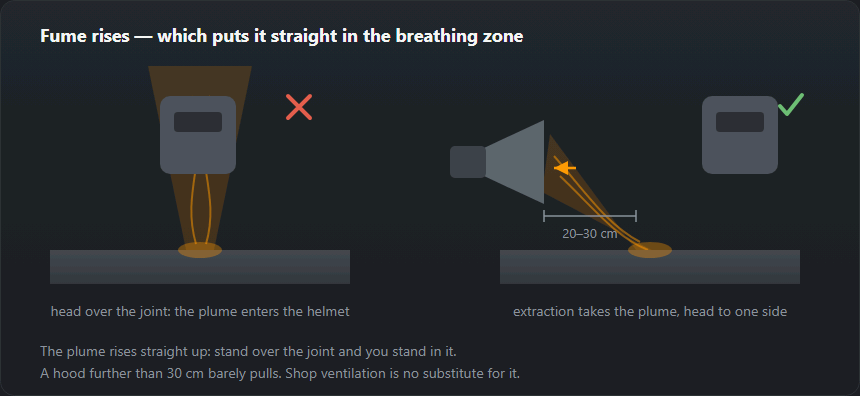
3. Extract at source. A fume arm positioned within about 300 mm of the arc, or an on-torch extraction system. This is the control that actually works, and its effectiveness collapses with distance — at 600 mm a fume arm captures a fraction of what it captures at 300.
4. General ventilation. Dilutes what escapes the extraction. Not a substitute for it.
5. Respiratory protection. FFP3 or a powered respirator, as the last layer rather than the first.
Where you stand
The plume rises. Standing directly over the joint puts your face in it, and no amount of general ventilation changes that. Keep your head to one side of the plume, and use the extraction arm to pull the fume away from you rather than past you.
On a bench, position the extraction on the far side of the joint so the flow is away from your face. It sounds obvious and it is routinely done the other way round.
Extraction at source: how to position the fume extractor
Within about 300 mm of the arc, moved with the joint. Each type has a catch:
- Fume arm with hood — any process and part shape, but only if the welder keeps moving it.
- Slot extraction along a bench edge — nothing to move on short fixed seams; on tall parts the plume rises out of reach.
- Downdraft table — small parts only; a big part blocks the grid, and the arc must stay close to the surface.
- On-torch extraction (MIG/MAG, flux-cored) — always at the source, even on site; heavier torch, and too much suction pulls the gas away.
How to check it, and the usual mistakes
Have a colleague watch from the side while you weld: the fume must bend into the hood straight from the arc, not rise past the helmet first. Typical faults: hood behind the welder or above the head, so the plume crosses the face; hose kinked or holed; clogged filter (noise stays, airflow goes — read the unit's indicator); hood never moved after the first joint; suction so close that it strips the shielding gas and gives porosity — move the hood slightly aside rather than switching it off.
Filter units: classes W1, W2, W3
Filter units are tested to EN ISO 15012-1. According to ABICOR BINZEL and arbeitsschutz-schweissen.de: W1 — at least 95 % separation, unalloyed and low-alloy steel; W2 — over 98 %, alloy steel with 5–30 % Ni and Cr; W3 — over 99 %, high-alloy steel and nickel alloys above 30 %. The class describes the air leaving the unit, not what the hood captures.
How to ventilate a welding shop
Supply air, not just exhaust. Every cubic metre thrown out must come back in; without planned supply it enters as draughts, extractors underperform and in winter everything gets shut. Supply low, exhaust high.
An open gate is not a solution. On a windy day it blows the plume into the next welder's face and strips the gas at the torch; on a still day it does nothing. A floor fan is the same: it moves fume, it does not remove it.
Recirculation. Returning filtered air saves heating and is common for unalloyed steel. For stainless and nickel alloys (Cr(VI), nickel), the same sources say Germany ties it to IFA-tested W3 units; otherwise the air goes outside.
Special cases: stainless, galvanised, painted, aluminium, confined spaces
Stainless steel. Hexavalent chromium and nickel, the tightest limits in the table: extraction is compulsory, and a mask on top is justified — see stainless fume and Cr(VI).
Galvanised steel. Grind the zinc off and weld with extraction. If fever, chills or a metallic taste appear in the evening: stop welding galvanised work, get fresh air, tell the supervisor, see a doctor if breathing is hard or it does not pass.
Painted and primed metal. Coatings burn into gases the fume table does not list: remove them from the weld zone first (with extraction — grinding makes dust; old paint may contain lead). No chlorinated degreasers near the arc: UV turns them into phosgene.
Aluminium. Bright metal reflects the arc UV, which makes ozone in the surrounding air rather than in the plume — a hood catches it less well, so general ventilation matters more (welding aluminium).
Confined spaces. Inside a tank, a vessel or a duct fume accumulates instead of dispersing, and argon and CO₂, heavier than air, displace oxygen from the bottom up — where the welder is. Forced ventilation with fresh air (never with oxygen), continuous oxygen monitoring, cylinders kept outside, a permit and someone outside watching. This is the scenario that kills welders who were entirely competent at welding.
Covered separately and in detail
Choosing a mask, a powered hood or extraction is covered in respiratory protection, and the hardest case in stainless steel fume: hexavalent chromium, nickel and the limit that applies across the EU.
The STOP principle: the legal order behind the hierarchy
The order is not a preference but a requirement of the framework directive: first remove the hazard, then stop it with equipment, then change how the work is organised, and only at the end dress the person.
| Step | What it means | In welding that is |
|---|---|---|
| S — Substitution | Remove the hazard or swap it for a less dangerous one | A different process or consumable: TIG instead of flux-cored wire, a low-fume electrode, galvanising ground off before welding |
| T — Engineering controls | Stop the hazard at source with equipment, before it reaches anyone | Extraction at the arc within 300 mm, on-torch extraction, bay ventilation. This is the control that actually works |
| O — Organisational measures | Change how the work is run: who, where, for how long and after what training | Rotating welders on long seams, a dedicated bay, a hot-work permit, trained supervision |
| P — Personal protection | Protect the person — the last line of defence, not the first | Helmet, gauntlets, EN ISO 11611 clothing, FFP3 or powered air. It supplements extraction, it does not replace it |
The German rule set
If you work in Germany, or plan to, these are the documents the employer produces and the inspector goes by. TRGS 528 is the axis of it: it decides whether ventilation is enough for your job or whether extraction and health surveillance become compulsory.
| Document | What it governs |
|---|---|
| TRGS 528 Schweißtechnische Arbeiten | The main German rule for welding work: risk assessment, fume classification, when ventilation is enough and when extraction and health surveillance become compulsory |
| DGUV Information 209-010 Lichtbogenschweißen | Arc welding in practice: the bay, booths, screens, extraction, work in confined spaces |
| DGUV Information 209-016 Schadstoffe beim Schweißen | Hazardous substances: what each process and material produces, how much of it, and what limits it |
| DGUV Regel 100-500 Kapitel 2.26: Schweißen, Schneiden | How welding and cutting are to be run on site, hot work included |
| ASR A3.6 Lüftung | Ventilation of workrooms: the air change rate the TRGS 528 assessment rests on |
Frequently asked questions
Is welding fume really classified as carcinogenic?
Yes. In 2017 the IARC reclassified all welding fume as a Group 1 carcinogen — carcinogenic to humans — not only the stainless-steel fraction. That reclassification is why enforcement of extraction requirements tightened across Europe afterwards.
Is an open door enough ventilation?
No, and the reason is where the fume goes. The plume rises straight past your face on its way to the roof. General ventilation dilutes the workshop air; it does nothing about the concentrated plume in your breathing zone. That needs local extraction at the arc.
What is metal fume fever?
Flu-like symptoms — fever, aching, chills — starting a few hours after welding galvanised steel, from inhaling zinc oxide. It passes in a day or two and it is a warning, not a rite of passage: it means you inhaled a substantial dose of something you should not have.
How much fume does MAG welding produce?
With solid wire, roughly 2–8 mg per second of arc, i.e. 7.2–28.8 g per hour of arc; over an 8-hour shift at 30 % arc time, 17.3–69.1 g. TIG makes under 1 mg/s. The exact figure for a risk assessment comes from the consumable datasheet or DGUV Information 209-016.
How far should the fume extractor be from the arc?
Within about 300 mm, to the side and slightly above the joint, and moved with the work. At 600 mm an arm captures only a fraction. If the weld turns porous, the suction is stripping the shielding gas.
Is a fan enough for welding ventilation?
No. A fan moves the plume without removing it, blows it at the next person and strips the shielding gas, which causes porosity. Indoors you need extraction at the arc plus general ventilation with planned supply air.
Updated: