Why aluminium welds differently from steel: TIG and MIG tips
Aluminium punishes habits learned on steel. It melts at half the temperature but needs more heat, it gives no colour warning before it collapses, and it is covered in an oxide that melts at three times the temperature of the metal.
The oxide film
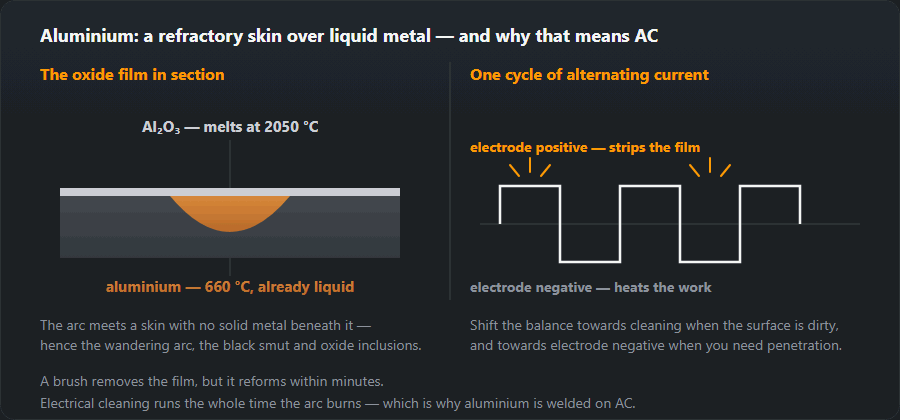
Every aluminium surface carries a layer of Al₂O₃ that reforms within minutes of being removed. It melts at about 2050 °C against 660 °C for the metal, so the arc meets a refractory skin over a pool that is already liquid underneath. That is what produces a wandering arc, black smut in the weld and oxide inclusions.
Two removals, and both are needed. Mechanically: a stainless wire brush kept exclusively for aluminium, used immediately before welding — not an hour before. Electrically: the electrode-positive half of the AC cycle in TIG blasts the film off the surface ahead of the arc. That cathodic cleaning is the whole reason aluminium is TIG welded on alternating current.

Heat, and the lack of warning
Aluminium conducts heat about five times faster than steel, so it draws heat away from the joint and a cold start will not fuse. On thick sections a modest warm-up helps the start and drives off condensation — but for 6xxx alloys the ceiling is about 120 °C, preheat and interpass alike, and for no longer than 15 minutes (the AWS D1.2 limit for heat-treatable alloys and 5xxx with more than 3 % Mg, as quoted by Hobart and ESAB). Above it the HAZ loses its temper permanently.
The part that catches everyone: aluminium does not glow before it melts. Steel warns you by going red; aluminium goes from looking cold to collapsing into a hole with nothing in between. The only warning is the surface going shiny and liquid, which is roughly one second before it is too late.
TIG settings
AC, with the balance set for more electrode-negative time when you want penetration and more electrode-positive when the surface needs cleaning — around 70/30 is a normal starting point. AC frequency narrows the arc cone as it rises: 100–120 Hz for a tight arc on thin work.
Tungsten: pure (green) or zirconiated (white) if the machine gives a sine wave, since both hold the balled end that suits it; lanthanated (blue) ground to a point on a modern square-wave inverter. Diameter with a margin over the DC figure, because AC runs the electrode hotter — the tungsten calculator allows for this.
Gas: pure argon, and more of it than on steel — 8–14 l/min — because argon has to displace air from a pool that oxidises instantly.
MIG settings
Pure argon, spray or pulsed transfer, and never short arc: short arc on aluminium gives cold lapping that looks like a weld and is not.
The feeding problem dominates everything. Aluminium wire is soft enough to buckle under the pressure needed to push it down a normal torch, so: U-groove drive rolls, PTFE liner, minimum roll pressure, the shortest torch you can work with, laid out straight. For anything beyond occasional work a spool gun or a push-pull torch is not a luxury.
| Parameter | TIG | MIG |
|---|---|---|
| Current type | AC with about 30 % cleaning balance | DC, reverse polarity |
| Gas | Ar 100 %; Ar + He on thick sections | Ar 100 %; from 6 mm Ar + 30 % He |
| Electrode | WZ-8 (white), balled tip | — |
| Feeding | filler rod by hand | a push-pull feeder |
Porosity
Hydrogen dissolves readily in molten aluminium and almost not at all in solid aluminium, so everything dissolved during welding comes out as the weld freezes. The sources are moisture on the surface, oil, and hydrated oxide on material stored outdoors.
The defences are the boring ones: degrease with solvent, brush immediately before welding, keep the filler rod clean and dry, and do not weld cold material that has condensation on it. See also porosity in welds.
ER 4043 or ER 5356
| ER 4043 (Si) | ER 5356 (Mg) | |
|---|---|---|
| Fluidity | higher, the bead comes out smoother | lower |
| Strength | lower | higher |
| Crack resistance | better | worse on some alloys |
| Anodising | goes dark | the colour holds |
| Feeding in MIG | soft and prone to birdnesting | stiffer and feeds more evenly |
| Property | ER 4043 | ER 5356 |
|---|---|---|
| Alloy base | About 5 % silicon | About 5 % magnesium |
| Weld strength | Lower | Higher |
| How the pool behaves | More fluid, lays down easily | Stiffer, wants a steadier hand |
| Hot cracking | Better on 6xxx alloys | A risk on 6xxx, good on 5xxx |
| After anodising | Darkens to a grey shade | Keeps the colour of the parent |
| Feeding in MIG | Soft wire, prone to birdnesting | Stiffer, feeds more evenly |
| Service at raised temperature | No restriction | Not recommended above 65 °C: stress corrosion cracking |
Which alloy it is, and which filler
Before choosing wire, you need to know what is on the bench. The first digit of the alloy designation names the main addition, and that decides the filler more than thickness or process do.
| Series | Examples | Filler | What to watch |
|---|---|---|---|
| 1xxx (pure Al) | 1050, 1200 | 4043 | Soft, easy to burn through |
| 5xxx (Al-Mg) | 5754, 5083 | 5356 | 4043 on high-magnesium alloys gives a brittle weld |
| 6xxx (Al-Mg-Si) | 6060, 6082 | 4043 or 5356 | Hot cracking when welded without filler; HAZ softening |
| Al-Si castings | housings, sumps | 4043 | Porosity from oil-soaked castings |
| 7xxx (Al-Zn) | 7020, 7075 | 7020 — 5356 | 7075 is not suitable for arc welding |
If the part is going to be anodised, the choice narrows to 5356 — 4043 turns grey, as the comparison table above shows. If the joint will run above 65 °C, 5356 is out because of stress corrosion cracking. When both conditions apply at once, make the decision with the filler manufacturer.
AC TIG, step by step
- Balance. Start at about 30 % cleaning, as in the settings table. More cleaning gives a wider frosted band beside the weld and a hotter electrode; less gives deeper penetration but the oxide stops lifting.
- Electrode. WZ-8 with a balled end or, on newer inverters, whatever the machine manual specifies. The diameter comes from the tungsten calculator.
- Start. Higher current at the beginning, because aluminium soaks the heat away; the pedal takes current off as the part warms up.
- Filler. Feed the rod into the leading edge of the pool and keep it inside the gas shield — a hot rod end oxidises in a second.
- Reading the weld. A bright frosted band next to the bead is the cleaning zone and should be there. Black soot on the bead means dirt, too little cleaning or not enough gas.
General process rules are on the TIG welding page.
MIG on aluminium: why push-pull
Aluminium wire is soft. Pushed through several metres of cable it buckles, birdnests at the rolls and feeds in jerks. That is why the settings table lists a push-pull feeder, and when there is none, one of the substitutes is used:
- Push-pull torch — a second motor in the handle pulls the wire while the feeder rolls push it. The workshop answer, and the only reliable one with long cables.
- Spool gun — a small spool in the gun itself, so the wire travels only a few centimetres. Handy for occasional work.
- A short cable with a PTFE liner, U-groove rolls and light tension — works with 5356, which is stiffer; 4043 is more trouble.
The contact tip for aluminium is one size larger than the wire, because the wire expands with heat. Use a push angle, not a drag, so the gas leads the pool. Gas: argon, and from 6 mm argon with 30 % helium, as in the table. Setting the rolls and liner is covered in welder servicing.
Worked example: a frame from 6082 box section, 40×40×3
- Alloy 6082 — 6xxx series, so 4043 filler, or 5356 if the frame will be anodised.
- Process. For a few frames, AC TIG; for a batch, push-pull MIG, preferably pulsed.
- Preparation. Degrease, a stainless brush kept for aluminium only, and weld within a few minutes of cleaning.
- Temperature. Preheat no higher than the limit given in the heat section above — beyond it the alloy loses its temper. Let the part cool between runs.
- Strength. The HAZ in 6082 is always weaker than the parent metal — the frame designer has to allow for that, not the welder. The weight of the sections comes from the aluminium weight calculator.
Common aluminium mistakes
- A brush that has touched steel. Iron particles in the weld mean corrosion and inclusions.
- An abrasive disc for edge prep. Grit gets embedded in the soft metal — use a cutter or an aluminium file.
- Wire from a spool left open in the shop. Hydrated oxide on the wire is hydrogen in the weld and porosity.
- Dragging the MIG torch. The pool leaves the gas cover and the weld turns black.
Frequently asked questions
Why does the arc wander and the weld look dirty?
The oxide film. Aluminium oxide melts at about 2050 °C while the metal beneath melts at 660 °C, so unless the film is removed the arc is working on a ceramic skin over liquid metal. Brush with a dedicated stainless brush immediately before welding, and use AC on TIG for the cleaning action.
Which filler — 4043 or 5356?
4043 (aluminium-silicon) flows well, is easier to weld with and suits castings and 6xxx extrusions. 5356 (aluminium-magnesium) is stronger, takes anodising more evenly and is the choice for 5xxx sheet and structural work. If the joint will be anodised, 4043 goes dark and 5356 does not.
The wire keeps birdnesting in the MIG.
Aluminium wire is soft and cannot be pushed far. Use U-groove rolls, a PTFE liner, minimum roll pressure, the shortest possible torch laid out straight — or a spool gun or push-pull torch, which is the real answer for anything more than occasional work.
4043 or 5356 for 6082 aluminium?
Both are used. 4043 gives a more fluid pool and copes better with the tendency of 6xxx alloys to hot crack; 5356 gives a stronger weld and keeps its colour after anodising. If the joint runs above 65 °C, 4043 is the one left.
Can I MIG weld aluminium without a push-pull or spool gun?
On a short cable with a PTFE liner, U-groove rolls, light tension and a tip one size up from the wire — ideally with 5356, which is stiffer. Otherwise a spool gun with the spool in the gun. For long cables and production work push-pull is the only reliable answer.
Can aluminium be stick welded?
Yes, for repairs: the electrode catalogue lists OZA-1, OZA-2 and ESAB OK 96.20 (E Al Si 12), all on DC+. The slag is corrosive and must be removed completely, and weld quality falls short of TIG and MIG, so they are not used on structures.
Updated: