Why cast iron cracks when welded and how to repair it
Cast iron contains two to four per cent carbon — ten times what weldable steel carries. Everything about welding it is an attempt to work around that one number.
Why it cracks
Three reasons, all rooted in the carbon.
The heat-affected zone turns to white iron. Rapid cooling converts the graphite-bearing structure into hard, brittle cementite. That zone is glass-hard, cannot be machined, and cracks under the shrinkage stress of the weld itself.
Cast iron has almost no ductility. Steel accommodates shrinkage by yielding a little. Cast iron does not yield; it breaks.
Old castings are contaminated. Decades of oil, coolant and combustion products soak into the porous surface, and they come out as gas during welding. An engine block that looks clean is not.
Cold welding — the workshop method
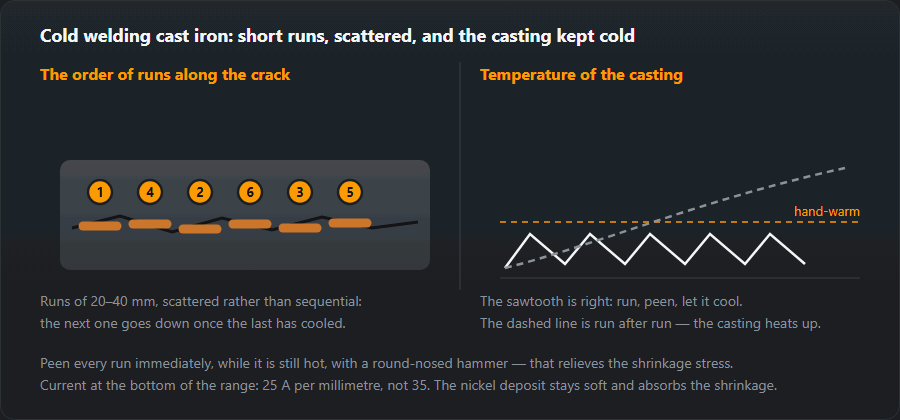
Nickel electrodes, low current, short runs, peening, and never letting the part get hot. The nickel deposit stays soft and ductile, so it absorbs the shrinkage instead of transmitting it into the casting.
The electrode choice and the full sequence, with the current worked out, follow further down; the order of the runs is what the diagram shows.

Cold or hot: the two methods side by side
The alternative to the cold method is hot welding: the whole casting at 500–600 °C, a cast-iron filler rod, slow cooling in a furnace. The result is machinable and matches the parent metal, but it needs an oven — a foundry or a specialist repair shop, not a bench (details under hot welding in practice). The critical part is the cooling, not the welding. Cool a preheated casting in air and you will have produced the exact hardened structure the preheat was meant to prevent.
| Cold | Hot | |
|---|---|---|
| Preheat | none, or up to 100 °C | 500–600 °C, the whole part |
| Electrode | nickel: Ni, NiFe, NiCu | a cast-iron filler rod |
| Current | as low as it will run | the normal working value |
| Technique | runs of 20–40 mm, peen them, let it cool | continuously, while it is hot |
| Cooling | in still air | slow, in sand or in the furnace |
| Where it is used | shop repairs | critical and heavy parts |
What to expect
A cold nickel repair to a bracket, a housing or a manifold is a genuine repair that will hold. A cold repair to a part that must be machined afterwards will disappoint, because the heat-affected zone is harder than the cutter. And a crack through a heavily loaded section of an old casting may simply not be worth welding: replacement is often cheaper than the third attempt.
Which cast iron is it: grey, ductile, malleable or white
“Cast iron” covers four materials that weld very differently. What differs is the shape of the carbon, not its amount, so identify the part before choosing the method.
| Type | Designation | How to recognise it | Welding |
|---|---|---|---|
| Grey | EN-GJL, EN 1561 (GG) | Dark granular fracture, dull sound, dusty chips; housings, blocks, machine beds | Cold with nickel or hot |
| Ductile | EN-GJS, EN 1563 (GGG) | Lighter, finer fracture, rings when struck, chips curl | Yes, more tolerant than grey; NiFe |
| Malleable | EN-GJM, EN 1562 (GTS, GTW) | Small thin-walled parts, pipe fittings; known by the part and its marking | Limited: the weld undoes its heat treatment locally |
| White | — | Silvery fracture, a file skids, a drill will not cut; wear parts | Practically not weldable |
Marking and quick tests
In the European designation the number is the minimum tensile strength in MPa: EN-GJL-250 is grey iron of at least 250 MPa. Ductile grades add the elongation in per cent: EN-GJS-400-15 means 400 MPa and 15 %. Older machines carry the DIN names GG-25 and GGG-40 for the same grades. Without a marking, a grinding spark separates cast iron from steel (short reddish streams against long forked ones), the fracture and the ring separate grey from ductile, and a file that bites nowhere means white iron — do not weld it. The carbon equivalent does not apply: its formulas were built for steels with tenths of a per cent carbon and lose their meaning at 2–4 %.
What to weld cast iron with: Ni or NiFe
Two types of nickel electrode, Ni-CI and NiFe-CI in EN ISO 1071 (ENi-CI and ENiFe-CI in AWS A5.15). In the site's catalogue they are ESAB OK 92.18 and UTP 86 FN: basic-coated, DC+, re-dried at 150–250 °C.
- Ni — the softest deposit, best when the repair will be drilled or machined and on thin walls; weaker on thick loaded sections.
- NiFe — stronger and more forgiving on dirty material; for ductile iron, thick walls, multi-layer fills and joints to steel (see dissimilar metal joints).
On a large groove the two are combined: butter the faces with Ni, fill with NiFe.
Cold welding step by step

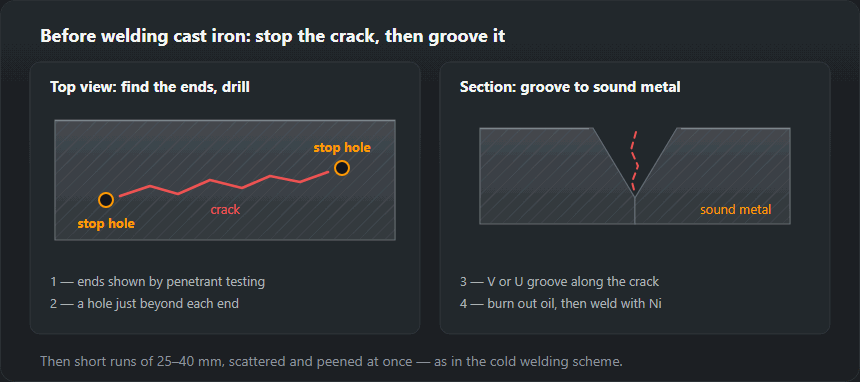
- Find the whole crack — cast iron cracks run further than they look. Dye penetrant shows the tip; on an oily casting, warm it gently with a torch and the oil seeping out marks the crack as a dark line.
- Drill a 3–4 mm hole just beyond each tip.
- Grind the crack out to sound metal, with a rounded bottom rather than a sharp V.
- Burn out the oil — crankcases, blocks and gearbox housings are soaked with it. Heat with a torch, or run the arc over the groove without filler, until the smoke stops; lay a short test run; if the pool boils, grind out and burn again.
- Set the current low: about 25 A per millimetre of diameter (example below).
- Butter the faces with a thin nickel layer: it takes up the carbon, and the fill then sits on nickel.
- Runs of 20–40 mm, scattered, each peened at once while hot.
- Wait until the casting is hand-warm before the next run; let it cool on its own, with no water or compressed air.
Current: a worked example
At 25 A per millimetre: 2.5 mm × 25 ≈ 62 A (set 60–65 A), 3.2 mm × 25 = 80 A, 4.0 mm × 25 = 100 A. At the usual 35 A/mm the 3.2 mm electrode would take 112 A, 40 % more. Go lower while the arc stays stable; a bead sitting on top like a drop means too low.
Hot welding in practice
The whole casting goes to 500–600 °C, the value in the table — not only the area round the crack, because local heating creates the very temperature difference that cracks cast iron. It is heated slowly in a furnace or a brick enclosure and held there for the whole job. The traditional route is gas welding: a neutral oxy-acetylene flame, a cast-iron rod and a cast-iron flux that dissolves the oxide skin on the pool. Afterwards the casting cools for many hours in the closed furnace or in dry sand. The joint matches the part and machines like it, which is why the method is kept for heavy, expensive castings.
Alternatives to welding: braze welding and stitching
Braze welding with brass
The casting is not melted: the groove is heated with an oxy-acetylene torch until a brass rod with flux wets and fills it. No molten iron means no white iron at a fusion line and much less heat. It suits thin castings and covers that must stay tight. The joint is weaker than the casting, softens when the part runs hot, stays visibly yellow, and brass gives off zinc fumes — work under extraction.
Cold stitching (Metalock and similar)
No heat at all: overlapping tapped holes along the crack are filled with studs peened flat, and shaped keys set across the crack pull the edges together. There is no heat-affected zone and no distortion, and large engine blocks, press frames and housings can be repaired in place.
How to choose: a crack in a bracket or housing — cold nickel welding; a thin or leak-tight part — braze welding; a large casting that must not be heated — stitching; a part to be machined — hot welding.
Typical mistakes and how to spot them
- A crack beside the weld minutes later, often with a click: the casting overheated — runs too long, no pause, no peening.
- A boiling pool and pores: oil. More current will not help; burn it out again.
- A hard white edge that a drill skids on: white iron after a steel electrode, high current or fast cooling. A thin band is normal with nickel.
- A steel electrode on a loaded part: cracks along the fusion line within days.
More on crack types: weld cracks. The preheat calculator works for steel to EN 1011-2; for cast iron it gives no answer, but it serves the steel side of a cast-iron-to-steel joint.
When a part is not repaired by welding
Brake drums and discs, parts under pressure and parts whose failure could injure someone are replaced. So are white-iron wear parts and iron oxidised by years of heat service, which cracks again beside every run. For the rest, if a new part costs less than two attempts, buy the new part.
Frequently asked questions
Cold or hot welding?
Cold with nickel electrodes for repairs where the part cannot be heated and some hardness in the joint is acceptable — most workshop repairs. Hot, at 500–600 °C with slow controlled cooling, where the joint must be machinable and match the parent metal. Hot welding needs an oven or a furnace and is not a bench job.
Why peen the weld?
To relieve the shrinkage stress while the metal is still hot. Tapping the bead with a round-nosed hammer immediately after each short run stretches it slightly and takes the tension out. On cast iron that is the difference between a repair that holds and one that cracks alongside the weld as it cools.
How do I tell grey iron from ductile iron?
By the fracture and the ring. Grey iron breaks with a dull grey granular face and sounds dead when struck; ductile iron has a brighter, more silvery fracture and rings. It matters because ductile iron tolerates welding considerably better.
Can you weld cast iron with a MIG welder?
Not with ordinary steel wire: the result is the same as with a steel electrode — a hard deposit and a crack along the fusion line. Nickel-based wires for cast iron do exist, and with them the rules stay the same: short runs, peening, a pause until the casting is hand-warm. A MIG torch invites long continuous runs, which is exactly what cast iron cannot take, so for an occasional repair a nickel stick electrode is the simpler tool.
What electrode should I use for cast iron?
A nickel one. Ni-CI (AWS ENi-CI) where the repair must be drilled or machined, NiFe-CI (AWS ENiFe-CI) for strength, for ductile iron and for joints to steel. Run it on DC+ at about 25 A per millimetre of diameter: 80 A for a 3.2 mm electrode.
Why does my cast iron weld crack?
It almost always cracks beside the weld, not in it. The heat-affected zone has turned into hard white iron, and the shrinkage of the weld pulls on it while the casting cannot stretch. Too long a run, no peening, no pause between runs, a steel electrode or oil in the pores — any one of these is enough.
Updated: