Joining stainless to carbon steel: the Schaeffler diagram in practice
Joining two different steels is not a compromise between two procedures. The weld metal is a third alloy, made of both parents plus the filler, and the filler is chosen so that mixture lands somewhere safe.
Dilution is the whole problem
A weld melts parent metal from both sides and mixes it with the filler. The proportion that comes from the parents — the dilution — is typically 20 to 40 % depending on the process and the joint, more with deep-penetrating processes and less with low-current ones.
On a joint between like materials that hardly matters. On a dissimilar joint it decides everything: 30 % carbon steel mixed into a stainless deposit gives a composition neither the filler nor the parent was designed to be, and that composition can be martensitic and brittle.

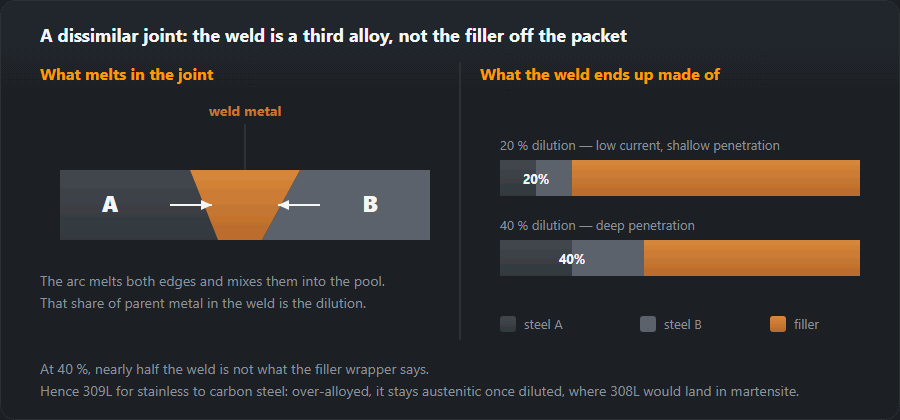
The Schaeffler diagram in practice
The Schaeffler diagram plots chromium equivalent against nickel equivalent and marks out the regions: austenite, ferrite, martensite and the mixtures. Its practical use is straightforward. Mark the two parent metals, draw a line between them, mark the filler, and the weld composition sits on the line between the filler and the mixed parents, at the dilution fraction.
What you want is for that point to land in the austenite-plus-ferrite region, with a few per cent of ferrite: enough to resist hot cracking, not so much that the joint becomes brittle. What you want to avoid is the martensite region.
The common pairs
| Joint | Filler | Note |
|---|---|---|
| 304 / 316 + carbon steel | 309L / 309LMo | The standard answer: over-alloyed so that it survives dilution |
| Stainless + Cr-Mo steel | 309L or a nickel alloy | Nickel filler where the joint runs hot in service |
| Carbon steel + low-alloy steel | match the weaker parent | Preheat for the more hardenable of the two |
| Duplex + carbon steel | 309LMo / 2209 | Watch the interpass temperature: duplex is sensitive to it |
| Stainless + cast iron | nickel (Ni, NiFe) | Treat it as you would cast iron |
| Different austenitics, 304 and 316 | match the more alloyed side | 316L for a 304-to-316 joint |
| Stainless + aluminium | — | Not weldable by fusion at all: use a transition insert |
Buttering
Where dilution cannot be kept low enough, one face is "buttered" first: a layer of the filler alloy is deposited onto the carbon steel side, ground flat, and then the actual joint is welded between the buttered layer and the stainless. The dilution then happens twice, and each time against a smaller composition difference.
It costs an extra operation and it is the standard answer on thick sections and on anything that will see service temperature or cyclic loading.
Practical rules
- Keep dilution low. Low current, stringer runs rather than weaving, and aim the arc at the filler pool rather than into the parent metal.
- Preheat for the more hardenable parent. Work its carbon equivalent out with the CE calculator and use the higher of the two preheat figures.
- Watch the service temperature. Above about 300 °C, carbon migrates from the carbon steel into the stainless over time and leaves a soft decarburised band. That is a design consideration, and it is why nickel-based fillers are specified on hot joints.
- Expect different expansion. Austenitic stainless expands about 50 % more than carbon steel, so a dissimilar joint that is thermally cycled is under stress every cycle whether it is welded well or not.
A worked Schaeffler example: one pair, six variants
18/9 austenitic stainless (A) to carbon steel (B) with a 309L-type filler. The compositions are the defaults of the Schaeffler diagram calculator; only the shares change — how much of each metal ends up in the weld:
| Shares A / B / filler, % | Cr-eq | Ni-eq | Structure from the diagram | Ferrite |
|---|---|---|---|---|
| 15 / 15 / 70 | 20.0 | 13.1 | austenite with ferrite | 0–5 % |
| 25 / 25 / 50 | 17.1 | 11.9 | austenite | 0 % |
| 35 / 35 / 30 | 14.1 | 10.8 | austenite with martensite | 0 % |
| 50 / 50 / 0 | 9.7 | 9.1 | martensite | — |
| 30 / 10 / 60 | 20.3 | 13.1 | austenite with ferrite | 0–5 % |
| 10 / 30 / 60 | 16.7 | 11.9 | austenite with martensite | 0 % |
- 15/15/70 — dilution around 30 %, as with stick and narrow stringers: austenite with ferrite, ferrite 0–5 %. This is the region you aim for.
- 25/25/50 — half the weld is parent metal: austenite with no ferrite. No martensite, but fully austenitic weld metal is prone to hot cracking.
- 35/35/30 — the arc is mostly melting the bevel walls — deep penetration and a wide weave: austenite with martensite. This is where brittleness starts.
- 50/50/0 — fusing without filler: martensite. That is why stainless is never joined to mild steel with an autogenous TIG pass.
- 30/10/60 and 10/30/60 — the same filler share, but the arc shifted once to the stainless side and once to the carbon side. Result: austenite with ferrite versus austenite with martensite. That is the number behind the rule “favour the stainless side”.
The diagram gives a region, not a guarantee: a point near a boundary moves with a small change in heat composition. For your own steels enter the mill certificate analysis and estimate the shares from a macro section of a test piece.
Which process keeps dilution down
TIG with filler and stick usually dilute less than spray-transfer MAG; with MAG stay in short-circuit or pulsed transfer. The last two rows of the table show why arc placement matters as much as the process: the same filler share lands in two different regions depending on which parent the arc is melting. Buttering, above, is the answer when neither is enough.
Stainless to carbon steel, step by step
- Separate tools for stainless. A brush or disc that has touched carbon steel smears iron particles into the stainless — and rust streaks follow on the side that was not supposed to rust.
- Preheat for the carbon steel side. Work out its carbon equivalent and the temperature in the preheat calculator; the stainless needs none.
- 309L filler — electrode E 23 12 L (AWS E309L), wire G 23 12 L Si (ER309LSi), TIG rod W 23 12 L; for molybdenum stainless, 309LMo.
- Root on pipe — with gas backing on the inside of the stainless side, or the root oxidises black.
- Cleaning after welding — pickle or passivate the stainless only; the carbon steel side gets a coating like any mild steel.
Common mistakes and how to spot them
- 308L instead of 309L — a crack along the fusion line on the carbon steel side, often only after loading. Dye penetrant testing or a break test finds it.
- Too much current on MAG — a wide, flat bead sunk deep into the mild steel; hardness at the fusion line clearly above both parents.
- Hot cracks along the weld centreline — fully austenitic weld metal with no ferrite, as in the half-diluted variant; the crack runs down the middle of the bead straight after welding.
- Rust on the stainless next to the weld — iron contamination from shared tools, not a filler defect. The rules for stainless itself — welding stainless steel.
Frequently asked questions
Why 309L for stainless to carbon steel?
Because it is over-alloyed. When 309L is diluted by carbon steel from one side, the resulting mixture still lands in the austenitic-plus-ferrite region of the Schaeffler diagram rather than becoming brittle martensite. A matching 308L would be diluted below the safe composition and could crack.
What is dilution and why does it matter?
The proportion of parent metal melted into the weld. At 30 % dilution, nearly a third of the weld is parent metal, so the deposit composition is not what the filler wrapper says. On dissimilar joints that shift is what decides whether the weld is tough or brittle.
Can I weld stainless to aluminium?
Not by fusion welding. The two form brittle intermetallic compounds and the joint has essentially no strength. It is done with explosion-welded transition inserts, friction welding or mechanical joints — but not with an arc.
What MIG wire for welding stainless to mild steel?
309LSi wire — G 23 12 L Si to EN ISO 14343, ER309LSi in AWS terms — with a stainless shielding mix. Use short-circuit or pulsed transfer: spray melts too much mild steel and raises the dilution.
What stick electrode joins stainless to structural steel?
A 309L electrode: E 23 12 L to EN ISO 3581, E309L-16 or -17 in AWS terms. For molybdenum stainless (316L), 309LMo. A 308L electrode is not suitable for this joint.
Do I need preheat when welding stainless to carbon steel?
The carbon steel side decides: if its carbon equivalent and thickness call for preheat, preheat as if you were welding it alone. The austenitic side needs none.
Updated: