Steel grade equivalents: EN, GOST, AISI and PN
Material arrives with an EN certificate, the drawing was made to GOST, and the stainless in the rack is known by its AISI number. The table below lines the four systems up — with the caveat that makes it safe to use.
Short answer
S235JR is Ст3сп and A283 Gr. C, 1.4301 is AISI 304, 1.4404 is AISI 316L. An equivalent matches strength, not chemistry — and welding depends on chemistry. The table below carries 39 grades in six families.
Matching strength does not mean matching composition, and welding depends on composition. Two grades with the same yield strength can have different carbon equivalents and need different preheat. Use the table to work out what you are holding; use the certificate of the actual batch to choose parameters and filler.
How an EN designation reads
Structural steels: the letter S, the minimum yield strength in MPa, then the impact grade. So S275JR is 275 MPa with 27 J at room temperature. Quality steels start with C and the carbon content in hundredths of a per cent: C45 is 0.45 % C. Alloy steels spell out the alloying elements with their content multiplied by a factor: in 42CrMo4 the 42 is 0.42 % C and the 4 is the chromium content times four, so about 1 % Cr, with some molybdenum.
Stainless steels are usually quoted by material number — 1.4301, 1.4404, 1.4462 — because the name designation is long. The number is unambiguous, which is why it belongs on the order.

EN, GOST, AISI, SAE and ASTM: how the systems differ
| System | Who issues it | How the designation is built | Example |
|---|---|---|---|
| EN 10027 | CEN | A letter for the kind, then either the property or the composition: S355 is 355 MPa yield, C45 is 0.45 % carbon. Alongside it the material number 1.xxxx — unambiguous, and the one that belongs on the order | S355J2 · 1.0577 |
| ГОСТ | Rosstandart | Carbon in hundredths of a per cent, then the alloying elements as Cyrillic letters: 09Г2С is 0.09 % C, manganese up to 2 %, silicon | 09Г2С |
| AISI / SAE | SAE International | Four digits: the first two are the alloy group, the last two are carbon in hundredths of a per cent. 1045 is plain carbon steel with 0.45 % C. AISI and SAE are the same system — AISI stopped maintaining the register, SAE maintains it | 1045 |
| ASTM | ASTM International | Not a grade but a specification — a document for a product. The letter A and a document number, with the grades inside it as Grade. That is why “A572” on its own is incomplete: it needs the grade | A572 Gr. 50 |
| PN | PKN | The old Polish system, still on drawings and in stockyards: St3S, 18G2A, NC11LV. Superseded by EN, but it has not gone away | 18G2A |
| UNS | ASTM + SAE | A group letter and five digits — one key across all the American systems. S30400 is AISI 304 | S30400 |
Articles found: 0
Nothing found. Try another word, or browse the sections instead.
Structural steels
| EN | Material no. | GOST | AISI / ASTM | PN (old) | Weldability |
|---|---|---|---|---|---|
| S185 | 1.0035 | Ст0 | — | St0S | good, no preheat |
| S235JR | 1.0038 | Ст3сп, Ст3пс | A283 Gr. C | St3S | good, no preheat |
| S235J2 | 1.0117 | Ст3сп5 | — | St3SX | good, no preheat |
| S275JR | 1.0044 | Ст4сп | A570 Gr. 40 | St4S | good, no preheat |
| S355J2 | 1.0577 | 09Г2С, 17Г1С | A572 Gr. 50 | 18G2A | good, preheat from about 30 mm |
| E295 | 1.0050 | Ст5пс | — | St5 | limited, preheat usually needed |
| E335 | 1.0060 | Ст6пс | — | St6 | limited, preheat usually needed |
| S690QL | 1.8928 | — | A514 Gr. B | — | preheat and heat treatment |
Sheet and strip
| EN | Material no. | GOST | AISI / ASTM | PN (old) | Weldability |
|---|---|---|---|---|---|
| DC01 | 1.0330 | 08кп | A1008 CS | — | good, no preheat |
| DD11 | 1.0332 | 08пс, Ст2пс | A1011 CS (ex A569) | — | good, no preheat |
| DD13 | 1.0335 | 08Ю | A1011 DS | — | good, no preheat |
| DX51D+Z | 1.0917 | — | A653 CS | — | good, but grind the zinc back at least 25 mm from the joint |
Pipe and boiler steels
| EN | Material no. | GOST | AISI / ASTM | PN (old) | Weldability |
|---|---|---|---|---|---|
| P195TR1 | 1.0107 | Ст2 | A53 Gr. A | — | good, no preheat |
| P235GH | 1.0345 | Сталь 20, 20К | A106 Gr. B | — | good, no preheat |
| P265GH | 1.0425 | 22К | A516 Gr. 70 | — | good, preheat from about 30 mm |
| 13CrMo4-5 | 1.7335 | 12ХМ | A335 P11 | — | preheat and heat treatment |
| 10CrMo9-10 | 1.7380 | 10Х2М | A335 P22 | — | preheat and heat treatment |
Quality and alloy steels
| EN | Material no. | GOST | AISI / ASTM | PN (old) | Weldability |
|---|---|---|---|---|---|
| C22 | 1.0402 | Сталь 20 | 1020 | — | good, no preheat |
| C35 | 1.0501 | Сталь 35 | 1035 | — | limited, preheat usually needed |
| C45 | 1.0503 | Сталь 45 | 1045 | — | limited, preheat usually needed |
| 16MnCr5 | 1.7131 | 18ХГ | 5115 | 16HG | limited, preheat usually needed |
| 16Mo3 | 1.5415 | 16М | A204 Gr. A | — | preheat and heat treatment |
| 25CrMo4 | 1.7218 | 25ХМ | 4130 | — | preheat and heat treatment |
| 42CrMo4 | 1.7225 | 38ХМ | 4140 | — | preheat and heat treatment |
| 34CrNiMo6 | 1.6582 | 34ХН3М | 4340 | — | preheat and heat treatment |
Tool steels
| EN | Material no. | GOST | AISI / ASTM | PN (old) | Weldability |
|---|---|---|---|---|---|
| X100CrMoV5 | 1.2363 | — | A2 | — | repair welding only: preheat 300–400 °C and temper straight after |
| X153CrMoV12 | 1.2379 | Х12МФ | D2 | NC11LV | repair welding only: preheat 300–400 °C and temper straight after |
| 100MnCrW4 | 1.2510 | ХВГ | O1 | — | repair welding only: preheat 300–400 °C and temper straight after |
| 90MnCrV8 | 1.2842 | 9ХВГ | O2 | — | repair welding only: preheat 300–400 °C and temper straight after |
| X40CrMoV5-1 | 1.2344 | 4Х5МФС | H13 | — | repair welding only: preheat 300–400 °C and temper straight after |
| 55NiCrMoV7 | 1.2714 | 5ХНМ | L6 | — | repair welding only: preheat 300–400 °C and temper straight after |
Stainless steels
| EN | Material no. | GOST | AISI / ASTM | PN (old) | Weldability |
|---|---|---|---|---|---|
| X5CrNi18-10 | 1.4301 | 08Х18Н10 | 304 | 0H18N9 | good, keep heat input low |
| X2CrNi19-11 | 1.4306 | 03Х18Н11 | 304L | 00H18N10 | good, keep heat input low |
| X5CrNiMo17-12-2 | 1.4401 | 10Х17Н13М2 | 316 | 0H17N14M2 | good, keep heat input low |
| X2CrNiMo17-12-2 | 1.4404 | 03Х17Н14М2 | 316L | 00H17N14M2 | good, keep heat input low |
| X6CrNiTi18-10 | 1.4541 | 12Х18Н10Т | 321 | 1H18N9T | good, keep heat input low |
| X6Cr17 | 1.4016 | 12Х17 | 430 | 0H17 | limited, grain growth |
| X2CrNiN23-4 | 1.4362 | — | 2304 (duplex) | — | good, with interpass control |
| X2CrNiMoN22-5-3 | 1.4462 | — | 2205 (duplex) | — | good, with interpass control |
| Example | What it says |
|---|---|
S355J2 | S — structural; 355 — yield strength in MPa; J2 — 27 J at −20 °C |
P265GH | P — for pressure vessels; 265 — yield strength; GH — for elevated temperatures |
C45 | C — plain carbon quality steel; 45 — 0.45 % carbon |
42CrMo4 | 0.42 % C, alloyed with chromium and molybdenum; 4 — chromium content multiplied by 4, so about 1 % Cr |
X5CrNi18-10 | X — high-alloy; 0.05 % C; 18 % Cr; 10 % Ni |
1.4301 | Material number to EN 10027-2 — the same steel as X5CrNi18-10 |
How to find a substitute grade across EN, DIN (1.xxxx), AISI/SAE, ASTM, GOST, PN and JIS — step by step
An equivalence table gives you a candidate, not an answer. Whether the candidate can replace the grade on the drawing is decided in six checks, in this order, and each one can end the search.
- Family and purpose. First establish what the steel is for: structural plate, sheet for forming, pressure pipe, quenched and tempered shaft steel, tool steel or stainless. A substitute must come from the same family — a grade from the pipe group does not replace a structural one just because the yield strength matches. The table on this page is grouped the same way.
- Chemistry. Compare C, Mn, Cr, Ni and Mo, and the upper limits on S and P. Carbon and manganese decide hardenability and the carbon equivalent; Cr, Ni and Mo decide corrosion resistance and behaviour at temperature; low S and P decide toughness and resistance to cracking.
- Mechanical properties. Minimum yield strength (Re) and tensile range (Rm), and the impact test — not only the energy but the test temperature. In EN 10025 that is carried by the letters: JR is 27 J at +20 °C, J0 at 0 °C, J2 at −20 °C, K2 is 40 J at −20 °C. A substitute without a test at the required temperature is not a substitute.
- Delivery condition. +N normalised or normalised rolled, M thermomechanically rolled, Q quenched and tempered (S690QL in the table). The same strength reached by different routes behaves differently in the heat-affected zone: thermomechanical and quenched steels do not like being hot-formed or normalised afterwards.
- Weldability. Put the chemistry from the certificate into the carbon equivalent calculator. If the substitute has a higher CE than the original, the welding procedure and preheat change with it.
- Write it down. On the drawing or in the change note: “1.0577 S355J2+N supplied as an equivalent of 18G2A, certificate 3.1 no. …, approved by …”. The word equivalent stays in the record — it is an analogue, not an identical grade.
Why “equivalent” does not mean “the same”
Standards written in different countries set different tolerances on the same elements, test different things and express the result in different units. Two examples from the table show how far apart a listed pair can be.
S355J2 and A572 Gr. 50. The EN number is the yield strength in MPa: 355. The ASTM grade is the yield strength in ksi: 50 ksi is about 345 MPa. So the American plate is nominally a little weaker. And J2 means an impact test at −20 °C is part of the grade; on the ASTM side, look at the certificate — if it shows no Charpy result at −20 °C, the plate does not meet J2, whatever the table says.
S235JR and Ст3сп. Similar strength, but EN puts tighter limits on sulphur, phosphorus and nitrogen and requires an impact test; GOST also distinguishes killed (сп) and semi-killed (пс) steel, which EN does not state in the name.
When a substitution needs the designer’s or inspector’s approval
- load-bearing steelwork, where the grade is part of the design calculation;
- pressure equipment and boiler parts — the pipe group of the table (P235GH, P265GH, 13CrMo4-5) — where the grade is fixed by the approved design;
- anything working cold: a JR or J0 grade must not stand in for J2 or K2;
- stainless in contact with food, chemicals or chlorides, where 304 and 316L are not interchangeable;
- any change that raises the carbon equivalent, because the qualified welding procedure may no longer cover it.
The 3.1 certificate
An inspection certificate type 3.1 to EN 10204 is the manufacturer’s document with the test results of the actual delivery: chemical analysis of the heat, tensile and impact results. For a substitution it is the only evidence that counts — the table says which grade should match; the certificate says what you actually have.
Worked examples from the table
S235JR ↔ Ст3сп / Ст3пс ↔ A283 Gr. C ↔ St3S
Material number 1.0038. The pair S235JR / St3S is the one most often read off old Polish drawings. Check: same family (structural), similar strength, but the EN grade brings a tested impact value at +20 °C. If the drawing needs a test at −20 °C, the table row below is the one to use: S235J2, 1.0117.
S355J2 ↔ 09Г2С / 17Г1С ↔ A572 Gr. 50 ↔ 18G2A
Material number 1.0577. 18G2A (Polish standard PN-86/H-84018) is still written on Polish drawings; its EN successor in the table is S355J2, as the Akrostal and Steel Trans data sheets also give it. On the GOST side two grades are listed because neither matches exactly: 09Г2С is a low-carbon Mn-Si steel, 17Г1С has more carbon. Order to EN, not to the old name, and state the delivery condition (+N or M).
1.4301 ↔ AISI 304 ↔ 08Х18Н10 ↔ 0H18N9, and 1.4404 ↔ 316L
X5CrNi18-10 is the basic 18/10 austenitic steel; 0H18N9 is its old Polish name (PN-71/H-86020). The low-carbon version is 1.4306 / 304L / 03Х18Н11 / 00H18N10. With molybdenum: 1.4401 / 316, and its low-carbon version 1.4404 / 316L / 03Х17Н14М2 / 00H17N14M2. For welded construction the L grades are the safer choice.
16MnCr5 ↔ 18ХГ ↔ 5115 ↔ 16HG
Material number 1.7131, a case-hardening steel. The table rates its weldability as limited, with preheat: it is not a structural steel, and swapping it for one would change both the heat treatment and the welding.
C22 ↔ 1.0402 ↔ Сталь 20 ↔ AISI 1020, and C22E / 1.1151
C22 is in the table. The variant C22E, 1.1151 (formerly DIN Ck22), is the same carbon level with tighter limits on phosphorus and sulphur — that is how the Saarstahl and thyssenkrupp product sheets describe the pair C22 / C22E. For welding both behave as 0.2 % carbon steels.
S275JR ↔ Ст4сп ↔ A570 Gr. 40 ↔ St4S
Material number 1.0044, formerly St4S in Poland. As with S235JR, the letters JR mean an impact test at +20 °C — for work in frost, order a grade with a higher impact class.
ASTM A569 → A1011 CS ↔ DD11
A569 has been withdrawn; the table lists its replacement, A1011 CS, and the European hot-rolled sheet for cold forming DD11 (1.0332). An old drawing with A569 is therefore read as DD11 or A1011 CS.
Old national designations that are not in the table
Where a grade is not in the table, the answer below comes from two matching external sources, named in each case. Where no two sources agree, we say so.
- H25T (Poland) — a titanium-stabilised ferritic heat-resisting steel; Alfa-Tech and Multistal give 1.4746, X8CrTi25, and GOST 15Х25Т. It is not a structural steel and not a replacement for 1.4301.
- 35HGS (Poland) — a Cr-Mn-Si steel for quenching and tempering. The Akrostal and MTM Stal data sheets give no EN, material number or AISI equivalent; the closest counterpart is GOST 35ХГС. There is no direct substitute — choose by chemistry and required hardness, and confirm it with the designer.
- F-1140 / F-114 (Spain, UNE) — Aceros del Vallès and Aceros Llobregat list it as C45 / AISI 1045 (DIN Ck45). C45 is in the table: 1.0503, Сталь 45, weldability limited.
- F-622 (Spain) — we did not find two consistent sources for this designation. Take the chemistry from the certificate and look for the nearest grade by C and Mn.
- SS 2142 (Sweden) — the Ovako and Tibnor data sheets say it corresponds closely to S450J0 and is similar to 19MnVS6. It is stronger than S355, so an S355 is not a like-for-like substitute.
How the designations of each system read

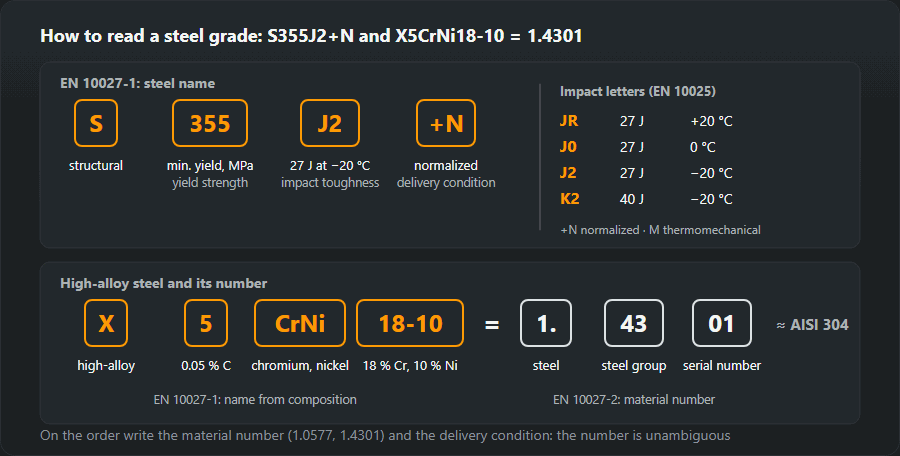
The systems table above gives the principle of each system; these are the details that trip people up when a real designation has to be read.
- EN 10027-1, name: anything after the plus sign is the delivery condition, not part of the grade: S355J2+N is S355J2 supplied normalised.
- EN 10027-2, number (Werkstoffnummer): 1.0577 — the first digit 1 means steel, the next two the steel group, the last two a sequence number.
- AISI/SAE: stainless grades have three digits, not four — 304, 316 — and the letter L means low carbon.
- GOST: 09Г2С — 0.09 % C, Г manganese, С silicon; 12Х18Н10Т — 0.12 % C, 18 % Cr, 10 % Ni, Т titanium. Ст3сп — ordinary structural steel, killed.
- PN (old Polish): 18G2A — carbon in hundredths, G manganese, A higher quality; 0H18N9 — H chromium, N nickel, the leading 0 and 00 mark low and very low carbon (00H18N10 is 304L); T at the end is titanium (1H18N9T is 321).
- UNE (Spain): F followed by digits, such as F-1140; the short form F-114 is the same grade.
- JIS: SS400 — structural steel with a minimum tensile strength of 400 MPa; SUS304 and SUS316L repeat the AISI numbers of the stainless grades.
What a substitution changes in welding
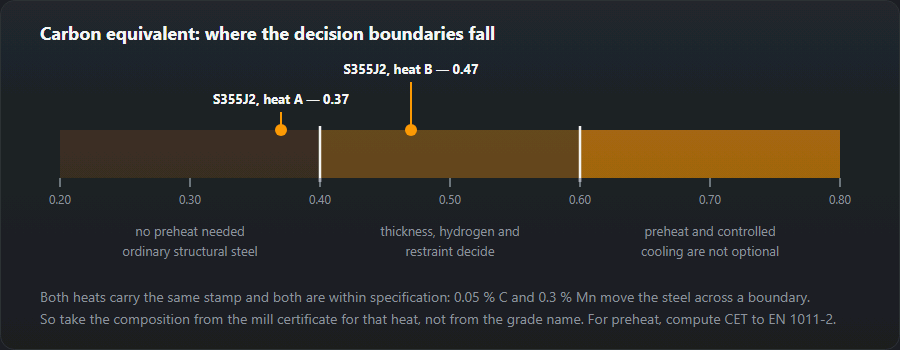
A different grade means a different carbon equivalent, and a different carbon equivalent means different preheat. An example with the calculator (CE = C + Mn/6 + (Cr + Mo + V)/5 + (Ni + Cu)/15, preheat by EN 1011-2 method B): 20 mm plate, hydrogen 5–10 ml/100 g, heat input 1.0 kJ/mm.
- Heat certified as S235JR with C 0.14 %, Mn 0.70 %, other elements nil: CE 0.257, CET 0.210 — preheat not required.
- The calculator’s default composition, within the S355J2 limits (C 0.18, Mn 1.40, Si 0.30, Cr 0.05, Mo 0.02, V 0.01, Ni 0.05, Cu 0.10): CE 0.439, CET 0.331 — preheat 100 °C; with basic dry consumables (up to 5 ml/100 g) 75 °C.
So replacing S235JR with S355J2 “because it is stronger” moves the joint from no preheat to preheat. The weldability column in the table is a rough guide; the calculation for the actual heat is what counts, and once CE comes out above about 0.40 the preheat calculator is the next step.
For austenitic stainless the risk is the opposite one: not hardening but sensitisation and distortion, which is why the advice there is to keep the heat input down — see welding stainless steel. 304 and 304L differ in carbon — the L grade is less prone to intergranular corrosion after welding. 321 (1.4541, 12Х18Н10Т, 1H18N9T) is stabilised with titanium, which ties up the carbon; titanium burns off in the arc, so it is usually welded with a niobium-stabilised 347 filler. Replacing 321 with 304 in service at temperature is not a neutral swap. When a stainless grade is joined to carbon steel, check the weld metal structure on the Schaeffler diagram and see welding dissimilar steels.
Frequently asked questions
What does S355J2 mean?
S is structural steel, 355 is the minimum yield strength in MPa, and J2 is an impact energy of 27 J tested at −20 °C. JR is tested at +20 °C, J0 at 0 °C, and K2 requires 40 J at −20 °C.
Is 1.4301 the same as AISI 304?
In composition, near enough: 1.4301 is the EN material number, X5CrNi18-10 is its name designation and AISI 304 is the American equivalent. The tolerances on carbon and nitrogen can differ, so for anything that matters you check the certificate rather than the table.
Can I substitute one equivalent for another?
Not on your own authority. An equivalent matches strength, not chemistry, and welding cares about chemistry. Substitution is a decision for the designer, recorded on the drawing — with the certificate of the actual batch in hand.
What is the AISI equivalent of S355?
There is none: AISI/SAE numbers describe chemistry (1020, 4140), while S355 is defined by strength and impact class. The nearest ASTM plate in our table is A572 Gr. 50 — 50 ksi, about 345 MPa, so nominally a little lower — and it does not carry the J2 impact test at −20 °C unless the certificate shows it.
What replaced ASTM A569?
A569 has been withdrawn; the table gives A1011 CS as its successor and DD11 (1.0332) as the European hot-rolled sheet for cold forming. GOST lists 08пс or Ст2пс for the same row.
What is SS 2142 equivalent to?
It is a Swedish grade that is not in our table. The Ovako and Tibnor data sheets say it corresponds closely to S450J0 and is similar to 19MnVS6 — stronger than S355, so S355 is not a like-for-like replacement.
Updated: