18G2A: the old Polish grade and its EN replacement
18G2A is an old Polish low-alloy structural steel to PN-86/H-84018. Its closest EN equivalent is S355J2 (1.0577) to EN 10025-2. It is an equivalent, not the same grade: the phosphorus and sulphur limits and the maximum CEV differ.
Short answer
The 18G2A equivalent is S355J2, material number 1.0577; on the GOST side the table gives 09Г2С and 17Г1С, on the ASTM side A572 Gr. 50. ISO/TR 15608 group 1.2. It welds well, but thicker sections need preheat: with CET 0.39 from the upper composition limits and basic electrodes (HD 4) the EN 1011-2 formula gives 110 °C at 20 mm and 160 °C at 40 mm.
Grade card
| Designation and standard | 18G2A · PN-86/H-84018 |
|---|---|
| Closest equivalent | S355J2 (EN 10025-2) |
| Material number | 1.0577 |
| GOST | 09Г2С, 17Г1С |
| AISI / ASTM | A572 Gr. 50 |
| PN | 18G2A |
| ISO/TR 15608 group | 1.2 — steel with a yield strength above 275 and up to 360 MPa, chemistry within group 1 limits |
| Weldability (equivalents table) | good; preheat by CE, often from about 20 mm |
The EN, GOST, AISI/ASTM and PN rows come from the steel grade equivalents table. An equivalent is the closest grade, not an identical one.
In the PN name, 18 is carbon in hundredths of a per cent, G2 manganese (up to 1.50 % in this grade) and A a higher quality class. Fametal lists building structures, bridges, reinforcing bars, tanks and pressure pipes as uses. Plate and sections are now ordered to EN 10025-2, and distributor cards still print both names side by side, which is why the old name keeps turning up on drawings from Poland.

18G2A chemical composition, % by mass
| Element | 18G2A | S355J2 |
|---|---|---|
| C | ≤ 0.20 | ≤ 0.20 |
| Mn | ≤ 1.50 | ≤ 1.60 |
| Si | ≤ 0.50 | ≤ 0.55 |
| P | ≤ 0.040 | ≤ 0.025 |
| S | ≤ 0.040 | ≤ 0.025 |
| Cr | ≤ 0.30 | — |
| Ni | ≤ 0.30 | — |
| Cu | ≤ 0.30 | ≤ 0.55 |
Source: 18G2A — Fametal, Kronos EDM; S355J2 — Akrostal.
Akrostal gives the S355J2 composition without a split by product thickness.
Mechanical properties
| Property | 18G2A | S355J2 |
|---|---|---|
| Re, MPa | 335* | — |
| ReH, MPa, ≤ 16 mm | — | 355 |
| ReH, MPa, 16–40 mm | — | 345 |
| ReH, MPa, 40–63 mm | — | 335 |
| Rm, MPa | 490–630 | 470–630 |
| A, % | — | ≥ 22 |
| KV | — | 27 J, −20 °C |
Source: 18G2A — Fametal, Kronos EDM, Steel Trans; S355J2 — EN 10025-2 (S235–S460 steel properties).
* The Fametal, Kronos EDM and Steel Trans cards give Re 335 MPa without a split by thickness.
The 335 MPa on the cards is given without a split by thickness, while S355J2 guarantees 355 MPa only up to 16 mm and less in thicker sections. J2 is the impact test: 27 J at −20 °C. Whether the substitute meets the design assumptions is for the designer to confirm from the 3.1 certificate.
Carbon equivalent: CE, CET and the CEV limit
| Value | Formula | Result | Basis |
|---|---|---|---|
| CE (IIW) | C + Mn/6 + (Cr+Mo+V)/5 + (Ni+Cu)/15 | 0.55 | upper composition limits from the table |
| CET | C + (Mn+Mo)/10 + (Cr+Cu)/20 + Ni/40 | 0.39 | upper composition limits from the table |
| CEV limit — 18G2A | CEV | ≤ 0.48 | Total Materia, steelestores |
| CEV limit — S355J2, ≤ 30 / 30–40 / 40–150 mm | CEV | ≤ 0.45 / 0.47 / 0.47 | EN 10025-2 |
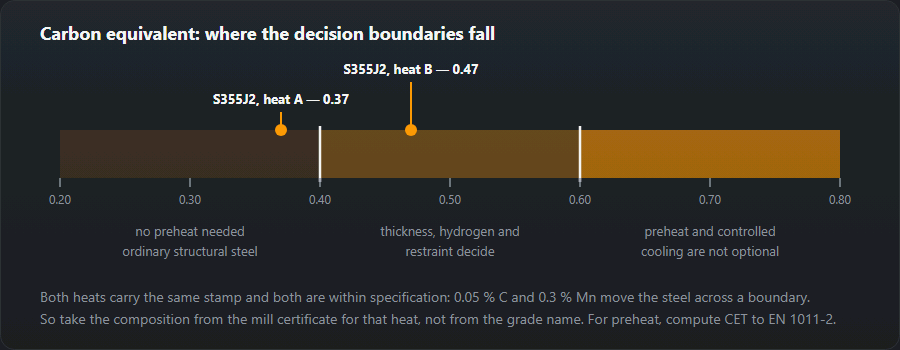
From the upper composition limits, CE falls in the calculator band: Limited — Preheat 100–200 °C, low-hydrogen electrodes, baked.
CE 0.55 from the maxima alone is a worst case and higher than the 0.48 CEV on the card: no heat has every element at its upper limit at once. In the preheat table, the column with CET 0.34 is the typical S355J2 value from the calculator list, the columns with CET 0.39 are the 18G2A upper limit. The procedure is decided by the certificate analysis.
Enter the analysis from your mill certificate in the carbon equivalent calculator: the link opens it with the composition limits from this page, ready to overwrite.
Preheat and interpass temperature
| d, mm | CET 0.34 (typical S355J2 from the calculator) · HD 4, °C | CET 0.39 (upper limits) · HD 4, °C | CET 0.39 (upper limits) · HD 12, °C |
|---|---|---|---|
| 10 | 35 | 75 | 120 |
| 20 | 75 | 110 | 160 |
| 30 | 100 | 140 | 185 |
| 40 | 120 | 160 | 205 |
| 60 | 140 | 180 | 225 |
EN 1011-2, Annex C, method B, the same formula as the preheat calculator: heat input 1.5 kJ/mm, result rounded up to 5 °C, "—" means no preheat is needed. HD 4 — basic electrodes and solid wire, HD 12 — rutile electrodes.
Work out your own CET, thickness and hydrogen in the preheat calculator (the link opens it with the CET from the upper composition limits).
Interpass: the calculator takes the range from the calculated preheat up to 250 °C, since above that the toughness of structural steels drops. On 10 mm plate with typical CET and basic electrodes the formula gives 35 °C, with rutile electrodes already 85 °C — hydrogen matters as much as thickness here.
Filler metal
| Process | Filler | Gas |
|---|---|---|
| 111 — stick (MMA) | E 42 4 B 42 H5 — Lincoln Basic 7018, ESAB OK 48.00; E 50 4 B — УОНИ 13/55 | — |
| 135 — MAG, solid wire | G3Si1 / ER70S-6 | Ar + 15–20 % CO₂ · CO₂ |
Basic electrodes marked H5 bring in little hydrogen, and it is hydrogen together with a hard heat-affected zone that causes cold cracking. They are redried per the maker's card: Lincoln Basic 7018 at 325–375 °C, ESAB OK 48.00 at 350 °C, UONI 13/55 at 350–400 °C. G3Si1 / ER70S-6 wire in M21 gas is the default for 135.
How to weld it
- Start from the certificate. Enter C, Mn, Cr, Mo, V, Ni and Cu in the CE calculator; the result for the heat replaces the estimate on this page.
- Preheat from CET, thickness and hydrogen: the table above or the preheat calculator. Hold it until the joint is finished.
- Low-hydrogen filler: redried basic electrodes, solid wire in M21.
- Heat input in the normal range for manual processes; the heat input calculator shows what your amps, volts and travel speed give.
- Interpass no higher than 250 °C.
Substituting the equivalent: what changes in the paperwork
Write the EN grade and ISO/TR 15608 group 1.2 in the pWPS and WPS, not the old name: the qualification range of a procedure to ISO 15614-1 is counted in material groups.
On the order, state the standard, the delivery condition (e.g. +N) and an EN 10204 3.1 certificate. The S355J2 CEV limit up to 30 mm is 0.45, lower than the 0.48 on the 18G2A card.
Where the figures come from
- Fametal, karta 18G2A (1.0562)
- Kronos EDM, 18G2A (1.0562)
- Steel Trans, S355J2 / 1.0577 / 18G2A
- Akrostal, 1.0577 S355J2
- Total Materia, PN 18G2A
- steelestores, PN 18G2A (PN H84018)
- EN 10025-2:2019 — S235–S460 steel properties
- ISO/TR 15608:2013, tab. 1 (later ISO/TR 15608:2017; replaced by ISO 15608:2025)
Figures from distributor and manufacturer datasheets are for information; for a given delivery, the EN 10204 3.1 certificate decides. CE, CET and preheat are calculated when the page is shown, with the same formulas as the calculators.
Frequently asked questions
What is the equivalent of 18G2A?
S355J2, material number 1.0577, to EN 10025-2. The equivalents table also gives 09Г2С and 17Г1С on the GOST side and A572 Gr. 50 on the ASTM side. These are the closest grades, not identical ones: order to EN, with a 3.1 certificate.
Is 18G2A the same as S355?
Roughly: both have a yield strength of about 335–355 MPa and similar chemistry. The phosphorus and sulphur limits differ (18G2A up to 0.040 %, S355J2 up to 0.025 %), and so does the CEV limit (0.48 against 0.45–0.47).
What is the chemical composition of 18G2A?
According to the Fametal and Kronos EDM cards: C up to 0.20 %, Mn up to 1.50 %, Si up to 0.50 %, P and S up to 0.040 %, Cr, Ni and Cu up to 0.30 %. Total Materia gives a CEV of up to 0.48.
Does 18G2A need preheating?
It depends on thickness, hydrogen and the heat analysis. From the upper composition limits CET is 0.39; with basic electrodes (HD 4) and 1.5 kJ/mm the EN 1011-2 formula gives 75 °C at 10 mm, 110 °C at 20 mm and 160 °C at 40 mm. Work out the CET of your own heat from the certificate.
Which electrodes for 18G2A?
Low-hydrogen basic ones, for example E 42 4 B 42 H5 (Lincoln Basic 7018, ESAB OK 48.00) or E 50 4 B (UONI 13/55), redried before use. With MAG, G3Si1 / ER70S-6 wire in Ar + 15–20 % CO₂.
Updated: