0H18N9: the Polish name for 18/9 austenitic stainless
0H18N9 is the PN-71/H-86020 designation of an 18/9 austenitic stainless steel. The closest grades are 1.4301 (X5CrNi18-10) to EN 10088 and AISI 304; on the GOST side, 08Х18Н10.
Short answer
The 0H18N9 equivalent is 1.4301 / X5CrNi18-10 / AISI 304. ISO/TR 15608 group 8.1. It welds well, without preheat, with interpass up to 150 °C and 308L filler. Do not confuse it with 00H18N10 (1.4306, 304L) or 1H18N9T (1.4541, 321): those are three different steels.
Grade card
| Designation and standard | 0H18N9 · PN-71/H-86020 |
|---|---|
| Closest equivalent | X5CrNi18-10 (EN 10088-2) |
| Material number | 1.4301 |
| GOST | 08Х18Н10 |
| AISI / ASTM | 304 |
| PN | 0H18N9 |
| ISO/TR 15608 group | 8.1 — austenitic stainless, subgroup with Cr ≤ 19 % (18 % nominal) |
| Weldability (equivalents table) | good, keep heat input low |
The EN, GOST, AISI/ASTM and PN rows come from the steel grade equivalents table. An equivalent is the closest grade, not an identical one.
The PN letters: 0 is low carbon (up to 0.07 %), H chromium, N nickel, and the figures their approximate content in per cent. 00H18N10 is the extra-low-carbon version and 1H18N9T the titanium-stabilised one. Today the steel is bought as 1.4301, and for thicker welded work often as low-carbon 1.4307 (304L).

0H18N9 chemical composition, % by mass
| Element | 0H18N9 | 1.4301 |
|---|---|---|
| C | ≤ 0.07 | ≤ 0.07 |
| Mn | ≤ 2.00 | ≤ 2.00 |
| Si | ≤ 0.80 | ≤ 1.00 |
| P | ≤ 0.045 | ≤ 0.045 |
| S | ≤ 0.030 | ≤ 0.015 |
| Cr | 17–19* | 17.5–19.5 |
| Ni | 9–11 | 8.0–10.5 |
| N | — | ≤ 0.11 |
Source: 0H18N9 — Alfa-Tech (PN-71/H-86020), steelestores; 1.4301 — Linstar, demark (EN 10088-2).
* Cr 17–19 % according to steelestores, 17–20 % according to Alfa-Tech: the two disagree.
Mechanical properties
| Property | 1.4301 C | 1.4301 P |
|---|---|---|
| Rp0.2, MPa | ≥ 230 | ≥ 210 |
| Rm, MPa | 540–750 | 520–720 |
| A, % | ≥ 45 | ≥ 45 |
Source: EN 10088-2 — Outokumpu, tubingchina, Righton Blackburns (S235–S460 steel properties).
C — cold-rolled sheet and strip (up to 8 mm), P — hot-rolled plate (up to 75 mm).
For 0H18N9 itself the cards give incomplete properties (Alfa-Tech only R0.2 of about 220 MPa), so the table shows 1.4301 to EN 10088-2 in two product forms.
Carbon equivalent: CE, CET and the CEV limit
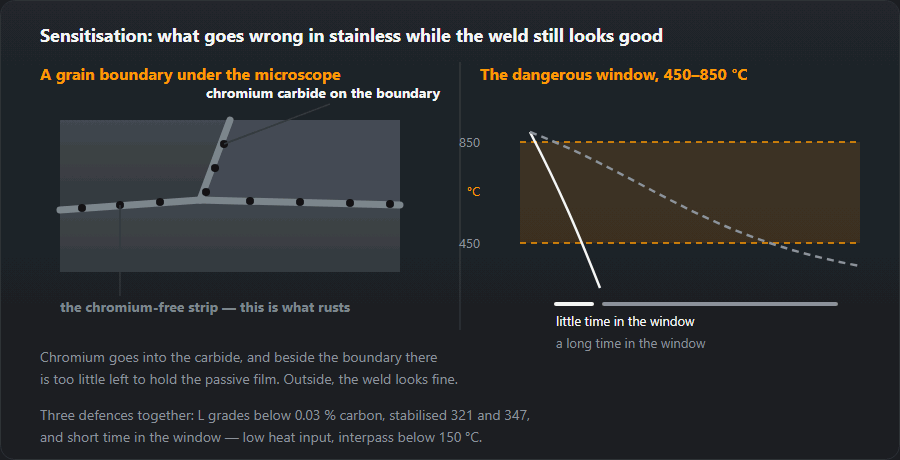
CE and CET describe how prone ferritic steels are to hardening in the heat-affected zone. Austenite does not harden, so neither CE nor a preheat from that formula means anything for 0H18N9. Two other things count: the ferrite in the weld (check it on the Schaeffler diagram) and the time spent between 450 and 850 °C, where chromium ties up as carbides at the grain boundaries.
Preheat and interpass temperature
No preheat. Interpass no higher than 150 °C: stainless conducts heat worse than carbon steel, so heat stays at the weld and stretches the time in the sensitisation range. Waiting for the joint to cool is cheaper than pickling and rewelding later.
Filler metal
| Process | Filler | Gas |
|---|---|---|
| 111 — stick (MMA) | E 19 9 L R 12 / E308L-17 — ESAB OK 61.30 | — |
| 135 — MAG, solid wire | ER308L | Ar + 2 % CO₂ · Ar + 2 % O₂ |
| 141 — TIG | ER308L | Ar |
308L is low in carbon, and its weld metal holds a little ferrite that protects against hot cracking. For a joint to carbon steel, use 309L (see dissimilar steels). With MAG, use a mix with 2 % CO₂ or O₂, never straight CO₂: carbon from the gas goes into the weld and lowers its corrosion resistance.
How to weld it
- Keep it clean. Brushes and discs for stainless only; carbon steel dust rusts on its surface.
- Little heat. Current 10–20 % lower than on carbon steel of the same thickness, short runs in alternating order rather than one long continuous weld.
- Interpass up to 150 °C.
- Back purge with argon where the root sees the medium: without it the root oxidises and rusts first.
- After welding heat tint is pickled and passivated (see welding stainless steel).
Substituting the equivalent: what changes in the paperwork
On the order, write 1.4301 or X5CrNi18-10 with the product standard (plate and sheet: EN 10088-2) and a 3.1 certificate. If the structure has thick walls or works where intergranular corrosion is a risk, consider 1.4307 (304L) — a different steel, and the designer's decision.
In the pWPS and WPS, write the EN grade and ISO/TR 15608 group 8.1 instead of the old PN name.
Where the figures come from
- Alfa-Tech, 0H18N9 (PN-71/H-86020)
- steelestores, PN 0H18N9 (PN H86020)
- Linstar, 1.4301
- demark, 1.4301
- EN 10088-2 — S235–S460 steel properties
- ISO/TR 15608:2013, tab. 1 (later ISO/TR 15608:2017; replaced by ISO 15608:2025)
Figures from distributor and manufacturer datasheets are for information; for a given delivery, the EN 10204 3.1 certificate decides. CE, CET and preheat are calculated when the page is shown, with the same formulas as the calculators.
Frequently asked questions
What is the equivalent of 0H18N9?
1.4301, X5CrNi18-10, AISI 304; GOST 08Х18Н10. The two compositions overlap in most elements; 1.4301 has a narrower chromium range (17.5–19.5 %) and a lower sulphur limit (0.015 %).
Is 0H18N9 acid-resistant?
In the everyday sense, yes: it is an 18/9 austenitic stainless steel, sold in Poland as «kwasoodporna». Where chlorides are present, a molybdenum grade does better — 0H17N14M2, that is 1.4401 / AISI 316.
What is the chemical composition of 0H18N9?
According to Alfa-Tech (PN-71/H-86020): C up to 0.07 %, Mn up to 2.00 %, Si up to 0.80 %, P up to 0.045 %, S up to 0.030 %, Ni 9–11 %, Cr 17–20 % (steelestores gives Cr 17–19 %).
What filler for 0H18N9?
308L: an E 19 9 L R / E308L-17 electrode (e.g. ESAB OK 61.30), ER308L wire in Ar + 2 % CO₂, or ER308L rod in argon for TIG. For a joint to carbon steel, 309L.
Does 0H18N9 need preheating?
No. Austenite does not harden, so preheat gains nothing, and extra heat does harm: it lengthens the time between 450 and 850 °C. Watch the interpass temperature instead — up to 150 °C.
Updated: