Tungsten electrodes: colours, designations and use
The colour code of ISO 6848: which oxide, for which current and which metal, how to grind it, and how much current an electrode of a given diameter will take.
Colour and composition
| Designation | Tip colour | Oxide | Current | Where it is used |
|---|---|---|---|---|
| WP | green | W ≥ 99.95 % | AC | Aluminium, magnesium and their alloys |
| WT-20 | red | 2 % ThO₂ | DC | Steel, stainless, titanium, copper |
| WT-10 | yellow | 1 % ThO₂ | DC | Steel, low and medium current |
| WT-30 | purple | 3 % ThO₂ | DC | Steel, high current |
| WC-20 | grey | 2 % CeO₂ | AC / DC | General purpose, excellent at low current |
| WL-15 | gold | 1.5 % La₂O₃ | AC / DC | General purpose |
| WL-20 | blue | 2 % La₂O₃ | AC / DC | General purpose, the most common choice |
| WZ-8 | white | 0.8 % ZrO₂ | AC | Aluminium where weld contamination is unacceptable |
| WY-20 | dark blue | 2 % Y₂O₃ | DC | Critical joints, titanium, deep penetration |
The colour is a standard, not a brand: the code comes from ISO 6848 (EN 26848), so a red tip means 2 % thoria whoever made it.
The code comes from ISO 6848 (EN 26848 in Europe), so a red tip means 2 % thoria whoever made it. Unpainted and repainted counterfeits do turn up, though: if the arc behaves unlike it should, this is often why.
Current by electrode diameter
| Diameter, mm | DC−, A | AC, A | Filler rod, mm |
|---|---|---|---|
| 1.0 | 15–80 | 20–60 | 1.0–1.6 |
| 1.6 | 70–150 | 60–120 | 1.6–2.0 |
| 2.0 | 100–200 | 80–160 | 1.6–2.4 |
| 2.4 | 150–250 | 100–180 | 2.0–3.0 |
| 3.2 | 250–400 | 160–250 | 2.4–4.0 |
| 4.0 | 400–500 | 200–320 | 3.0–4.0 |
Grinding

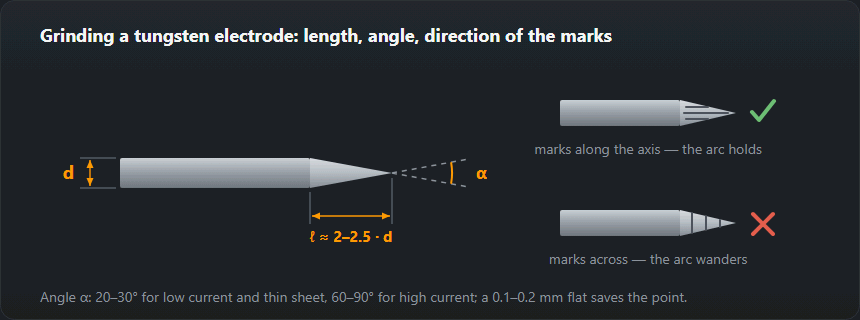
| Included angle | Current | What it gives |
|---|---|---|
| 15–30° | low | Easy striking, narrow arc, deep narrow penetration. Wears quickly. |
| 30–60° | medium | The compromise: steady arc and acceptable life. |
| 60–90° | high | Wide arc, longest life, less risk of melting the tip off. |
| Balled end | AC (WP, WZ-8) | Forms by itself on AC and holds the cathode spot steady. |
Common mistakes
- Grinding across. Marks perpendicular to the axis make the arc wander. Grind along the axis, on a wheel kept for tungsten only.
- Dipping into the pool. A contaminated tip gives an unstable arc and tungsten inclusions in the weld — regrind it rather than trying to burn it clean.
- WT-20 on AC. Thoriated tungsten cracks and spits on alternating current. For aluminium use WP, WZ-8 or WL-20.
- Too much stick-out. Outside the gas shield the tungsten oxidises and turns blue. Keep the stick-out no longer than the cup diameter.
Reading the designation: letter, number, colour
An electrode designation has three parts. W is tungsten; the second letter says which oxide has been added: P — pure tungsten with no addition, T — thorium, C — cerium, L — lanthanum, Z — zirconium, Y — yttrium. The number is the oxide content times ten: WL-15 has 1.5 % La₂O₃, WT-20 2 % ThO₂, WZ-8 0.8 % ZrO₂. The tip colour repeats this so the electrode can be identified out of its box — which is why each regrind should leave the paint on the other end.
Which tungsten for what — the quick choice
- Steel and stainless on DC−: WL-20 (blue) first; WC-20 (grey) when you weld thin sheet at low current and need a reliable start.
- Aluminium and magnesium on AC: WP (green) or WZ-8 (white), which form a ball on the end; on a square-wave inverter WL-20 ground to a point works as well.
- Titanium and critical joints: WY-20 (dark blue) on DC.
- One type on the shelf: WL-20 — it runs on both DC and AC, so a shop that welds steel and occasionally aluminium does not need to stock three types.
Red WT-20 is still on sale and welds very well on DC, but its grinding dust contains radioactive thorium. If you use it, grind on a separate wheel with extraction and do not breathe the dust. Lanthanated and ceriated electrodes give practically the same arc without the problem.
Worked example: which diameter for which current
The current table above gives the range for each diameter separately on DC− and AC. Two typical cases:
- 5 mm steel, 160 A DC−. A 2.4 mm electrode carries 150–250 A on DC− — 160 A sits at the bottom of the range, and a 30–60° point is fine. A 1.6 mm electrode (70–150 A) would already be overloaded.
- Aluminium, 200 A AC. The same 2.4 mm tops out at 180 A on AC, so at 200 A it would already be overloaded, with the ball visibly growing. 3.2 mm (AC 160–250 A) is the right pick.
The mistake works both ways. Too thin an electrode at high current melts its tip and drops tungsten into the pool. Too thick at low current — say 2.4 mm at 30 A on 1 mm sheet — strikes reluctantly and the arc skates about the end. That is what the 1.0 mm size is for (DC− 15–80 A).
Grinding in practice
- A dedicated wheel. A wheel that has been used on steel carries filings onto the tungsten and from there into the weld. Keep a separate wheel for tungsten, ideally diamond, or a dedicated grinder.
- Taper length 2–3 diameters. For 2.4 mm that is 5–7 mm. A short taper gives a wider arc, a long one a narrower arc.
- A small flat on the tip at high current: instead of a needle point, a land that will not drop off into the pool.
- The AC ball forms by itself on WP and WZ-8. A ball that grows fast and beyond the electrode diameter means too much current or balance pushed too far towards electrode-positive.
The paint has worn off — identifying the electrode
Not by eye: electrodes with different additions look identical. That is why they are kept in labelled tubes, one type per tube, and ground at the unpainted end. An unknown electrode is better set aside than guessed at: WT-20 on AC cracks and spits, and WP on DC− quickly loses its point.
Diameter, grind angle and cup size for a given current are worked out by the tungsten electrode selector, current by plate thickness is on the TIG welding page, and the gas for TIG in shielding gas selection.
Frequently asked questions
Which tungsten for aluminium?
On AC, WP (green) or WZ-8 (white): both hold the balled end that AC wants. On square-wave inverters WL-20 (blue) also works well, and it is ground to a point rather than balled.
What replaces thoriated WT-20?
WL-20 (lanthanated, blue) is the closest match for arc behaviour on DC, without the weak radioactivity of thorium. WC-20 (ceriated, grey) strikes better at low current and suits thin material.
What angle do I grind to?
Rule of thumb: make the ground length two to three times the electrode diameter. A sharp grind (15–30°) gives a narrow arc and reliable striking at low current; a blunt one (60–90°) gives a wider arc and lasts longer at high current. Grind along the axis, never across — transverse marks pull the arc sideways.
What does a green tungsten mean?
A green tip is WP — pure tungsten, at least 99.95 % W, with no oxide addition. It is used on AC for aluminium and magnesium, because on AC it forms a stable ball on the end by itself.
Which tungsten for stainless steel?
WL-20 (blue) or WC-20 (grey) on DC−, ground lengthwise to a taper 2–3 diameters long. For sheet up to 2 mm a 1.6 mm diameter is enough.
Is thoriated tungsten harmful?
The thorium in WT-20 is weakly radioactive, and the main hazard is breathing the grinding dust. If you use it, grind with extraction on a separate wheel; lanthanated WL-20 replaces it without the problem.
Updated: