Welding shade number calculator
Which shade to set on the helmet, by process and current, to EN 169 and EN 379.

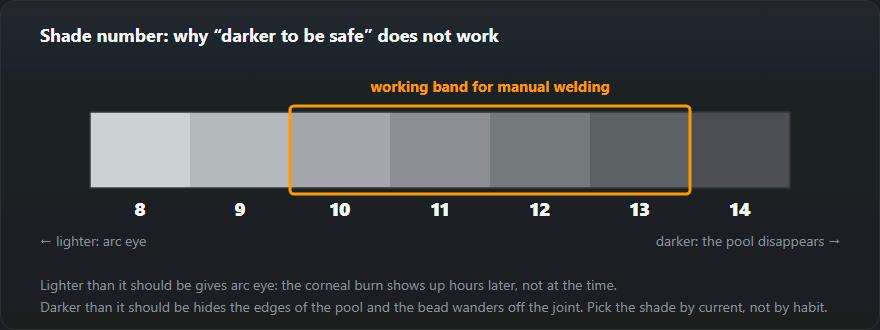
Too dark is a real problem too
A shade darker than necessary is not the safe option. It hides the edges of the pool, so the welder leans in to see, which puts the head into the fume plume and worsens the arc position at the same time. The right shade is the lightest one at which the arc is comfortable.
Shade number table to EN 169
| Current, A | MMA | MIG/MAG steel | MIG aluminium | TIG | Plasma | Gouging |
|---|---|---|---|---|---|---|
| up to 15 | 8 | — | — | 8 | 8 | — |
| 15–20 | 9 | — | — | 9 | 8 | — |
| 20–40 | 9 | — | — | 9 | 9 | — |
| 40–80 | 10 | 9 | — | 10 | 10 | — |
| 80–100 | 11 | 10 | 10 | 10 | 11 | — |
| 100–150 | 11 | 11 | 11 | 11 | 11 | 10 |
| 150–175 | 11 | 11 | 11 | 11 | 12 | 10 |
| 175–250 | 12 | 12 | 12 | 12 | 12 | 11 |
| 250–300 | 12 | 12 | 13 | 13 | 13 | 12 |
| 300–350 | 13 | 13 | 13 | 13 | 13 | 12 |
| 350–400 | 13 | 13 | 14 | 13 | 13 | 12 |
| 400–500 | 13 | 13 | 14 | 14 | 14 | 13 |
| over 500 | 14 | 14 | 15 | 14 | 14 | 13 |
What the shade actually blocks
Ultraviolet and infrared are filtered by the glass at every shade number — that part does not vary with the setting, and a compliant filter protects against arc eye even in its light state. The shade number controls visible light only. This matters when the auto-darkening cartridge fails to switch: the flash still dazzles and strains the eyes, but the UV protection was there regardless.
The four numbers stamped on an auto-darkening cartridge — optical class, diffusion, homogeneity and angle dependence — are explained on the welding helmet page. 1/1/1/1 is the best grade; the last digit is the one that matters most for long sessions.
What one number means: the scale is logarithmic
The shade number is tied to the visible-light transmittance τ by N = 1 + (7/3)·log₁₀(1/τ). In practice each step up lets through about 2.7 times less light, two steps about 7 times less, three steps about 19 times less. In numbers:
- Shade 9 — passes about 1/2700 of the light;
- Shade 10 — about 1/7200;
- Shade 11 — about 1/19,000;
- Shade 12 — about 1/52,000;
- Shade 13 — about 1/139,000.
That is why being two shades out is not a detail: it is a sevenfold difference in the brightness reaching the retina. And it is why one shade darker is clearly felt over a long run, even though you can still see the pool.
Same current, different processes — examples from the calculator
- 40 A: MMA — shade 9, MAG — shade 9, TIG — shade 9.
- 100 A: MMA — shade 11, but MAG, MIG on aluminium and TIG — shade 10: for stick electrodes the table goes one number higher here.
- 150 A: MMA, MAG, MIG and TIG — shade 11; arc gouging — shade 10.
- 250 A: MMA, MAG, MIG and TIG — shade 12; gouging — shade 11.
- 350 A: MMA, MAG, MIG and TIG — shade 13; gouging — shade 12.
A 3.2 mm rod (90–140 A in our welding current table) sits entirely within shade 11 — one helmet setting covers that rod’s whole range.
How to read the table
- The current column is the top of each band. 175 A means “up to and including 175 A”; at 180 A the next shade applies.
- A dash in a cell means the process is not used at that current: in the table MAG starts at 40 A, MIG on aluminium at 80 A, gouging at 100 A.
- On a band boundary, go darker for long runs and in a bright shop, lighter for short tacks and in a dark room.
- The ±1 band in the calculator is an allowance for conditions and eyesight, not a free choice: two shades lighter is already a risk.
Helpers, neighbours and reflections
The arc blinds more than the welder. A helper holding the part and people walking past get the same radiation without a helmet. Bays are separated with welding curtains (EN ISO 25980 sets the requirements for them), and light walls are painted matt and dark — reflected light gets in under the helmet from the side.
The signs of arc eye (photokeratitis) — grit under the eyelids, watering, sensitivity to light — usually appear only several hours later, often at night. See a doctor, and the next day find where the UV got in: reflections, the neighbouring bays, the fit of the helmet and the screening of the bay. The rest of the protective kit is covered in welding PPE.
Common mistakes
- One shade for everything. A helmet set to shade 11 for MMA is too light for MAG at 250 A and too dark for TIG at 40 A.
- A “safe” extra-dark filter. You cannot see the pool, your head moves closer, into the fume.
- A dirty cover lens — it dims and scatters the view, and then the temptation is to lighten the filter.
Frequently asked questions
What happens with a shade that is too light?
The pool looks too bright: glare, squinting, tired and aching eyes by the end of the shift, and over long work a load on the retina from the intense visible and blue light of the arc. Ultraviolet and infrared are not the issue — a filter to EN 379 / EN ISO 16321 blocks them at every shade. Arc eye, a UV burn of the cornea, comes from light getting round the helmet (reflections, a neighbour’s arc, a raised visor), not from the shade number.
And one that is too dark?
You stop seeing the pool and see only the arc. The weld suffers, and because you lean closer your head sits deeper in the fume plume. That is why the shade is matched to the current rather than set as dark as possible.
Is a fixed-shade helmet enough?
For occasional work in one process, yes. Anyone moving between 40 A TIG and 200 A MAG needs an adjustable shade — the difference is three to four steps, and fixed cartridges do not cover it.
What shade for a 3.2 mm (1/8 in) rod?
Shade 11. A 3.2 mm rod runs at 90–140 A, and that whole range falls inside shade 11 for MMA. For long runs in a bright shop you can go to 12; for short tacks in a dark room, 10.
How much darker is shade 12 than shade 10?
About seven times. Each step up passes about 2.7 times less light: shade 10 lets through about 1/7200, shade 12 about 1/52,000 of the visible light.
What shade for low-amp TIG?
From the table: up to 15 A shade 8, up to 40 A shade 9, up to 100 A shade 10. A helmet with a 9–13 range cannot go down to 8, so the thinnest work needs a cartridge with a wider range.
Updated: