Choosing an auto-darkening helmet: EN 379 and shade by process
The helmet is the one piece of equipment that protects an organ you cannot replace. Two standards define whether it does its job, and two numbers decide whether you can see what you are doing.
The standards
EN 175 covers the shell: impact resistance, coverage, materials. EN 379 covers the filter cartridge: the shade range, the switching time and the four optical class numbers. EN 169 gives the shade scale itself.
A helmet without these markings is not equipment, it is a hat. The markings are on the cartridge frame and on the shell, and they are small — worth checking before buying rather than after.
Choosing the shade

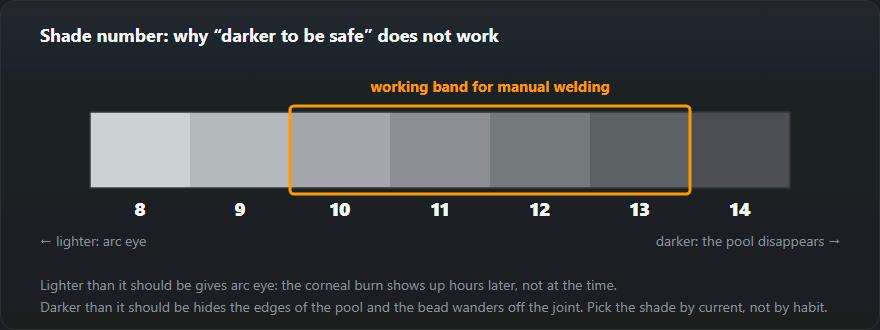
The shade number depends on the process and the current: roughly 9–10 for low-current MMA, 11–12 for MIG/MAG at 200 A, 12–13 for high current. The shade calculator gives the figure for your case.
Setting the shade too dark is a real and underrated mistake. You cannot see the edges of the pool, so you lean closer to see — which puts your head into the fume plume and worsens your control of the arc at the same time. Pick the lightest shade at which the arc is comfortable.
Switching time
Quoted in fractions of a millisecond: 1/25 000 s is ordinary, 1/30 000 s better. In practice anything at or below 1/20 000 s protects the eye, because the damaging exposure builds over a longer period than that. What longer switching times cost you is comfort — the flash before the filter reacts is what makes eyes tired by the afternoon.
Watch the low-temperature specification too: many cartridges slow down below about −5 °C, which matters on winter site work.
The optical class numbers
1/1/1/1 means the filter is essentially a clean window at every angle. Cheaper cartridges rate 1/2/1/2 or worse, and the third and fourth numbers are the ones that produce eye strain: the shade varies across the field or changes as you move your head. For occasional use it hardly matters; for a full day of TIG it matters a great deal.
| Parameter | Acceptable | Good |
|---|---|---|
| Switching time | 1/10 000 s | 1/25 000 s or faster |
| Arc sensors | 2 | 4 |
| Optical class | 1/2/1/2 | 1/1/1/1 |
| Working temperature | from −5 °C | from −10 °C |
The unglamorous parts
The headgear determines whether the helmet is usable. A four-point harness with adjustable pivot distance can be set so the filter sits close to the eyes, which widens the field of view. Weight matters over eight hours; so does whether the helmet stays put when you nod it down.
Keep spare cover lenses. A spatter-pitted outer lens costs a few coins and ruins the view completely, and welders will often work through a whole job looking through one rather than spend two minutes changing it. The rest of the protective kit is covered in personal protective equipment.
Which shade for which job — examples
Values from the same table the shade calculator uses (EN ISO 16321 / EN 169). Rod currents are the middle of the range in our welding current table.
- MMA, 2.5 mm rod, 85 A — shade 11.
- MMA, 3.2 mm rod, 115 A — shade 11.
- MMA, 200 A — shade 12.
- MIG/MAG on steel, 150 A — shade 11; 250 A — shade 12.
- MIG on aluminium, 200 A — shade 12: the arc on aluminium is brighter than on steel.
- TIG, 30 A (thin stainless) — shade 9; 80 A — shade 10; 150 A — shade 11.
- Arc gouging, 300 A — shade 12.
How to read the table: the number is a starting point. The calculator also shows a ±1 band — lighter if you cannot see the pool, darker if you see afterimages after work.
The shade range and the processes you use
An EN 379 cartridge carries a marking such as 4/9–13 … 1/1/1/2/379: 4 is the light state, 9–13 the dark range, then the maker, the four optical class digits and the standard number. The examples above show that 9–13 covers MMA and MIG/MAG but not the most delicate TIG: at 15 A the table gives shade 8. Anyone who TIG-welds thin sheet needs a cartridge whose range starts at 5 or 8.
Grind mode holds the filter in the light state so sparks from a grinder do not keep darkening it. Safety glasses under the helmet are still needed when grinding — the cover lens is not protection against fragments from the disc.
Sensitivity and delay — how to set them
- Higher sensitivity for low-current TIG: the arc is weak and the sensors may miss it.
- Lower sensitivity in a shop where others weld nearby: their arcs will not keep darkening your filter.
- Short delay for tacking — you see sooner where the next tack goes.
- Longer delay at high current: the glowing pool stays bright for a moment after the arc goes out.
A buying checklist
- EN 175 on the shell and EN 379 on the cartridge — without them it is not protective equipment.
- Optical class: the more ones, the less tired your eyes. For full shifts, 1/1/1/1 or 1/1/1/2.
- A shade range that covers all your processes and currents.
- Four sensors if you weld out of position and in corners.
- A replaceable battery as well as the solar cell.
- Cover lenses you can actually buy — they wear out first.
- Weight and headgear: try it on, nod a few times, check it does not drop on its own.
- For long hours in fume, a powered-air version (PAPR) — see respiratory protection.
How to check a helmet before work
- The test button on the cartridge — the filter must darken instantly.
- Look at a bright lamp in the light state: the view should be clear, not hazy. A hazy view is usually a worn cover lens, not the filter.
- Turn your head with the arc lit: if the shade changes with the angle, the fourth class digit is weak.
- A short strike first, then the long bead.
Common mistakes
- “Darker is safer.” Too dark a filter makes you lean over the pool, straight into the plume — see welding fumes.
- Working through a pitted cover lens instead of replacing it for pocket change.
- Storing the helmet in a dark cupboard — the solar cell cannot top up the battery.
- No glasses under the helmet when grinding and chipping slag.
- A helper next to the arc without protection. The radiation reaches everyone in line of sight.
Frequently asked questions
What do the four numbers on the cartridge mean?
Optical class, diffusion of light, variation in luminous transmittance, and angle dependence — in that order, each from 1 (best) to 3. 1/1/1/1 is the top grade. The last digit is the one you notice over a long day: a poor angle rating means the shade changes as you tilt your head.
Is a passive helmet worse than auto-darkening?
Not optically — a good passive filter is excellent. It is worse ergonomically: nodding the helmet down loses the exact spot you were about to strike, and that costs accuracy on tacks and on TIG. For occasional heavy welding a passive helmet is perfectly serviceable.
Does the filter protect me when it fails to darken?
From ultraviolet and infrared, yes — a compliant filter blocks those in both states, so you will not get arc eye from a cartridge that failed to switch. What you will get is a very bright flash and a headache. Test the cartridge against a lighter flame or the test button before each session.
Which shade range: 9–13 or 5–13?
For MMA and MIG/MAG, 9–13 is enough: even a 2.5 mm rod at 85 A is shade 11. Low-current TIG needs a wider range — at 15 A the table gives shade 8, at 30 A shade 9.
What does 4/9–13 on the cartridge mean?
4 is the shade in the light state; 9–13 is the range you set for welding. After that come the maker’s mark, the four optical class digits (for example 1/1/1/2) and the standard number, EN 379.
Does a welding helmet protect you when grinding?
Grind mode keeps the filter light and the shell shields the face from sparks. Wear safety glasses underneath anyway: with the helmet up or a cracked lens, a fragment from the disc goes straight into the eye.
Updated: