Respiratory protection for welders
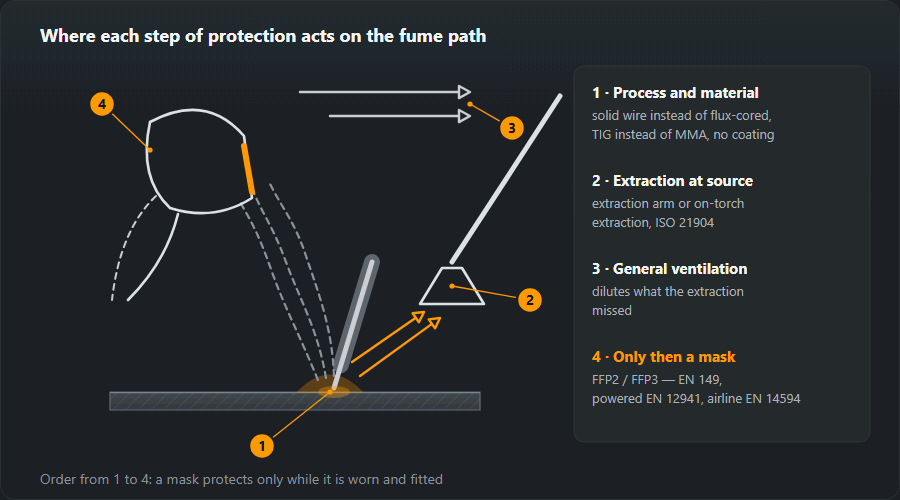
The mask is the last link in the chain, not the first. You remove the source, then extract the fume where it is made, and only what cannot be removed is caught by a filter on the face. That order is written into occupational safety law, not just into guidance.
The order that applies
- Change the process or the material. Solid wire instead of flux-cored, TIG instead of MMA, uncoated stock instead of galvanised — that cuts fume by multiples, not by percentages.
- Extract at source. An extraction arm, or on-torch extraction to ISO 21904, takes the fume before it reaches the breathing zone.
- Ventilate the room. General ventilation dilutes whatever escaped the extraction.
- Only now, the mask. Personal protection comes last, because it works only while it is worn and fitted.

What to protect yourself with
| Device | Standard | When |
|---|---|---|
| FFP2 half mask | EN 149 | Short jobs on non-alloy steel with the ventilation running |
| FFP3 half mask | EN 149 | Stainless, galvanised, long jobs, confined spaces |
| Powered air hood (PAPR) | EN 12941 | A whole shift under the hood; no breathing effort, cools the face |
| Compressed-air line breathing apparatus | EN 14594 | Vessels and confined spaces where air itself may be short |
| On-torch extraction | ISO 21904 | Extraction at source — the first step before any personal protection |
FFP2 or FFP3
The filter class says how much of the particulate it holds back: FFP1 the least, FFP3 the most. In welding the line falls like this: FFP2 for short work on non-alloy steel with the ventilation running; FFP3 for stainless and galvanised, for a full shift, for confined spaces, and for anything where the fume is carcinogenic.
Fit, though, often matters more than class. A half mask works by sealing to the face, and the seal is ruined by a beard, by a scar, by the wrong size, and simply by pushing the mask under the chin "for a minute". A leaking FFP3 protects worse than a well-fitted FFP2, because the air travels past the filter.
Powered air: why it often works better
A powered hood to EN 12941 is a blower on the belt, a filter and a hose to the shell. The slight positive pressure under the shell means leaks push clean air outwards rather than drawing dirty air in — which is why a beard does not matter to it and why breathing costs no effort.
The real advantage, though, is different: a powered hood does not get taken off after twenty minutes. Almost everyone eventually pulls a half mask off under a helmet in the heat, and equipment that has been removed protects nothing. In tight vessels, where the oxygen itself may run short, no filter helps at all: there you need air-line breathing apparatus to EN 14594, fed from outside.
On-torch extraction
Extraction built into a MIG/MAG torch takes the fume a few centimetres from the arc, that is before it rises to your face. ISO 21904 sets out the requirements for such equipment and how its effectiveness is checked.
Two caveats from the shop floor. First, extraction that is too strong pulls the shielding gas away and gives porosity — so the flow is adjusted, not turned to maximum. Second, extraction at source does not cancel the mask on stainless: it takes most of the fume, but hexavalent chromium is dangerous at levels where "most" is not enough.
Welding respirator classes at a glance: FFP, P and TH
Five families of equipment turn up at a welding bay, each with its own standard. The filtering half mask to EN 149 is mask and filter in one and carries the class FFP1, FFP2 or FFP3; the marking NR means "single shift only", R means "reusable". The rubber or silicone half mask to EN 140 takes replaceable particle filters to EN 143 in classes P1, P2 and P3. The powered air-purifying respirator with helmet or hood to EN 12941 — the powered welding helmet — comes in classes TH1, TH2 and TH3; the same with a tight mask to EN 12942 in classes TM1 to TM3. With compressed-air line apparatus to EN 14594 the air does not pass a filter at all: it comes treated from the compressed-air line.
How much a device protects is stated differently from country to country. Germany uses the protection level from DGUV Regel 112-190 (table 2), the UK the Assigned Protection Factor from HSE HSG53 (table 10). Both say by what factor the concentration in the air you breathe falls below the concentration around you, as long as the device fits and is worn — but the numbers are not the same everywhere:
| Device | Standard | Protection level, DGUV Regel 112-190 (Germany) | APF, HSE HSG53 (UK) |
|---|---|---|---|
| FFP1 / half mask with P1 | EN 149 / EN 140 + EN 143 | 4 | 4 |
| FFP2 / half mask with P2 | EN 149 / EN 140 + EN 143 | 10 | 10 |
| FFP3 / half mask with P3 | EN 149 / EN 140 + EN 143 | 30 | 20 |
| Powered, with helmet or hood TH1 / TH2 / TH3 | EN 12941 | 5 / 20 / 100 | 10 / 20 / 40 |
| Powered, with mask TM1 / TM2 / TM3 | EN 12942 | 10 / 100 / 500 | 10 / 20 / 40 |
| Compressed-air line apparatus with hood or helmet, class 1A / 2A / 3A / 4A | EN 14594 | 5 / 20 / 100 / 500 | — |
Three things follow. First: FFP2 and P2 sit at 10 in both documents and TH2 at 20 — that far they agree. Second: they part at FFP3 and TH3; if you do not know which rule set your employer assesses by, use the lower figure. Third, and decisive in welding: DGUV Regel 112-190 does not allow FFP1, P1 or TH1 powered units against carcinogens — that is, against hexavalent chromium and nickel in stainless fume — and HSG53 also advises against FFP1 for welding fume. The letter P after the class (TH2P, TH3P) means a particle filter; it says nothing about gases.
When a powered hood or supplied air is needed
A half mask on the face is no longer enough as soon as any of these applies:
- Stainless and high-alloy steels. The fume carries hexavalent chromium and nickel, both carcinogenic. For this case the German TRGS 528 names powered welding helmets TH2P or TH3P and powered masks TM1P to TM3P as suitable. Details — stainless steel fume.
- Galvanised and coated stock. Zinc oxide is a particle and stays in a P filter; primers, paints and oils, however, also break down in the arc into gases that no particle filter stops. Best of all, grind the weld zone bright first.
- Confined spaces, vessels, double bottoms. Fume does not dilute and shielding gas displaces the air. How ventilation and extraction must look there — welding fume and ventilation.
- Long jobs. Anyone welding most of the shift runs into the mask's wear-time limit and the heat under it; a powered hood has neither (figures below, from DGUV Regel 112-190).
- A beard. A powered helmet or hood needs no face seal; an FFP mask and a half mask need one without exception.
Gases: where a particle filter does nothing
A P filter holds particles, not gases. Welding produces three dangerous gases: ozone, made from the oxygen in the air by the arc's UV, most of all in TIG and MIG welding of aluminium; nitrogen oxides, mainly from gas welding and plasma cutting; carbon monoxide, from CO₂ breaking down in MAG welding. Gases need a gas or combined filter to EN 14387 whose type the maker approves for the specific substance, or air from outside. There is no work filter for carbon monoxide — only fresh air or supplied air. And where oxygen itself may run short, say in a vessel that argon has flowed into, no filtering device helps at all: only breathing apparatus independent of the surrounding air, that is air-line or self-contained.
DGUV Regel 112-190 names one more hazard explicitly: sparks and hot spatter can set a filter alight, and a smouldering filter gives off carbon monoxide that the wearer breathes straight in. Welding therefore calls for devices that keep sparks out as far as possible — a spark guard in front of the filter, the filter not facing the spatter.
Choosing respiratory protection for welding, step by step
- Establish the process and the material. The material decides whether the fume carries carcinogens; the process decides how much fume there is.
- Estimate the amount of fume. The order of magnitude per process is in the table on the welding fume page: between TIG and self-shielded flux-cored wire lies a factor of ten or more.
- Check for extraction at source. An extraction arm or on-torch extraction lowers what reaches your face. Without it, go one class up.
- Set the class. Non-alloy steel, short job, with extraction — FFP2 or P2. Stainless, galvanised, whole shift, confined spaces — at least FFP3 or P3, better a TH2 or TH3 powered hood. Gases — combined filter or air from outside. Oxygen shortage — breathing apparatus.
- Match it to the welding helmet. The half mask must fit under the lowered shell without being pushed; there are flat models made for this. With a powered hood eye and breathing protection are one unit — check the filter shade, headband and weight together, see welding helmet.
- Check the fit. At first selection do a fit test that finds the model and size; after that a fit check before every use as the maker describes. Clean-shaven where the mask seals.
- Set the filter change. A particle filter mainly gets harder to breathe through as it loads. Change it when breathing becomes noticeably harder, when it is damaged or soaked, and on a powered unit when the alarm reports low airflow. An FFP marked NR goes in the bin after the shift. Always change both filters of a twin-filter mask together (HSE HSG53).
- Store it properly. Clean the mask after the shift and keep it with the filters in a closed box or bag, not on a hook above the bench: dust settles inside and is breathed in the next time it goes on. Charge the blower battery, replace the pre-filter and spark guard in good time.
If you work in Germany: TRGS 528 and DGUV on respiratory protection
Welding in Germany is governed by TRGS 528 "Schweißtechnische Arbeiten" and the DGUV publications; the list of documents and their scope is on the welding fume page. For respiratory protection three points decide: what TRGS 528 requires, how long a device may be worn under DGUV Regel 112-190, and which health surveillance the ArbMedVV attaches to it.
What TRGS 528 requires
If substitution, extraction and ventilation are not enough, the employer provides suitable respiratory protection — at the employer's cost, as part of the controls and not as the welder's private business. Where carcinogens are released, especially when welding high-alloy steels and nickel-base alloys, respiratory protection must be provided except for processes in the "low" emission group. TRGS names powered helmets and hoods with particle filter TH2P or TH3P and powered masks TM1P to TM3P as suitable. Non-burdening protection — under 3 kg and without breathing resistance, i.e. the powered hood — is to be preferred. Burdening protection (over 3 kg or with breathing resistance, which includes FFP masks and half masks with filters) must not be a permanent measure: no more than 120 hours in three months. For someone who welds daily that limit comes quickly — in practice it leads to the powered hood.
Wear time under DGUV Regel 112-190
What used to be called the wear-time limit is called "Gebrauchsdauer" in the 2021 edition. Table 21 of the rule gives guide values:
- FFP mask without exhalation valve: 75 minutes of wear, then 30 minutes of recovery, at most 360 minutes per shift;
- FFP mask with exhalation valve: 150 minutes, 30 minutes of recovery, at most 420 minutes;
- half mask with P3 filter: 135 minutes, 30 minutes of recovery, at most 420 minutes;
- powered unit with helmet or hood up to 3 kg: no limit.
These are guide values for normal conditions; heat at the welding bay and heavy work shorten them, and the rule provides reductions for that. Recovery means mask off, but out of the fume — not next to the arc where a colleague is still welding.
Health surveillance under ArbMedVV
Which occupational health check is due depends on the device group under AMR 14.2, set by weight and breathing resistance. For groups 2 and 3 — which include a half mask with a P3 filter — the check is mandatory: without it the work may not start. For group 1 — FFP masks, half mask with P2 — the employer must offer it. It can be dropped for devices under 3 kg without breathing resistance, i.e. the powered hood, and for group 1 if it is worn no longer than half an hour a day. The check is done by an occupational physician, usually under DGUV principle G 26. Independently of the respirator, the fume itself can trigger surveillance; that belongs to the fume assessment under TRGS 528.
Typical respiratory protection mistakes in welding
- A dust mask or FFP1 for MAG on stainless. It is not approved against carcinogens; here protection starts at FFP3, and the right answer is a TH2 or TH3 powered hood.
- A mask that does not sit under the helmet. The shell presses on the mask, it lifts at the nose, and the fume goes past the filter. Check: breathe in hard with the shell down — the mask must pull further onto the face.
- P3 against ozone. A particle filter does not hold gas; on aluminium TIG it protects from the fume, not from the ozone.
- A beard or stubble. DGUV Regel 112-190 lists stubble explicitly among what breaks the seal. Either shaved — or a powered hood.
- Taking the mask off "just for a second". Tacking, looking at the bead, changing grip — it all happens next to the arc, where the fume is thickest. A device worn part of the time protects part of the time.
- Filters kept in the dust. Open filters on the bench load up with grinding dust before they are even used; the mask on a nail has dust inside that is breathed straight in when it goes on.
- Carrying on when the blower alarms. When airflow drops, a helmet no longer protects enough (DGUV Regel 112-190); leave the area and change the filter or battery.
What next
What the fume contains and how a bay is ventilated — welding fume. The worst case — stainless steel fume. The rest of the kit — gloves and clothing.
Frequently asked questions
FFP2 or FFP3 for welding?
FFP2 is enough for short work on non-alloy steel with the ventilation running. FFP3 is needed on stainless, on galvanised steel, for long jobs and in confined spaces — anywhere the fume carries carcinogens, or where the concentration is high and stays high for hours.
Does a welding helmet protect the lungs?
An ordinary one does not protect them at all — it shields the eyes and face, and the air under it is the same air the whole workshop breathes. Protection starts with a powered air hood to EN 12941, that is with a blower and a filter, or with a separate half mask worn under the shell.
Does a beard matter?
Yes, and more than people expect. A half mask works by sealing against the face; a beard destroys that seal, and air takes the path of least resistance — past the filter rather than through it. Anyone who will not shave needs powered equipment, which does not depend on a seal.
What respiratory protection is required for welding?
No law names a model: the employer sets the protection in the risk assessment and provides it. The common rule across Europe is the order of controls — respiratory protection is required where extraction and ventilation do not bring the fume down far enough. In Germany TRGS 528 goes further: on high-alloy steels and nickel alloys it is required as a rule, and it names powered hoods TH2P or TH3P and powered masks TM1P to TM3P as suitable.
FFP3 or a powered respirator (PAPR)?
For someone who welds every day, the powered hood. An FFP3 is rated 30 in Germany (DGUV Regel 112-190) and 20 in the UK (HSE HSG53); a TH3 hood 100 and 40. The practical side matters more: an FFP3 needs a clean-shaven seal and is a breathing burden with limited wear time, while a hood has neither problem. FFP3 stays for short, occasional work.
Does a P3 filter protect against ozone?
No. P means particles; ozone, nitrogen oxides and carbon monoxide are gases and pass through any particle filter. Ozone and nitrogen oxides need a gas or combined filter to EN 14387 that the maker approves for that substance, or air from outside; there is no work filter for carbon monoxide. Start at the source, though: ozone comes mainly from TIG and MIG on aluminium, and extraction close to the arc cuts it.
How often should the filter be changed?
By condition, not by calendar. A particle filter gets harder to breathe through as it loads: change it when breathing becomes noticeably harder or when it is damaged or wet. On a powered unit the low-airflow alarm decides. A disposable FFP marked NR lasts one shift. Change both filters of a twin-filter mask together; gas filters can run out much earlier than particle filters.
Updated: