Welding gloves and clothing
The label with the standard number tells you more than the look or the price. Below: what the EN ISO 11611, EN 12477, EN 388 and EN 407 markings mean — and what must never be worn to weld at all.
Short answer
- Clothing — EN ISO 11611, class 1 or 2 depending on how much spatter there is.
- Gloves — EN 12477, type A for MMA and MAG, type B for TIG.
- Footwear — EN ISO 20345, class S3 with an HRO outsole and a closed upper.
- Helmet — EN 175 for the shell, EN 379 for the filter, shade number matched to the current.
The standards and their markings
| Standard | What it covers | Marking |
|---|---|---|
| EN ISO 11611 | Protective clothing for welding | class 1 / class 2 |
| EN ISO 11612 | Clothing against heat and flame | A B C D E F |
| EN 12477 | Welders’ gloves (types A and B) | A / B |
| EN 388 | Gloves — mechanical risks | abcd |
| EN 407 | Gloves — thermal risks | abcdef |
| EN ISO 20345 | Safety footwear | S1 · S2 · S3 · HRO |
| EN ISO 20349-2 | Footwear for welding (WG mark) | WG |
| EN 175 · EN 379 | Eye and face protection for welding | DIN 9–13 |
EN 407, EN 12477, EN ISO 20349: are they clothing standards?
No. Welding clothing has one standard, EN ISO 11611 (and EN ISO 11612 for heat and flame in general). EN 12477 and EN 407 are glove standards: the first sets the type A and B welding gauntlets, the second describes resistance to heat and flame in six digits. EN ISO 20349-2 is for footwear, and the WG mark means resistance to splashes of molten metal. EN 407 alone on a label does not show that a garment is welding clothing. The complete kit is in the article on welding PPE.
Class 1 or class 2
EN ISO 11611 splits clothing into two classes by how much spatter and radiant heat it has to withstand. Class 1 is enough where spatter is light: TIG, thin sheet, currents up to roughly a hundred amps. Class 2 is for MMA and MAG at higher currents, for positional work, and anywhere spatter flies upwards and down your collar.
A practical test: if you find burnt pinholes on the sleeves at the end of a shift, the class was too low — or the garment is simply worn out. The fabric loses its protective properties after years of washing, and burnt holes do not grow back.
Gloves: type A or type B
EN 12477 is the standard written specifically for welding gloves and it distinguishes two types. Type A — more heat resistance at the cost of feel, for covered electrodes and semi-automatic work. Type B — more dexterity at the cost of protection, for TIG, where the filler rod is fed with the fingers.
The same glove carries two further markings. The four digits of EN 388 describe mechanical risks: abrasion, cut, tear, puncture. The six digits of EN 407 describe thermal risks, and for a welder the last two count most: resistance to small splashes and to large quantities of molten metal.
Skin soaked with sweat or water conducts. Welding in damp conditions, lying down or in confined spaces, that is one of the real routes to a shock — which is why gloves are not used wet, and why work in such conditions carries the extra measures set out under electrical safety.
What must never be worn
Synthetics underneath. Polyester and nylon do not burn — they melt. The melt sticks to the skin and the burn goes deeper than the spatter alone would take it. Underwear for welding is cotton or wool, and that includes socks.
Oily clothing. Oil and grease on a garment are fuel. The same jacket that shrugs off spatter when clean will catch fire once stained.
Pockets and turn-ups facing upwards. Spatter finds every open pocket and rolled-up sleeve, and stays there. Trousers go over the boot, never tucked into it.
Exposed laces and ankles. That is where most foot burns come from: a drop finds its way inside the boot and there is no way to fish it out wearing gloves.
EN ISO 11611 in numbers: class 1, class 2, A1 and A2
The class on the label is not the manufacturer's idea of “better”, it is the result of specific fabric tests. Two of them decide the class: how many drops of molten metal the fabric takes before the temperature behind it rises by 40 K, and how many seconds of radiant heat it takes to warm it by 24 K (the RHTI24 index). The minimums below are given in agreement by the fabric makers TenCate and HAVEP; the work assigned to each class comes from Annex A of the standard as summarised by Kübler and powerandcables:
| Test | Class 1 | Class 2 |
|---|---|---|
| Molten metal drops before a 40 K temperature rise (ISO 9150) | ≥ 15 drops | ≥ 25 drops |
| Radiant heat, RHTI24 (ISO 6942) | ≥ 7 s | ≥ 16 s |
| Limited flame spread (ISO 15025) | A1 required, A2 optional | A1 required, A2 optional |
| Typical work (Annex A of the standard) | TIG, low-current MIG, MMA with rutile electrodes, brazing, operating plasma cutting machines | MMA with basic and cellulosic electrodes, MAG, high-current MIG, flux-cored wire, manual plasma and oxy-fuel cutting, gouging, overhead work, confined spaces |

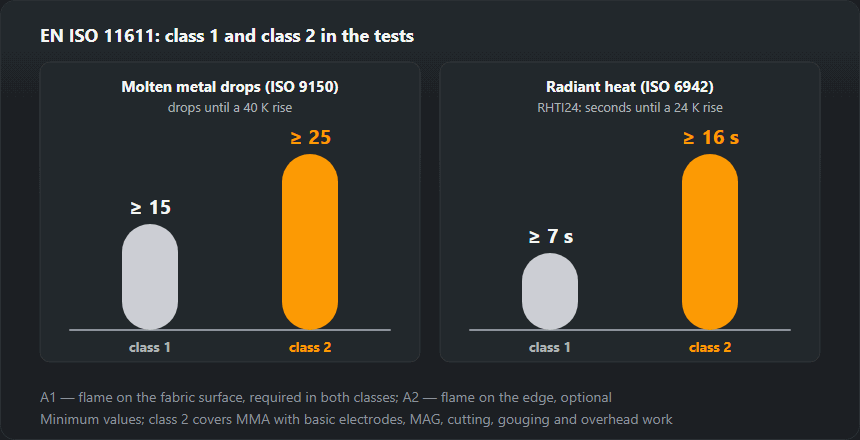
How to read it. Class 2 takes two thirds more drops (25 instead of 15) and protects against radiant heat for more than twice as long (16 s instead of 7). Both classes pass the same flame spread test: A1 means flame applied to the fabric surface and is mandatory, A2 means flame applied to the edge and is optional. A2 matters at the hems of trouser legs, sleeves and jacket fronts, where a spark lands exactly on the edge of the material. A label reading “EN ISO 11611 class 2 A1+A2” is therefore the fullest version of the standard.
A worked choice. A welder does MAG on structural steel in the morning (180 A) and TIG on stainless in the afternoon. The class follows the heavier job: MAG is class 2, so the whole kit is class 2. The reverse does not work — a class 1 jacket on MAG burns through within weeks on the forearms and chest, where most spatter lands.
EN ISO 11611 vs EN ISO 11612: the difference
Both are flame-retardant clothing standards, but they protect against different things. EN ISO 11611 is written for welding: small drops of metal, brief flame contact, radiation from the arc. EN ISO 11612 covers work with heat and flame in general — steelworks, foundries, furnaces — and describes protection with letter codes and levels:
- A1/A2 — limited flame spread (as in 11611);
- B1–B3 — convective heat;
- C1–C4 — radiant heat;
- D1–D3 — molten aluminium splash;
- E1–E3 — molten iron splash;
- F1–F3 — contact heat.
The practical conclusion: clothing with EN ISO 11612 alone is not welding clothing, because it has not passed the small-drop test to ISO 9150 that 11611 requires. A jacket carrying both standards is fit for welding and for work at a furnace or pouring metal, where the D and E codes count. Labels also show EN 1149-5 (electrostatic properties) and IEC 61482-2 (electric arc flash in electrical work) — separate hazards that have nothing to do with welding.
Material: leather, flame-retardant cotton, blends
Leather copes best with heavy spatter and heat, which is why aprons, sleeves, overhead capes and gloves are made of it. It is heavy and hot, so a full leather suit is the exception. Flame-retardant treated cotton is the usual jacket and trouser fabric: it breathes and is cheap, but the treatment lasts a number of washes stated by the maker. Blends with inherently flame-resistant fibres (aramid, modacrylic) do not lose their properties in the wash, and are lighter and dearer. Whatever the material, what makes it fit for welding is the standard and class on the label, not how the cloth looks.
Gloves: reading EN 12477, EN 388 and EN 407
A welding glove to EN 12477 must have mechanical test results (EN 388), thermal test results (EN 407) and meet the general glove requirements (formerly EN 420, now EN ISO 21420). Type A has to reach higher thermal and mechanical levels, type B higher dexterity. Reading the markings on a typical stick welding gauntlet:
- EN 388 “3122X” — abrasion 3, cut 1, tear 2, puncture 2; X means that test was not done.
- EN 407 “413X4X” — burning behaviour 4, contact heat 1, convective heat 3, radiant heat not tested, small splashes 4, large splashes not tested.
For a welder the key figure is the fifth digit of EN 407 — small splashes of molten metal. For MMA and MAG look for a high value there and a long cuff. For TIG what matters more is a thin glove that fits: an oversized type B glove means less feel for the rod and more dipping of the tungsten into the pool.
How to wear welding clothing
- Collar closed. With TIG and MIG on aluminium an open neck gets UV-burnt in a single shift.
- Sleeve over the gauntlet cuff. Spatter runs down the sleeve and off the outside of the glove, not into it.
- Pocket flaps closed. A pocket open at the top collects globules and holds them against the body.
- Trousers over the boots, no turn-ups. A turn-up catches a globule at the ankle — the classic welder's burn.
- Jacket overlapping the trousers. Bending over must not open a gap at the waist.
- Nothing flammable in the pockets. Butane lighters, matches and paper notes stay in the locker.
Washing, repair and when to retire welding clothing
Wash to the care symbols on the label, because only under those conditions does the manufacturer declare that the protection is kept. Wash oily or greasy clothing straight away: grease burns whether or not the fabric is flame-retardant. Repair with a patch of fabric with the same properties and flame-retardant thread; a denim or synthetic patch makes a hole in the protection.
Retire clothing when:
- it has burn-through holes or worn patches you can see through;
- the fabric is scorched, stiff or brittle;
- oil contamination does not wash out;
- it has passed the number of washes the manufacturer states;
- zips and fastenings no longer hold, so it cannot be worn closed.
Dry leather gloves away from the heater — leather overheated while wet hardens, shrinks and cracks. A glove with a burn-through or a split seam is replaced at once. Across the EU the employer provides this equipment free of charge (Directive 89/656/EEC); in Poland it must also launder and repair it (article 2379 § 2 of the Labour Code).
Common mistakes with welding clothing and gloves
- Fleece or a polyester T-shirt under the jacket. The most common winter mistake — the jacket burns through at one point, the burn from molten synthetic covers a large area.
- Sleeves rolled up in the heat. UV and spatter on the forearms.
- One pair of gloves for everything. A heavy type A gauntlet ruins rod control on TIG; a thin type B lets heat through within minutes on MMA.
- A polyester hi-vis vest on top. It melts; on site look for high-visibility clothing that also meets EN ISO 11611.
- A class 1 jacket for gouging and cutting. Annex A calls for class 2 there.
- Wet gloves when welding in the damp. The insulation is gone.
The rest of the kit
Eye protection and choosing the shade — the welding helmet and the DIN shade calculator. The respiratory protection that clothing cannot replace — masks and powered air. The whole kit in one place — personal protective equipment.
Frequently asked questions
Will ordinary workwear do for welding?
No. Welding clothing has to meet EN ISO 11611 — the point is that the fabric must not sustain a flame and that spatter must not lodge in it. Plain cotton overalls burn, and polyester melts and sticks to the skin; a burn from molten synthetic heals worse than one from the spatter itself.
What is the difference between a type A and a type B glove?
Heat resistance against feel. EN 12477 splits welding gloves into type A — thicker, for MMA and MAG where there is more spatter — and type B, thinner and more sensitive, for TIG, where the filler is fed with the fingers. Type B on covered electrodes means burnt hands; type A on TIG means filler on the floor.
What do the digits on a glove mean?
The four digits under the hammer pictogram are EN 388: abrasion, cut, tear and puncture — higher is better, usually on a 0–4 or 0–5 scale. The six digits under the flame are EN 407: burning behaviour, contact heat, convective heat, radiant heat, small splashes and large quantities of molten metal. For a welder the last two matter most.
What do A1 and A2 mean on welding clothing?
They are the flame spread test methods of ISO 15025. A1 — flame applied to the fabric surface, mandatory for EN ISO 11611. A2 — flame applied to the edge, optional, and relevant at the hems of sleeves and trouser legs. “A1+A2” means the fabric passed both.
Class 1 or class 2 for MIG/MAG?
For MAG, class 2: Annex A of EN ISO 11611 puts MAG under CO₂ and mixed gas, high-current MIG and flux-cored wire among the high-spatter processes. Class 1 is enough for low-current MIG and for TIG. In the test class 2 takes at least 25 drops of molten metal instead of 15.
Is EN ISO 11612 clothing suitable for welding?
Not on its own. EN ISO 11612 protects against heat and flame in general (codes A–F) but does not include the welding spatter tests EN ISO 11611 requires. For welding you need 11611; many jackets carry both on the label.
How should welding clothing be washed?
To the care symbols on the label, and straight away when it is oily — grease burns even on flame-retardant fabric. Treated cotton keeps its properties for the number of washes the maker states. Patch only with flame-retardant fabric and thread.
Updated: