Electrical safety in welding
A welding set is a high-current source with an exposed electrode, operated by someone holding metal while standing on metal. The voltages are low by industrial standards and they kill welders every year.

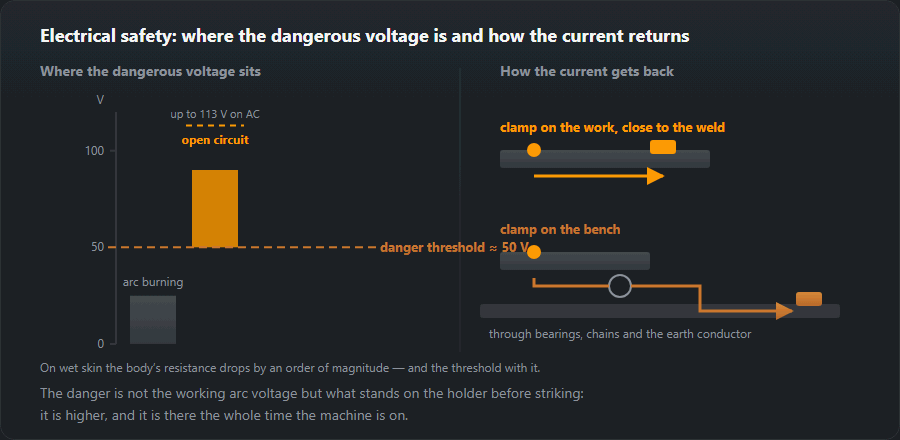
The voltage that matters
Two figures. Welding voltage is 15–35 V while the arc is burning — genuinely low. Open-circuit voltage is what sits on the electrode before the arc strikes: 50–90 V on a DC inverter, up to 80 V rms (113 V peak) on an AC transformer.
The dangerous threshold is around 50 V, and it falls with wet skin. Dry skin has a resistance of some tens of kilohms; wet skin has a few hundred ohms. The same voltage that is a mild shock in a dry workshop in March is a lethal one in a humid tank in August.
Situations with increased risk
EN 60974-1 defines them, and machines suitable for them carry the S marking — for AC that means a reduced open-circuit voltage (limits below):
- Confined conductive spaces — tanks, vessels, ducts, pipes.
- Restricted spaces where the body is in contact with conductive parts on several sides.
- Wet, damp or hot environments where clothing is soaked with sweat.
In these conditions: an S-marked machine, dry insulating mats, insulated gloves in good condition, and someone outside who can cut the power. Never work alone.
The return circuit
The return path is the half of the circuit nobody looks at, and it causes three separate problems when it is wrong.
A poor connection wastes voltage, so the arc gets less than the machine sent — the symptom is a weak arc and a sticking electrode.
Stray current finds another path. If the clamp is on a bench rather than the work, the return current will travel through whatever conducts: a bearing, a hinge, a wire rope, another machine's earth. Bearings destroyed by welding current are a well-known failure and an expensive one.
A hot clamp is a fire risk. A resistive connection at 200 A dissipates real power at exactly the point where nobody is looking.
So: clamp directly to the workpiece, on ground-bright metal, as near to the joint as you can get.
The equipment
- Leads. Inspect before use. Cuts in the insulation, exposed copper at the connectors, taped repairs — all of them need fixing rather than noting.
- The electrode holder. Insulated, undamaged, and never tucked under an arm or left on the bench with an electrode in it while the machine is live.
- Cable size. Undersized cable overheats along its length — see the cable calculator.
- The supply. RCD protection on the mains side. An RCD that trips is reporting a real fault; find it rather than resetting it — the causes are listed in why your welder trips the breaker.
The habits that matter
Switch off before changing an electrode in a risky environment. Do not weld in wet clothing or standing in water. Keep dry insulating material between you and the workpiece where you can. And treat the electrode as live at all times, because between arcs it is.
What open-circuit voltage the standard allows
EN IEC 60974-1 limits the open-circuit voltage of arc welding power sources, and the UK HSE guidance HSG118 on electrical safety in arc welding repeats the same figures:
- Normal conditions: DC up to 113 V peak, AC up to 80 V rms.
- Increased risk of electric shock (S marking): DC still up to 113 V peak, but AC only up to 48 V rms.
The gap between DC and AC is deliberate: at the same voltage, alternating current is more dangerous to the heart. That is why tank and vessel work calls for an S-marked DC machine, and an AC transformer without voltage reduction stays in the workshop.
VRD — voltage reduction at the holder
Some welders have a VRD (voltage reduction device). Until the electrode touches the work, the holder carries a voltage reduced to a safe level; full open-circuit voltage appears only as the arc strikes. For work in damp conditions, on structures and in tight spaces, that is real protection in the most common shock scenario — changing a rod.
How to check: the manual or the rating plate names VRD outright, and there is often an indicator lamp. With VRD on, striking can be slightly harder — a price worth paying.
Does an RCD protect the welder? Only on the mains side
A 30 mA RCD on the socket circuit protects against mains voltage: a damaged supply lead, a fault to the casing. The welding circuit is galvanically separated from the mains, so current flowing through your body from holder to workpiece never passes through the RCD — it cannot see it.
A simple Ohm’s-law sum shows the scale: 80 V across a body resistance of the order of 1000 Ω is 80 mA, many times the 30 mA that would trip an RCD on the mains. Against open-circuit voltage, only insulation (dry gloves, boots, a mat), an S-marked machine or VRD, and habits protect you.
MIG/MAG, TIG and MMA: where else the voltage sits
- MIG/MAG: with the trigger pressed, not only the contact tip but the whole wire is live — the spool and the feed rolls included. Switch the machine off before sorting out the wire in the feeder.
- TIG with HF start: the high-frequency pulse can bite through a glove and disturbs nearby electronics. Keep leads short and together, not in loops.
- MMA: the holder with a rod in it carries open-circuit voltage the whole time the machine is on — never rest it on the work or on a wet floor.
A five-minute check before work
- Supply lead and plug: no cracks, no signs of melting.
- Welding leads along their full length: no wear down to copper, no taped repairs.
- Holder and earth clamp: insulation intact, spring holds, contact clean.
- Connectors on the machine turned fully home.
- Gloves and boots dry, floor dry or covered with a mat.
- In a tank or in the wet: an S-marked machine and a standby person outside.
Good gloves and clothing are a subject of their own — see welding PPE.
If someone gets a shock
- Cut the power first — at the machine switch or the distribution board. Do not touch the casualty while the circuit is live.
- Call for help: 112 across Europe, 999 in the UK.
- If they are not breathing, start CPR and keep going until help arrives.
- After any shock, get a medical check — especially after loss of consciousness, chest pain or palpitations. Heart rhythm problems can appear later.
Common mistakes
- Changing a rod bare-handed with the machine on.
- Working in sweat-soaked gloves — wet skin inside wet leather is almost no insulation.
- Sitting on the structure being welded without a mat.
- An extension lead through a puddle and a plug lying in water.
- Welding in a confined space alone. The ventilation side of it is covered in welding fumes.
Frequently asked questions
Welding voltage is low. Is it actually dangerous?
Yes. Open-circuit voltage is typically 50–90 V DC and can reach 80 V rms (113 V peak) on AC machines, and the danger threshold is about 50 V — lower when the skin is wet. Sweat drops skin resistance by orders of magnitude, and a welder in summer is a welder with wet skin.
What does the S marking on a machine mean?
That the machine may be used in environments with an increased risk of electric shock — confined spaces, damp locations, work where the body is in contact with the structure. For AC it means open-circuit voltage cut to 48 V rms; DC stays within 113 V peak. Without that marking, a machine should not be used in those conditions.
Where should the earth clamp go?
Directly on the workpiece, as close to the joint as practical, on bare metal. Not on the bench that the work is resting on, and never anywhere that lets the return current find its way through a bearing, a hinge or another machine — that path damages what it passes through.
Does an RCD protect me from a shock off the electrode holder?
No. A 30 mA RCD protects against mains voltage — a damaged supply lead or a fault to the casing. The welding circuit is separated from the mains, so current flowing through you from holder to workpiece will not trip it. There, insulation, an S-marked machine or VRD protect you.
What open-circuit voltage is allowed in a tank or confined space?
Under EN IEC 60974-1, in conditions of increased shock risk DC may reach 113 V peak but AC only 48 V rms. Such power sources carry the S marking. In normal conditions AC up to 80 V rms is permitted.
What is VRD on a welder?
A voltage reduction device: until the electrode touches the work, the holder carries a voltage reduced to a safe level, and full open-circuit voltage appears only at the strike. It protects during rod changes, which is where most shocks happen.
Updated: