Why your welder trips the breaker
Four separate causes, and they are told apart by when the breaker goes: at switch-on, at the first arc strike, after a few minutes, or only on long runs.
Trips at switch-on: inrush current
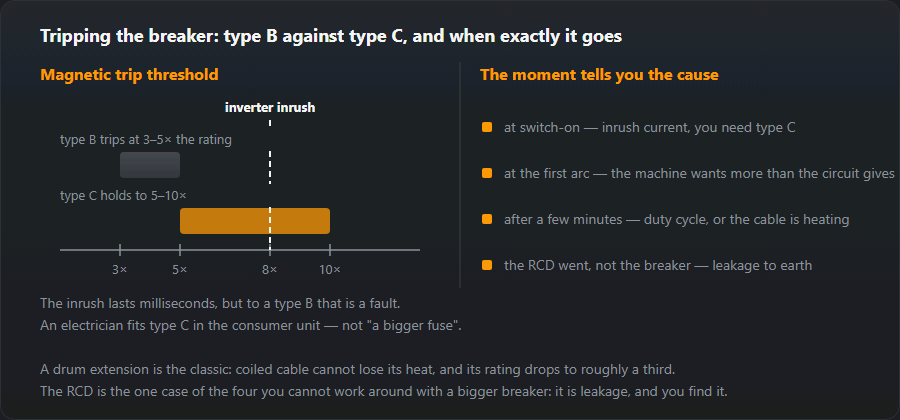
An inverter charges a bank of capacitors the instant it is powered up, and for a few milliseconds it draws far more than its rated current. A type B breaker, designed for lighting and sockets, trips at three to five times its rating and sees that as a fault.
The fix is a type C breaker, which tolerates five to ten times the rating briefly. It is a change an electrician makes to the consumer unit; it is not something to work around by using a bigger fuse of the wrong curve.
Trips at the first arc: the machine wants more than the circuit
The welding current is not the input current. A 200 A inverter running at full output on a single phase draws roughly 30 A from the wall — more than a standard 16 A domestic circuit can give.
Work out the real figure with the duty cycle and fuse calculator. If the machine genuinely needs 30 A, the honest answers are a dedicated circuit, a three-phase supply, or welding at lower current with a smaller electrode.

| Curve | Trips at | Suits welding |
|---|---|---|
| B | 3–5 × rated current | No — it trips on the inrush surge |
| C | 5–10 × rated current | Yes — the usual choice for a workshop |
| D | 10–20 × rated current | For heavy machines — specified by the electrical design |
Trips after a few minutes: duty cycle or cable heating
Two possibilities. Either the machine's own thermal protection is cutting in, which is the duty cycle doing its job and not a fault at all — the fan will be running and it will reset in a few minutes. Or the supply cable is undersized, warming up, and the breaker is responding to that.
Tell them apart by feeling the extension lead. A cable that is warm along its whole length is undersized. A drum extension is the classic case: a cable coiled on a drum cannot lose its heat, and its rating drops sharply — the reel carries two ratings, coiled and uncoiled, and the coiled one is far lower. Unwind it fully, every time.
Trips the RCD rather than the breaker
Different fault, different cause. An RCD responds to current leaking to earth, not to overload. Damp, a damaged lead, water on the floor or moisture inside the machine will do it — and unlike the others, this one is a genuine safety warning. Do not keep resetting it: find the leakage. The reasoning is in electrical safety in welding.
On a generator
A generator sized to the welder's rated output will still struggle with the inrush. Allow about 30 % margin, prefer an inverter-type generator with a clean waveform, and expect a cheap generator and a cheap inverter together to be an unhappy combination — the welder's power factor correction and the generator's regulation fight each other.
How many amps a welder pulls from the socket — worked figures
The figures below come from our duty cycle and fuse calculator for an MMA inverter on 230 V, 85 % efficiency and a power factor of 0.95. It takes the arc voltage from the conventional EN 60974-1 formula U2 = 20 + 0.04·I2. The rod currents are the middle of the range in our welding current table.
- 2.5 mm rod at 85 A — about 23.4 V at the arc, about 2.3 kW from the mains, so about 10.7 A. An ordinary 16 A socket circuit carries that without complaint.
- 3.2 mm rod at 115 A — about 3.3 kW and about 15.2 A. A 16 A circuit is at its limit: a kettle on the same circuit is enough to trip it.
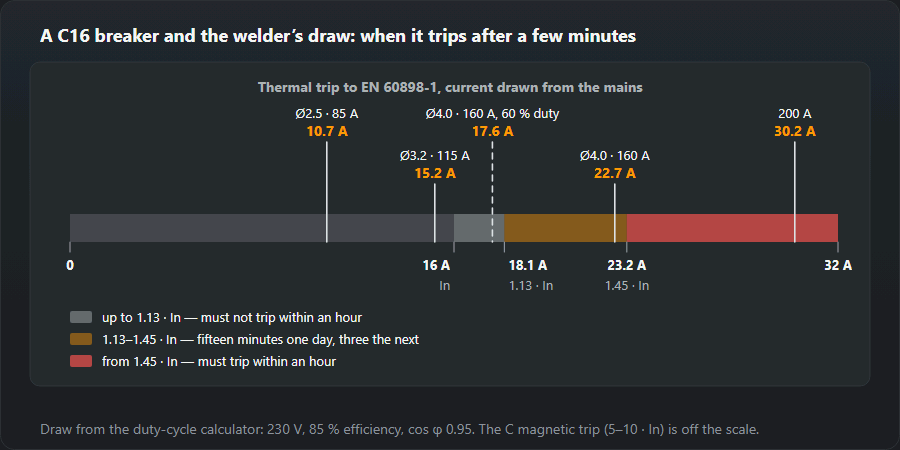
- 4.0 mm rod at 160 A — about 5.0 kW and about 22.7 A. A domestic 16 A circuit will not hold that through continuous welding.
- The full 200 A — about 6.6 kW and about 30.2 A from a single phase. The same power from a 400 V three-phase supply is about 10 A per phase, which is why the bigger machines are three-phase.
How to read these numbers: they are the draw while the arc is burning (I1max at that current). Your machine’s data plate may show different values because its efficiency and power factor correction differ — the plate always wins. In the UK, remember that a 13 A plug fuse sits in front of the circuit breaker; a machine that needs more than that belongs on a 16 A or 32 A industrial socket, not a household plug.
Why it trips “after a few minutes”: 1.13 and 1.45
EN 60898-1 sets two thermal thresholds for miniature circuit breakers: at 1.13 times the rating the breaker must not trip within an hour, and at 1.45 times the rating it must trip within an hour. For a C16 that is 18.1 A and 23.2 A. Between the two lies a band where the trip time depends on how warm the consumer unit is and how loaded the circuit was before.
A 4.0 mm rod drawing about 22.7 A lands squarely in that band: one day the breaker holds for a quarter of an hour, the next it lets go after three minutes. In normal work with pauses — changing rods, chipping slag — the thermal element sees an averaged current, which the calculator shows as I1eff = I1max·√duty. At 160 A and 60 % duty that comes to about 17.6 A, and the calculator suggests a C20.

The extension lead in numbers
Voltage drop on a supply lead is worked out exactly like drop on a welding cable: ΔU = 2·ρ·L·I / S (copper ρ = 0.0175 Ω·mm²/m, and the current goes out and back). For a draw of 22.7 A:
- 25 m of 1.5 mm² — about 13.2 V lost (5.8 %) and about 300 W of heat in the lead itself.
- 25 m of 2.5 mm² — about 7.9 V (3.5 %) and about 180 W.
- 50 m of 2.5 mm² — about 15.9 V (6.9 %).
An inverter draws roughly constant power, so at a lower voltage it pulls more current: a few percent of drop means a few percent more amps through the breaker. The same arithmetic is done by the voltage drop calculator.
Hot start, arc force and other loads on the same circuit
Hot start adds current for a fraction of a second as the arc strikes; arc force raises the current when the arc gets short. Both push up the peaks drawn from the mains. If the breaker goes exactly on the strike and the machine has these settings in its menu, turn hot start down and try again — it is a free test.
The other usual culprit is the neighbours on the circuit. A compressor starting its motor, an oil-filled heater, a mate’s angle grinder — they all add up on the same breaker. In a garage the welder wants a socket on its own circuit, or at the very least to be the only big load running while you weld.
Common mistakes
- “A bigger breaker” without checking the cable — the breaker protects the wiring, so that is a fire risk, not a repair.
- Swapping a B16 for a C20 in one go. Changing the curve is safe at the same rating; changing the rating needs the cable assessed.
- Welding off a half-unwound drum. The coiled rating applies until the last turn is off.
- A generator with no headroom. Generator output is sized with margin — see the generator size calculator.
- Resetting the RCD again and again. Every time it is warning about the same leak.
What to have ready for the electrician
- A photo of the welder’s data plate: U1, I1max, I1eff, number of phases.
- The marking on the breaker in the consumer unit (e.g. “B16”) and the RCD type.
- Cross-section and length of any extension lead.
- When it trips: at switch-on, on the strike, or after some minutes.
- What else runs on that circuit.
With that, an electrician can tell in a few minutes whether a change of curve is enough or whether you need a dedicated circuit or a three-phase socket. If you are still choosing a machine, check its input current before you buy — the guide to choosing a welding machine covers it.
Frequently asked questions
Type B or type C breaker?
Type C. An inverter draws a large inrush current when it switches on, charging its internal capacitors, and a type B curve trips on exactly that. Type C tolerates the inrush and still protects the cable. This is a job for an electrician, not a heavier fuse.
Can I just fit a bigger breaker?
Not without checking the cable. The breaker protects the wiring, not the welder: fitting a 25 A device on a circuit wired for 16 A removes the protection and leaves the cable to overheat inside a wall. If the machine genuinely needs more, the circuit needs upgrading.
It only trips after ten minutes of welding.
Then it is thermal, not inrush, and the machine is probably being run above its duty cycle — or the supply cable is undersized and warming up. Work out the real input current and duty cycle with the duty cycle calculator.
Will a 200 A welder run on a 16 A circuit?
With a 2.5 mm rod, yes: the draw is about 11 A. With 3.2 mm (about 15 A) it is at the limit, provided nothing else runs on the circuit. With 4.0 mm the draw rises to about 23 A and a 16 A breaker will trip after a few minutes. The full 200 A is about 30 A from one phase — a dedicated circuit or a three-phase supply.
It trips when I strike the arc, not at switch-on. Why?
The current peak at the start of the arc, boosted by hot start. First check whether the breaker is a type B, and turn hot start down in the machine menu. If that does not help, the circuit is too weak or another large load is running on it.
What size extension lead does a welder need?
At a draw of about 23 A, 25 m of 1.5 mm² loses about 13 V and dissipates about 300 W; 2.5 mm² loses about 8 V. Use 2.5 mm² or heavier, as short as possible, and always fully unwound from the drum.
Updated: