How to choose a welding machine
Four numbers decide whether a machine suits the work: maximum current, duty cycle, supply requirement and what the arc control offers. Everything else on the box is marketing.

Maximum current
Work backwards from the thickest single-pass weld you expect to make: about 40 A per millimetre. Thicker material is welded in several passes, so 5 mm plate does not need 200 A — but a machine at the very top of its range all day is a machine that spends half its time in thermal shutdown.
The current calculator gives the figure for the electrode diameters you intend to use, which is a more honest starting point than the plate thickness alone.
| Metal thickness | Electrode | Current | Machine from |
|---|---|---|---|
| up to 3 mm | 2.0–2.5 mm | 50–100 A | 140 A |
| 3–6 mm | 3.2 mm | 90–140 A | 160 A |
| 6–12 mm | 4.0 mm | 130–190 A | 200 A |
| from 12 mm | 4.0–5.0 mm | 180–250 A | 250 A, three phase |
Duty cycle — the number that gets exaggerated
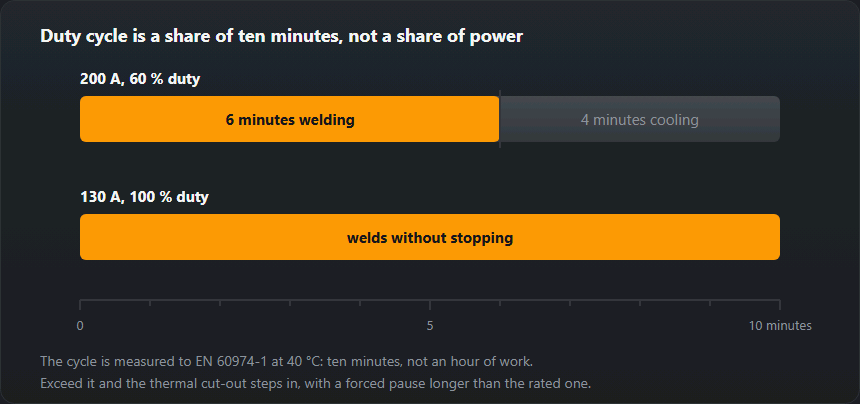
"200 A" on the front of the box usually means 200 A at 20 % duty cycle: two minutes of welding in every ten. What matters is the current at 60 %, and that figure is on the rating plate rather than the box.
Duty cycle also depends on ambient temperature — the plate figure is measured at 40 °C, and a machine in a hot workshop in August will do worse. The duty cycle calculator converts between currents and shows what supply the machine really needs.
The supply
The input current is not the welding current: a 200 A single-phase inverter draws around 30 A from the wall, which a standard domestic circuit cannot provide. Before buying, work out the input current and check what the building can give. A machine that can only be run at half output is a machine half bought.
Two practical points. Use a type C breaker, because the inrush of an inverter trips a type B. And if the machine will run off a generator, allow about 30 % margin — see why your welder trips the breaker.
Which features earn their price
Worth paying for. Hot start and arc force on an MMA machine — they turn a difficult basic electrode into an easy one. A proper wire feed unit with metal drive rolls and adjustable pressure on a MIG. HF start and a foot pedal or slope control on TIG. And AC output if you will ever weld aluminium, because without it you cannot.
Worth less than the price suggests. Synergic programs, which are useful when they match your wire and gas and misleading when they do not. Digital displays showing preset rather than measured values. And "IGBT" on the front panel, which describes a component every modern inverter contains.
The parts nobody photographs
The leads, the electrode holder, the earth clamp and — on a MIG — the torch are what you actually hold, and cheap machines save money there first. A machine supplied with 2 metres of thin lead and a stamped-tin clamp will feel weak regardless of what is inside it: the reason is in the cable size calculator.
Check spares availability too. Contact tips, liners and nozzles are consumables, and an orphaned machine whose torch parts nobody stocks is scrap long before it stops working.
Start with the socket: what welding current your circuit allows
Before comparing welders, check what the wiring will carry. Using the model in the duty cycle calculator (MMA inverter, 230 V, 85 % efficiency, power factor 0.95), the mains draw equals the circuit rating at these welding currents:
- 16 A circuit — about 120 A of welding;
- 20 A circuit — about 145 A;
- 25 A circuit — about 170 A;
- 32 A circuit — about 210 A.
Those figures are for an arc burning without a break. In normal work with pauses to change rods, the breaker sees an averaged current, so you can weld higher for short spells — but if you plan long runs with 4.0 mm rods (130–190 A), an ordinary 16 A socket will not do, whatever the welder can deliver.
Three typical set-ups
Garage: steel up to 6 mm, a 16 A socket
2.5 and 3.2 mm rods (70–140 A). The table above points to a 160 A machine. On a 3.2 mm rod at 115 A the inverter draws about 15 A — within a 16 A circuit if nothing else runs on it. A 2.5 mm² extension, fully unwound. A helmet with a 9–13 range is enough: these rods need shade 11.
Site work: 6–12 mm structures, generator power
4.0 mm rods (130–190 A), a machine from 200 A. At 190 A the draw is about 28 A from one phase, at the full 200 A about 30 A — that means a 32 A circuit or three-phase. On a generator, a PFC inverter needs about 9 kVA of continuous output, one without PFC about 12.5 kVA — details in the generator size calculator. This is where PFC and a wide supply-voltage range genuinely pay back.
Fabrication shop: heavy sections, three-phase supply
4.0–5.0 mm rods (180–250 A), a three-phase machine from 250 A. At 250 A the calculator shows about 13.4 A per phase — less than a small single-phase welder draws from one phase at 160 A. Welding leads: at 250 A and 10 m that is 25 mm², at 20 m already 50 mm² — see the cable size calculator.
Comparing two offers step by step
- Bring the duty cycle to 100 %. “200 A at 20 %” is about 89 A continuous, “160 A at 60 %” about 124 A.
- Check the duty-cycle test temperature: EN 60974-1 requires 40 °C.
- Compare I1max and I1eff with what your circuit gives (list above).
- PFC and supply-voltage range — important on a generator or a weak supply.
- IP rating — at least IP23 for outdoor work.
- Leads in the box: compare their section and length with the cable table — thin leads eat part of the output.
- Service and parts: can you get holders, tips and connectors where you live?
Budget: where not to save
- Current and duty-cycle headroom. A welder working at half its capacity runs cooler and lasts longer.
- The helmet. Optical class 1/1/1/1 or 1/1/1/2 and a range that covers your processes — see the welding helmet.
- Leads and earth clamp. A cheap clamp and a thin return lead are voltage drop no electronics can fix.
- A cylinder and regulator for MIG/MAG — without gas you are left with self-shielded flux-cored wire: better in wind, but with slag and more fume.
Common buying mistakes
- Buying on maximum current rather than duty cycle.
- Ignoring the wiring — a 200 A welder on a 16 A socket gives about 120 A in continuous work.
- A DC-only machine for aluminium. TIG on aluminium needs AC.
- No budget for protection — helmet, gloves and jacket are part of the kit, not an afterthought.
- No maintenance plan. Dust in the heatsink shortens the real duty cycle — see maintenance and faults.
Frequently asked questions
How many amps do I actually need?
Roughly 40 A per millimetre of the thickest material you will weld in one pass. For a home workshop up to 5 mm, a 160 A machine is enough; for 10 mm structural work, 200 A; beyond that you are into three-phase territory. Buying 250 A "to be safe" on a 16 A domestic supply buys you a machine you cannot run at full output.
Is a cheap inverter worth it?
For occasional light work, often yes. What you give up is duty cycle, the honesty of the rating plate, arc control features and the availability of spares in three years. What you must not give up is a CE mark and compliance with EN 60974-1 — that is the safety standard, not a marketing one.
Multi-process or single?
A combined MIG/TIG/MMA machine is genuinely useful if you will use all three. If you will really only use MIG, a dedicated MIG set at the same price will have a better wire feed unit — and the feed unit is what determines whether the machine is pleasant to use.
What welder can I run on a 16 A socket?
In continuous welding a 16 A circuit carries about 120 A of welding current (MMA inverter, by our duty cycle calculator). That covers 2.5 and 3.2 mm rods. A 160–200 A machine on such a socket makes sense as duty-cycle headroom, but you will only use its maximum in short bursts.
Does a 250 A welder need three-phase?
In practice, yes. At 250 A an MMA inverter draws about 40 A from a single 230 V phase, but about 13 A per phase from a 400 V three-phase supply. That is why machines of this class are three-phase.
How do I compare welders with different duty cycles?
Convert both to 100 %: I₁₀₀ = I·√X. “200 A at 20 %” gives about 89 A continuous, “160 A at 60 %” about 124 A. Also check the duty cycle is quoted at 40 °C, as EN 60974-1 requires.
Updated: