Welding machine servicing and typical faults
Almost everything that goes wrong with a welding set is dust, a loose connection or a consumable. The genuinely broken machine is the rare case, and it is the one worth ruling out last rather than first.
Routine servicing
Blow the dust out. Quarterly in a clean shop, monthly where grinding happens. Unplug the machine and leave it standing for a few minutes first — the capacitors inside an inverter hold a charge after the power is off. Use compressed air at moderate pressure; high pressure drives dust further in and can spin the fan hard enough to damage it.
Check the leads and connections. Bayonet connectors work loose, and a loose connector heats up. Run a hand along the leads and over the connectors after a session — anything warm is a resistance you are paying for at the arc.
Look at the earth clamp. The spring weakens, the jaws burn, the contact area shrinks. It is the cheapest part of the circuit and the most frequent hidden cause of a weak arc.
MIG only: change the contact tip, clean the nozzle, blow the liner through at every spool change — see torch consumables.
The common faults

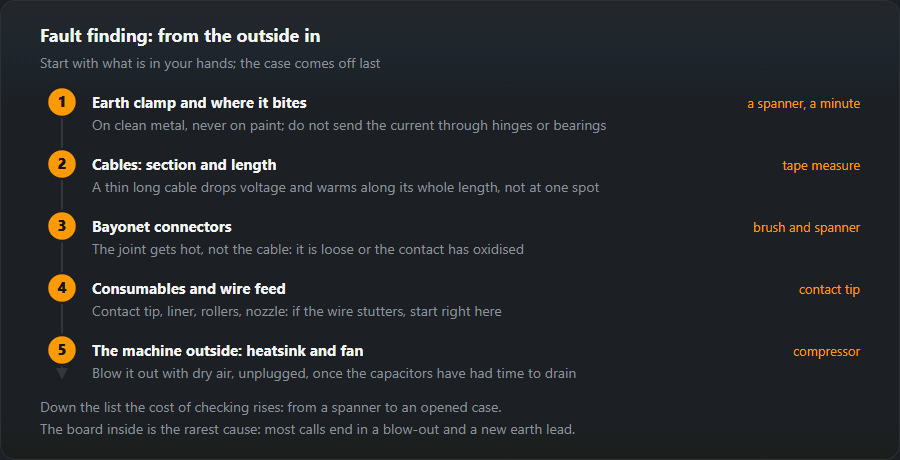
The pattern is that most rows point outside the machine. Working from the outside in — clamp, leads, connectors, consumables, then the machine — resolves the great majority without opening anything.
| Symptom | Look at |
|---|---|
| Will not strike | Earth clamp, polarity, a break in the holder, a damp electrode |
| Cuts out after a few minutes | Duty cycle exceeded, blocked vents, dust-clogged interior, ambient temperature |
| Weak arc at rated current | Earth clamp, cable size, connectors, supply voltage under load |
| Unstable arc, wandering current | Contact tip (MIG), loose connector, dirty tungsten (TIG) |
| Trips the supply | Breaker curve, circuit rating, coiled extension drum |
| Trips the RCD | Damp, damaged lead, moisture inside the machine — a genuine fault, not a nuisance |
| A connector runs hot | Tightness, an oxidised contact face |
| Erratic wire feed | Liner, feed rolls, contact tip |
Storage and transport
Damp is the enemy of stored equipment. A machine that has spent a winter in an unheated van needs several hours at room temperature before being switched on, because condensation inside a powered-up inverter is how power sections die.
Coil the leads loosely rather than tightly, and do not hang the machine by its torch. A MIG torch supports its own liner, and a machine hanging from it is bending that liner at the worst possible point.
An inverter contains capacitors charged to several hundred volts that stay charged after unplugging. Blowing dust out through the vents is maintenance; opening the case and probing the board is not, unless that is your trade.
The wire feeder: drive rolls, tension, liner
On a MIG set, half of all “welder faults” are really the wire path from the spool to the contact tip. Check it in this order, because each step needs more dismantling than the one before:
- Spool brake. Too slack and the spool overruns when the trigger is released, throwing wire off the reel; too tight and the feed motor labours while the wire slips in the rolls.
- Drive rolls. The groove must suit the wire size and type: V for solid steel, U for aluminium, knurled for flux-cored. The size stamped on the roll must match the spool — a 1.0 roll will not grip 0.8 mm wire and it slips.
- Tension. Just enough that the wire stops slipping when you hold it with a gloved hand at the torch outlet. Tension wound “all the way” flattens the wire, which then snags in the liner and tip, and aluminium simply gets crushed.
- Liner. With the tip removed, the wire should push through the torch by hand without noticeable resistance. If it drags, blow the liner out from the feeder end, and if that does not help, replace it. Steel liner for steel, PTFE or graphite for aluminium.
When fitting a new liner, measure the length with the torch cable laid straight. Too short leaves a gap in the connector where the wire kinks; too long snakes inside the cable and brakes the wire. The torch consumables are covered in MIG/MAG torch consumables, and the usual feed symptoms in wire feed problems.
Gas system: leaks and flow
A leak in a hose or fitting does more than waste gas. A hose with a leaking fitting draws air in by venturi effect and gives porosity even though the flowmeter reads correctly. The check takes five minutes:
- open the cylinder, shut off flow at the torch and brush the joints with water and washing-up liquid — bubbles show the leak;
- inspect the hose along its length, especially next to the fittings, where it cracks first;
- check the flow with the gas-test button on the feeder, not by ear.
How much gas should flow for a given nozzle and current is worked out by the shielding gas consumption calculator.
Coolers on water-cooled torches
A water-cooled torch overheats not because it is undersized but because the coolant is not circulating. Before the shift, check the level in the tank and that coolant returns into it in a steady stream. Fill with the coolant recommended by the equipment maker, not tap water: scale blocks the torch’s fine passages, and plain water freezes in an unheated shop and splits the hoses.
Periodic electrical inspection
Blowing out and tightening connectors is maintenance. Safety testing is covered by a separate standard — EN IEC 60974-4, on periodic inspection and testing of arc welding equipment. It includes visual inspection, protective conductor continuity, insulation resistance, leakage currents, no-load voltage and a functional test. It is done by someone with electrical competence and the right instruments; the interval is set by the employer’s risk assessment or by the manufacturer’s manual. Record the result on the machine’s card with the date of the next test, so nobody has to remember it.
Worked example: the MIG started crackling and the wire stutters
The symptom: an uneven arc, the wire speeds up and stalls, spatter balls stuck to the tip. The order in which to look for the cause:
- Contact tip. Bore worn oval — replace it. It costs pennies and clears half of these complaints.
- Earth. Clamp on clean bare metal, connector tight.
- Rolls and tension. Groove to suit the wire, tension set by the glove test.
- Liner. Push the wire through by hand with the tip off; if it drags, blow out or replace.
- Spool brake and the wire itself. Rusty wire from a spool kept in the damp will not run smoothly through any feeder.
Only when all five are right and the problem remains is it worth taking the set in for service — and then write down what has already been checked.
Mistakes that shorten a welder’s life
- Blowing out at full pressure from close up. The jet drives dust under components and can ruin the fan bearing.
- Grease or oil in the liner. It collects dust and swarf, and a week later the wire feeds worse than before the “service”.
- Running off a coiled extension reel. An unwound reel heats up and drops the voltage — the same issue appears in the fault table under the breaker row.
- Opening the case under warranty. Do the five external checks first; a broken seal over a clogged heatsink loses the warranty for nothing.
Frequently asked questions
How often should the machine be blown out?
Every three months in a clean shop, monthly where there is grinding dust. Conductive dust inside an inverter is what kills them: it bridges tracks on the board and shorts the power section. Compressed air at low pressure, with the machine unplugged and left to stand — capacitors hold a charge.
The machine shuts down after a few minutes and the fan keeps running.
That is the thermal protection working correctly, not a fault. Either the duty cycle is being exceeded or the air path is blocked. Check that nothing is against the vents and that the filter is clean, then work out the real duty cycle with the duty cycle calculator.
Is it worth repairing an old inverter?
Depends what failed. A fan, a switch, a lead or a socket — yes, easily. The power board on a machine out of production — rarely, because the board approaches the price of a new machine and the diagnosis takes an hour of a technician's time before anyone knows.
How do I set the drive roll tension on a MIG welder?
Start light and tighten until the wire stops slipping when you hold it with a gloved hand at the torch outlet. No more than that: excess tension flattens the wire, which then snags in the liner and tip. Aluminium needs noticeably less tension than steel.
When should a MIG torch liner be replaced?
When, with the tip removed, the wire will not push through by hand without drag and blowing out from the feeder end does not help. The second sign is jerky feed with a new tip and correctly set rolls. Use a steel liner for steel and PTFE or graphite for aluminium.
What coolant goes in a water-cooled torch?
The coolant recommended by the equipment manufacturer. Tap water leaves scale in the fine passages of the torch and freezes in an unheated shop, splitting the hoses. Before the shift, check the level and that coolant returns to the tank in a steady stream.
Updated: